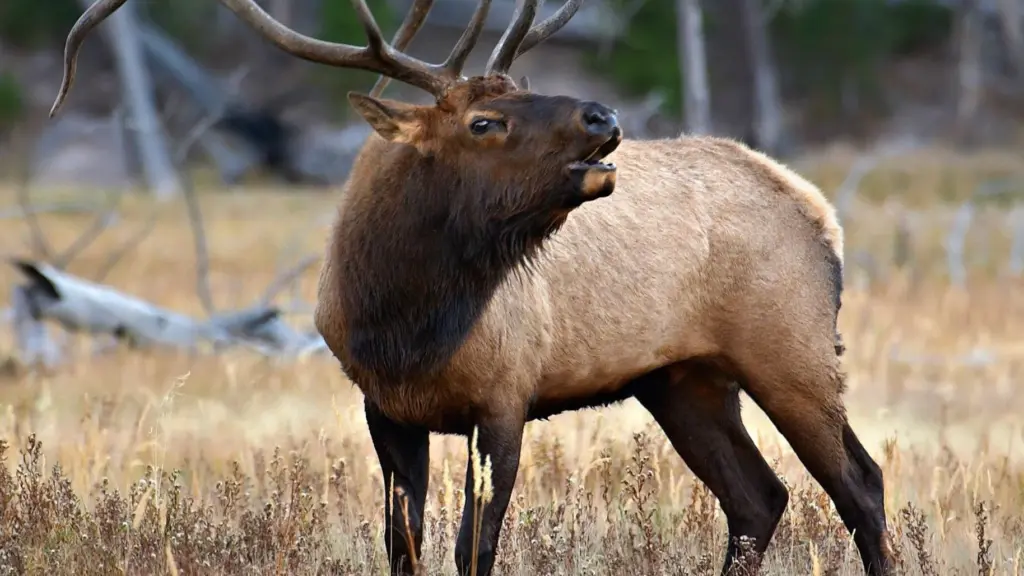
REXBURG, ID – A domestic elk that escaped from an eastern Idaho domestic elk facility and was killed by a hunter outside of the facility’s fence has tested negative for chronic wasting disease, state officials said.
Chronic wasting disease, or CWD, is a fatal and contagious neurological disease that threatens hooved mammals, such as elk and deer.
The disease is a threat to domestic and wild animals, according to the Idaho State Department of Agriculture.
“We tested it for CWD and it came back negative – that was the biggest concern right there,” Idaho Department of Fish and Game spokesman Roger Phillips said Wednesday.
Phillips said it is extremely rare for a domestic elk to escape from a fenced facility in Idaho and be shot by a hunter. He said he is not aware of any other such instances, and said the hunter was not cited and is not under investigation.
Because chronic wasting disease is a fatal disease that is able to be spread between animals through means that include contact with infected body fluids, stopping or limiting spread of the disease is a concern for state officials at the Idaho Department of Fish and Game, the Idaho State Department of Agriculture and hunters across the West.
For the first time in state history, domestic elk from two eastern Idaho captive domestic elk facilities tested positive for CWD in 2024 and early 2025, according to the Idaho State Department of Agriculture.
State is investigating the escape, Idaho state veterinarian says
The escaped domestic elk killed this fall was in eastern Idaho’s hunting unit 63A, Phillips said. Unit 63A includes portions of two of the counties – Madison County and Jefferson County – where the state reported positive CWD cases at domestic elk facilities.
Idaho State Veterinarian Dr. Scott Leibsle said the state is investigating the escape.
“We are aware of the escape, and as provided in statute, we conduct an investigation regarding any escaped domestic elk,” Leibsle said in a phone interview. “The investigation is ongoing, and we can’t comment on the specifics.”
In general, Leibsle said investigations involve an inspection of the facility where the domestic elk escaped, an interview with the facility’s owner or staff and the reconciliation of the year-end inventory count of domestic animals at the facility. Depending on the size of the facility and number of animals, the inventory and reconciliation process could take a couple of months and may not be completed until spring, Leibsle said.
Part of the reason for the inventory and reconciliation phase of investigation is to ensure that all of the animals are accounted for and that no other animals are missing or could have escaped.
There are several types of domestic cervidae or domestic elk facilities in Idaho. Some are breeding facilities, some raise the animals for meat or to sell and some operate high-fenced hunting ranches, where clients pay to hunt big game or trophy animals such as elk or buffalo on fenced, private land. Some large facilities include a combination of several types of facilities.
An example of a fenced hunting ranch is the Broadmouth Canyon Ranch, which is located in eastern Idaho near Firth and owned by former NFL player Rulon Jones.
Jeff Abrams, wildlife associate with the Idaho Conservation League, said the escaped elk was killed on state land located about three miles from the Broadmouth Canyon Ranch’s fenced hunting facility.
State officials have declined to name the specific facility where the domestic elk escaped from.
Less than two years ago, Jones and his son Chase Jones testified in favor of a new Idaho state law that removed a requirement to have double-fencing in place at domestic facilities where animals have tested positive for CWD.
Elk escaped after Idaho Legislature loosened fencing regulations for domestic facilities
The domestic elk escaped less than two years after the Idaho Legislature passed a 2024 law, House Bill 591, that eliminated the requirement to place double-fencing around quarantined domestic Cervidae or elk farms that were under quarantine orders following a positive CWD test. The law also allowed for the transfer of potentially infected animals to other captive elk facilities under the same ownership, according to minutes of the Idaho Legislature’s Senate Agricultural Affairs Committee.
Conservationists and wildlife groups opposed the law during public committee hearings at the Idaho State Capitol in 2024.
Jonathan Oppenheimer, then of the Idaho Conservation League, and Brian Brooks and Garrett Visser of the Idaho Wildlife Foundation, argued that passing the law would weaken existing rules put in place attempting to contain the spread of chronic wasting disease among domestic elk. Oppenheimer told legislators that the double-fencing rule was specifically put in place to allow domestic elk operators to import animals from Alberta, Canada, where CWD is more prevalent.
On the other hand, former Sen. Jeff Siddoway, R-Terreton, said that the double-fencing requirement was a strict and onerous government regulation that would put domestic elk ranching operations out of business, according to minutes from the Senate Agricultural Affairs Committee. Siddoway said it could cost $80,000 to $100,000 per mile of fence to comply with the double-fencing requirement.
Chase Jones told Idaho legislators that he has 18 miles of fencing around his ranch and the double-fencing requirement would cost him between $1.3 million and $1.6 million, state records show. The double-fencing requirement would cripple his business, he said.
In arguing for the law’s passage in March 2024, Siddoway told legislators that no domestic elk had tested positive for chronic wasting disease in Idaho.
Siddoway was correct.
But later that year, in December 2024, the Idaho State Department of Agriculture announced that a bull elk that had been transferred from Alberta, Canada, to a domestic elk ranch in Madison County, Idaho, died and tested positive for CWD.
It was the first case in state history of a positive CWD test at a domestic elk facility in Idaho.
Just over two weeks later, on Jan. 3, 2025, the Idaho State Department of Agriculture announced that a second domestic elk located at a different captive elk ranch located in Jefferson County, Idaho, had died and tested positive for CWD.
Idaho State Department of Agriculture officials said the second case of CWD was not associated with the first positive case announced just two weeks prior.
Following the second positive test, Department of Agriculture officials issued a quarantine order to restrict further movement of domestic elk at the Jefferson County facility.
The Department of Agriculture did not identify the specific domestic elk facilities. Instead, officials announced the county where each facility was located.
In an interview last week, Leibsle, the state veterinarian, told the Idaho Capital Sun that the department’s policy is to announce cases at the county level.
Leibsle told the Sun he did not take a position on the 2024 law. Instead, he said his job is to simply comply with and enforce the state laws on the books. Leibsle told the Sun that that double-fencing requirement would be a heavy economic burden to comply with and may not prevent the spread of CWD.
For example, if a domestic elk died within the second fence, CWD could still be spread if rainfall washed infected tissue from a dead animal outside of the fence or if a vulture or buzzard picked up pieces of an infected dead animal’s flesh and moved the flesh somewhere else or spread inflected prions through defecating.
“There are a lot of different opportunities for this to be spread, and it’s just not very well understood,” Leibsle said.
However, Leibsle said a double fence could potentially limit the spread of CWD in some ways.
“If they had a double fence with separation, that would limit nose-to-nose contact between wild and domestic animals,” Leibsle said.
This story first appeared on Idaho Capital Sun.