Originally posted on IdahoEdNews.org on December 2, 2025
BOISE, ID – A multimillion-dollar virtual school money trail came into sharp and stark focus Tuesday.
In 2024-25, the Idaho Home Learning Academy shifted $22.5 million of taxpayer money that had been earmarked for teacher salaries and staff benefits. IHLA saved much of this money by hiring part-time teachers — and far fewer staffers than the state funded.
IHLA then siphoned $20.6 million to a trio of private education vendors.
The vendors then administered $12.6 million in “supplemental learning funds” — $1,700 to $1,800 payments to IHLA families. Much of the money went toward computers, sports fees or musical instruments or lessons. But some of the money went toward private school classes — in direct violation of IHLA guidelines — and sundry items such as streaming services and gardening supplies.
Nothing in this flow of money is overtly illegal. IHLA and other virtual charters are operating in a public policy gray area, using practices neither allowed nor prohibited by law.
And the questions about IHLA’s business model aren’t new. Legislators questioned IHLA’s spending practices during the 2025 session, but made no changes in the law.
But Tuesday’s long-awaited report from the Office of Performance Evaluations, the Legislature’s oversight arm, could intensify the scrutiny on IHLA and the growing virtual school sector. The report recommends a series of policy changes, including funding safeguards. Several lawmakers seemed open to the idea Tuesday, and Gov. Brad Little strongly urged the Legislature to act.
A long and crowded hearing — and a few key exchanges
OPE presents reports like this one to the Joint Legislative Oversight Committee — an anomaly among Statehouse committees. The House-Senate committee is equally bipartisan by design, comprised of four Republicans and four Democrats.
Tuesday’s hearing strained space and time allotments.
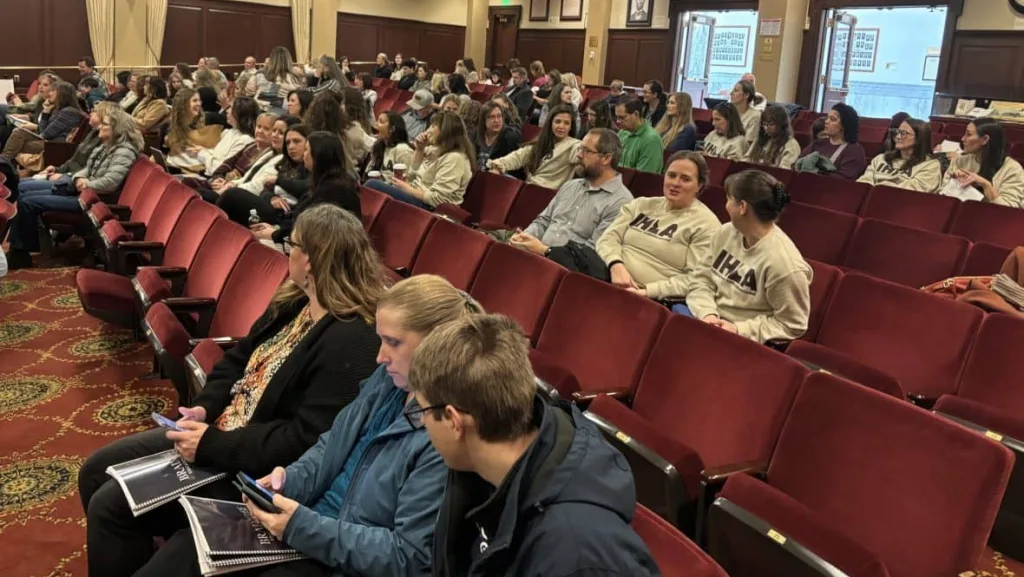
Before even getting underway, the committee shuffled from a Senate hearing room to the Lincoln Auditorium, the largest meeting room in the Statehouse, to accommodate a large crowd, made up largely of parents wearing matching gray IHLA sweatshirts.
Originally slated to go two hours, the hearing stretched to three hours — as lawmakers pressed staffers, an IHLA administrator and IHLA vendors for details about the school’s business model, its test scores, and its curriculum.
The lengthy hearing was long on details and short on dramatics, but lawmakers on both sides of the aisle found chances to make their points. Sen. James Ruchti, D-Pocatello, said he was “extremely concerned” with the way IHLA, a charter school, had moved around taxpayer dollars.
“If this was a traditional public school district,” he said, “this Legislature would go crazy.”
House Education Committee Chairman Douglas Pickett came to IHLA’s defense. He focused on survey responses, outlined in the report, that indicated that many parents choose IHLA because they are in some way dissatisfied with traditional brick-and-mortar schools. “These responses to me are very significant,” said Pickett, R-Oakley.
Sen. C. Scott Grow, R-Eagle, also urged legislators to tread carefully, especially in the area of curriculum. He said parents want alternatives to a rigid curriculum, and parents moving into the virtual sector want “some serious say” in what is offered to their kids.
Grow received a round of applause — the only audible reaction from the audience, as Tuesday morning’s hearing stretched into the noon hour.
‘Opportunities for misuse’
The 129-page report covered many issues that have surrounded IHLA since its opening nine years ago.
Curriculum is among those concerns. While IHLA’s core curriculum is aligned with statewide academic standards, parents can choose supplemental curriculum. And according to Tuesday’s report, these materials are not reviewed by the Oneida School District, which authorizes IHLA.
Student performance is another concern. IHLA’s test scores lag behind statewide averages — with English language arts and math proficiency rates lagging 12 and 18 percentage points below statewide averages. While students’ scores tend to improve after their first year at IHLA, student growth continues to lag. “Other Idaho public schools may be doing a better job of preparing students to meet state standards,” the report said.
But much of the report, and much of Tuesday’s discussion, centered on how IHLA spent its $47.8 million in state funding in 2024-25.
“IHLA is playing by the school funding rules,” said Christopher Shank, an OPE evaluator. But those rules don’t recognize the differences between traditional schools and virtual schools.
By design, IHLA hires fewer teachers and emphasizes a parent-directed learning.
The state funded 373 full-time teaching positions for IHLA, but the school filled just 232 jobs. Much of the savings went to the third-party private vendors. And by hiring most of their teachers to part-time jobs — an arrangement many IHLA teachers like, a school administrator told lawmakers Tuesday — the school saves money on benefits and routes additional money to the vendors.
Much of this money passes from the vendors to the families, in payments that are popular with parents. According to Tuesday’s report, 71% of parents would pull their kids from IHLA if the payments went away.
But Tuesday’s report also found problems.
At least $92,000 of taxpayer money went to private school classes and programs, and IHLA has no policy in place to keep this from happening.
In another case, a family received $382 for the purchase of two paddleboards. One was for the child. The second was purchased for the parent, “for safety purposes,” said the report.
“The reimbursement process creates opportunities for misuse,” evaluators found.
‘Idaho families are voting with their feet’
IHLA’s growth is beyond debate.
The school opened its virtual doors nine years ago to 238 students. Enrollment mushroomed during the COVID-19 pandemic and reached 7,600 students last school year. And 11 other school districts across the state are operating similar programs, said Kristie Brownell, an OPE evaluator.
Idahoans are making the choice to move their kids into an online setting, and a more engaged and flexible model, said Hailey Sweeten, an IHLA vice principal and the school’s incoming executive director.
“Idaho families are voting with their feet,” Sweeten said.
Sweeten and representatives from IHLA vendors took turns defending the virtual model.
Responding to repeated questions about the vendors — and their publicly funded profit margins — one vendor said her company budgets only a 4% profit.
“It’s worth it, because education is our passion,” said Emilee Bodily, executive director of Braintree Educational Services, which processed a total of $12.9 million from IHLA last year.
But for several state leaders, Tuesday’s report represented a wakeup call. In a letter to OPE Monday, Little called the report both thorough and troubling.
“Statutory safeguards are insufficient, oversight is inconsistent, and accountability measures have not kept pace with the fast expansion of the IHLA program,” Little wrote.