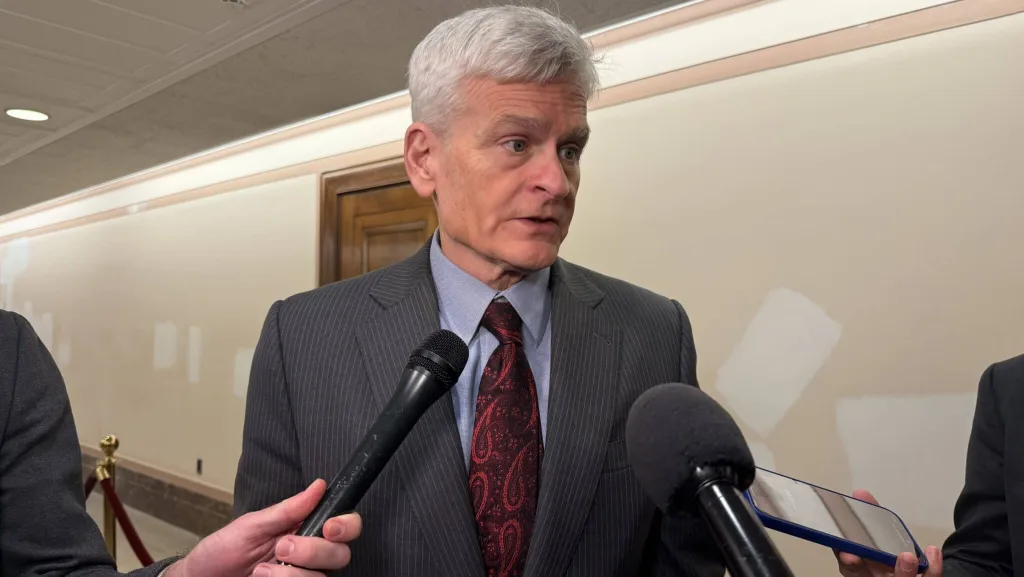
WASHINGTON, D.C. — The U.S. Senate committee that oversees health care started coalescing around an approach to lower costs for Americans during a Wednesday hearing, though several hurdles lay ahead.
Republicans and Democrats on the panel appeared to accept that enhanced tax credits for people who purchase their health insurance from the Affordable Care Act marketplace should not expire at the end of the year. Just days are left for open enrollment and premiums are expected to greatly increase.
The bipartisan momentum among a select group of senators will need to build significantly in the days ahead if an extension of the subsidies is going to speedily garner the 60 votes needed to advance in the Senate and then move through the GOP-controlled House.
It will also need President Donald Trump’s signature to become law, and he has so far not signaled support for an extension.
“I’m hoping that we can find a bill that can get 60 votes, that can fix the problem with the exchanges for January 1, 2026,” Health, Education, Labor and Pensions Committee Chairman Bill Cassidy, R-La., said. “It shouldn’t be a Republican solution. It shouldn’t be a Democratic solution. It should be an American solution.”
Cassidy cautioned lawmakers on the panel from pressing for “grandiose ideas,” saying Congress must “have a solution for three weeks from now.”
A ‘political problem’ seen for the GOP
But extending the ACA marketplace subsidies, possibly with tweaks, is just a short-term solution that senators on the committee agreed will need to be followed up with an overhaul of the American health care system.
Any efforts on larger-scale legislation will bump up against the deeply entrenched politics of the Affordable Care Act, well-funded lobbyists and next year’s midterm elections, none of which will make the process easy.
Vermont independent Sen. Bernie Sanders, the ranking member on the panel, said he appreciated Cassidy’s “sentiment about wanting to do something quickly,” but said Republicans should have focused on the expiring ACA tax credits earlier in the year, instead of leaving it until now.
“The reason for this hearing, to be frank, is that my Republican friends understand they’ve got a political problem,” Sanders said. “Their political problem is that all over America today, people on the Affordable Care Act are opening up packages coming from the insurance companies, and guess what? Their premiums on average are doubling and in some cases in my state are tripling or quadrupling.”
Sanders said Congress should extend the enhanced ACA marketplace tax credits for another year, or two, or three, while lawmakers sort through larger, structural issues around health care costs.
“Yes, the current system is broken. Yes, we need to create a new system,” Sanders said. “But unfortunately, we aren’t going to do it in two weeks.”
Sanders suggested the committee hold a series of hearings in the months ahead featuring leaders from other developed countries that provide health care to all of their residents.
Extensions of tax credits debated
Maine Republican Sen. Susan Collins said “there’s a limit to what we can do in this first year” and that lawmakers are “going to need a two-year plan.”
Collins indicated that she wants to see “reasonable” income caps to limit eligibility for ACA marketplace tax credits in any short-term extension that Congress may pass.
Washington state Democratic Sen. Patty Murray said Republicans who are serious about addressing the spike in costs for ACA marketplace enrollees should work with Democrats to pass a “clean, one-year extension” of the enhanced subsidies.
“And if their call for reforming tax credits is serious, we should look at that. We can talk about those reforms ahead of the 2027 year,” Murray said. “But I have to say, I’m not optimistic that most Republicans are serious about this because they refused to talk about this problem before right now, and I’ve been down this road before.”
Murray also rebuked Cassidy for not focusing the committee’s attention on the expiring tax credits earlier in the year by taking a swipe at his vote to confirm Health and Human Services Secretary Robert F. Kennedy Jr.
“This is about as serious as expressing concern about RFK Jr.’s anti-vax crusade after voting to make him the most powerful public health official in the country,” Murray said.
‘Reasonable caps’ backed
Alaska Republican Sen. Lisa Murkowski said members of the committee need to focus on what the next few months and years look like for Americans’ health care costs.
“I think we’re going to need to have a short-term extension. But I think we can put reasonable caps on. I think that we can put some of the parameters that we have been talking about. There’s no great secret sauce here to how we’re going to deal with this particular dilemma that we’re in,” Murkowski said. “But we’ve got to be looking longer term to — how do we ultimately reduce these costs of care?”
Murkowski said she was also concerned about a decrease in funding for public health and prevention initiatives, before asking the witnesses appearing before the committee what their top recommendations would be for “prevention-type programs that have the strongest evidence for reducing long-term costs.”
Joel White, president of the Council for Affordable Health Coverage in Washington, D.C., said Congress should allow “premium discounts in the individual market for wellness programs,” which he said is currently illegal.
Marcie Strouse, owner and partner at Capitol Benefits Group in Des Moines, Iowa, suggested lawmakers open up health savings accounts “to allow for more holistic and preventive services.” She also said Congress could highlight “direct primary care and making sure people are actually getting the care that they need.”
Dr. Claudia M. Fegan, national coordinator at Physicians for a National Health Program in Chicago, suggested enhanced primary care and screening people for diseases like cancer that can be easier to treat when caught early.
Wisconsin Democratic Sen. Tammy Baldwin said the hearing clearly demonstrated that there is “underlying agreement that this system needs a lot of reform.”
But, she said, Congress needs to take a look at the entire health care system, not just the Affordable Care Act.
“I want to make a point that just under 50% of Americans get their health insurance through employers or group insurance, 20% are on Medicaid, 15% on Medicare, 1% on TRICARE or VA, and just over 6% are in this market,” Baldwin said. “There are problems with this market. But I have to say that abandoning the ACA … is not going to solve the system as a whole.”
Ohio Republican Sen. Jon Husted appeared supportive of a short-term extension of the enhanced ACA tax credits to provide Congress more time to address larger issues with health care affordability.
“We can freeze the subsidies where they’re at right now for a temporary period of time. I don’t know if that’s one year or two years to help give some relief,” he said. “And by the way, just because we continue those tax credits does not drive down the cost. It transfers the burden to the taxpayer and future generations. But it is a little help right now that we both can agree on. And then we’ve got to fix it.”
Husted said there are easily a dozen bills that Congress could take up individually to start bringing down health care costs.
Hawley offers plan for health costs tax exemption
Missouri Republican Sen. Josh Hawley also appeared to side with extending the enhanced ACA marketplace tax credits in the short term.
“We are looking at a massive crisis unless Congress acts and acts soon,” Hawley said. “And my message is to the leadership of this body — to the leaders of the House, the leaders of the Senate —maybe it’s time we all locked ourselves in a room and got to a solution here.”
Halwey pitched a bill he just introduced to exempt health care from taxes.
“If you pay premiums, you ought to be able to deduct that from your taxes. If you have out-of-pocket medical expenses, you ought to be able to deduct every dollar off of your taxes. You want to lower the cost of health care immediately. Do that. No taxes on health care for any American,” Hawley said. “And you set an upper limit so you don’t have rich people gaming the system. I get it. That’s fine. But let’s think about working people in this country who cannot afford health care.”
Hawley said it should be allowed whether an American itemizes on their taxes or not.
All three panelists seemed initially supportive of the idea.
Redoing tax credits in 2026
Cassidy said after the two-hour hearing he’s working to get support from lawmakers in both political parties for an integrated approach for next year.
“You could use the income that would be used to extend the subsidies, apply them to the bronze plan, because the bronze plan is so much less expensive. You could then put that balance into the health savings account,” Cassidy said, referring to coverage levels in plans on the ACA marketplace. “So it does continue the support using the existing mechanisms we have, but integrates the HSA, which gives first dollar coverage and could potentially lower the net deductible.”
Cassidy said Congress could extend the open enrollment period for the ACA marketplace and then fund the Health Savings Accounts, which are tax-advantaged savings accounts, before the end of March.
“People would save their receipts and submit them for payment,” he said. “People do that all the time.”
Idaho Capital Sun is part of States Newsroom, a nonprofit news network supported by grants and a coalition of donors as a 501c(3) public charity. Idaho Capital Sun maintains editorial independence. Contact Editor Christina Lords for questions: info@idahocapitalsun.com.