BOISE, ID – Idaho’s potential budget deficit, which will be exacerbated if lawmakers chose to conform with the tax changes under the federal “Big Beautiful Bill Act,” will be the central challenge for the Legislature as members return to the state Capitol in Boise in January.
State elected officials who spoke Wednesday at the Associated Taxpayers of Idaho conference were somewhat at odds over the cause of that deficit and how to handle it, but everyone agreed budget cuts are coming.
Idaho is about $58 million behind revenue projections for the current fiscal year, with the Legislature’s projected deficit of at least $555.2 million for fiscal year 2027. Importantly, that number doesn’t include the estimated $167 million cost of Idaho adopting federal tax cuts in the federal tax and spending legislation adopted and signed by President Donald Trump in July. Other projections that include the cost of the federal tax bill show between a $600 million to $1 billion deficit for fiscal year 2027, the Idaho Capital Sun previously reported.
Legislators will vote during the 2026 session on whether to adopt the federal tax changes.
The annual tax policy conference featured speakers who were lawmakers, tax experts, industry leaders and other officials. It was attended by many legislators, lobbyists, business and corporate representatives, and other stakeholders.
Idaho Lt. Gov. Bedke blames deficit on budget-making process, encourages use of ‘rainy day fund’
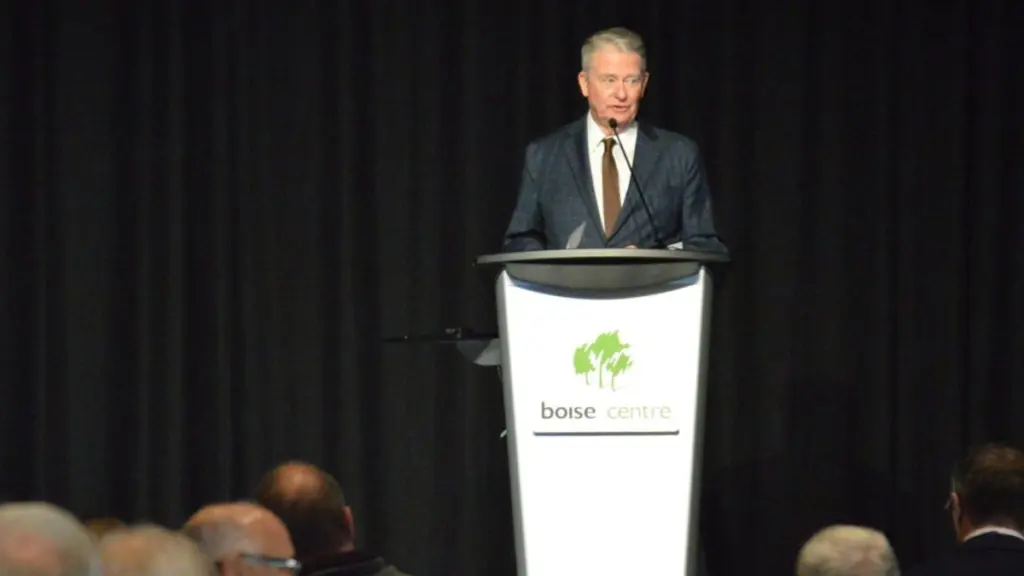
Lt. Gov. Scott Bedke began the day-long conference by critiquing the Legislature’s actions during the 2025 session, including passing a number of large spending bills before adopting a projected revenue number.
“For the first time in Idaho’s history, (in) last year’s budgeting session, we acted more like Washington, D.C., than we did Idaho,” Bedke said. “… We created a list of things that we wanted to accomplish and passed that list of things before we set the revenue number, and then we backed into the list with the revenue number, and adjusted the revenue number to pay for that list of things.”
As lieutenant governor, Bedke presides over the Idaho Senate and can cast tie-breaking votes, but otherwise is not often directly involved in creation and passage of legislation.
Idaho’s budget-making process requires a projected revenue number to balance the budget against. The joint Economic Outlook and Revenue Assessment Committee will listen to projections from a variety of economists, university professors, state budget officials, and other stakeholders, and vote on a recommended revenue based on those presentations. The state’s budget writers on the Joint Finance-Appropriations Committee then ultimately decide the revenue projection.
In 2025, it took several tries for the committee to agree on a revenue estimate, doing so on March 6, eight weeks into the legislative session and after $5.1 billion in spending had already been approved, the Sun reported.
Bedke said the state’s traditional method of garnering a consensus on a revenue number and then using a conservative estimate for that to keep money on the bottom line had been “the envy of every Western state.” He said Idaho had typically erred on the side of trying to under-project.
“Being wrong on the upside, like we are now, results in tough choices and (to have) a tough budget year,” he said. “We all get a little buzz of finger-pointing and denying and blaming and even gaslighting, but that buzz needs to be short-lived. And we need to roll up our sleeves and make some tough decisions, because the math is going to win eventually.”
To address the tough choices, he highlighted the state’s reserve fund, known as the “rainy day” fund. Idaho has around $1.4 billion in reserves, and Bedke argued it is “prudent that we use some of that to help and bridge over.”
However, he opposed the idea of not adopting the federal tax changes under the “big beautiful bill,” which include no taxes on tips, no taxes on overtime for some workers, and no taxes on interest on auto loans. Despite the cost, Bedke argued that rejecting this for the state’s taxes would give other states an advantage who accept the tax breaks.
“We cannot for long even entertain that thought of non-conforming to those federal changes,” he said.
Gov. Little says it’s ‘not raining,’ highlights positive state economic trends
Idaho Gov. Brad Little in brief remarks to the conference painted a more optimistic picture than the lieutenant governor.
He noted that Idaho had healthy reserves in its rainy day fund but said, “it’s not raining, maybe a cloud or two,” seemingly indicating he didn’t support tapping the fund for the current budget situation.
Little did acknowledge “there are many challenges facing Idaho,” but they weren’t unique to the Gem State.
He echoed his budget director, Division of Financial Management Administrator Lori Wolff, who earlier said that every state was dealing with revenue volatility as the infusion of federal funds from the pandemic are drying up.
He did acknowledge that, as the state looks to the next fiscal year, fiscal year 2027, Idaho “will have to do more with less.”
Little said the effects of the federal tax and spending bill will factor into making Idaho’s “budget environment very difficult going forward,” and will be approached “prudently,” but did not indicate if he supported or opposed conforming to the federal tax code.
The governor highlighted positive trends such as high personal income growth and the state’s high ranking for “tax-friendliness” due to the $6.1 billion in tax reductions or rebates approved since 2019. He pointed to the state’s rapid growth as the source of its challenges.
“We have been a victim of our own success, and I will not apologize for that,” Little said. “Our focus on common-sense policies continues to make Idaho a desirable place to relocate.”
Legislative budget writers say budget is ‘fixable problem,’ downplay concern as ‘irresponsible’
Co-chairs of the Legislature’s Joint Finance-Appropriations Committee, known as JFAC, acknowledged that current estimates show a budget shortfall if the states do not do further cuts. In August, Little directed all state agencies outside of public K-12 education to reduce spending by 3% across the board for the current fiscal year, and in September, directed agencies to cut 3% for the next fiscal year.
Rep. Wendy Horman, R-Idaho Falls, and Sen. Scott Grow, R-Eagle, said all projections are essentially a guess. Horman downplayed the projected deficit, saying its current shortfall when taking into account the budget from all sources — which include federal and dedicated funds in addition to general funds — “could almost be considered a rounding error.”
“You might have seen some headlines and some doom and gloom,” Horman said “Unconstitutional, crisis, these sorts of sound bites. I believe those terms to be inaccurate and irresponsible in some cases.”
The state’s total budget, using all sources, is about $13.9 billion. Federal and dedicated funds typically are earmarked for certain programs or projects. The general fund budget is around $5.2 billion for fiscal year 2025, and it consists of unobligated money that the state uses to pay many of its bills and to enact policies. The general fund is typically the focus of the state budget because there is little control over dedicated or federal sources of funds.
Idaho’s Constitution requires the state to have a balanced budget. If the state reaches the end of the fiscal year on June 30, 2026, and its expenses still exceed revenues, the deficit will violate the constitution. Horman argued the state will not reach this point, but spending cuts will be needed.
“(People) should expect those reductions to come,” she said. “Don’t anticipate that there are going to be huge increases in budgets this year. A predicted $555 million in requests in excess of predicted revenue has to come from somewhere.”
Grow said a lot of the growth creating challenges for the current fiscal year budget are driven by forecasts coming in below actual expenditures in Medicaid and the state Department of Correction system. Supplemental requests, to cover costs incurred that weren’t funded the previous legislative session, include an additional $87 million for Medicaid and $17 million for covering the costs of the inmate population in state prisons.
For the next fiscal year, there is a projected $133.7 million increase in the cost for state employee health insurance, he said.
“That’s huge; that’s a 26% increase over last year’s budget,” he said.
Horman cautioned against using the reserve funding for ongoing expenses to cover budget shortfalls.
“That is a recipe for disaster,” she said.
Grow and Horman indicated that tax conformity will be a major conversation during this year’s legislative session. Horman said the budget committee likely won’t set a revenue number until the tax policy committees produce a proposal for how to handle the federal tax changes and the income reduction that come with them.
“We will see what the tax committees do,” Horman said. “I think it’s risky to even set a revenue number before we have some general idea of what that bill is going to look like, just because the variance could be in the hundreds of millions of dollars, and that would make setting the budget very tough if we don’t have some indication a ballpark figure of what that number is going to be.”
This story first appeared on Idaho Capital Sun.