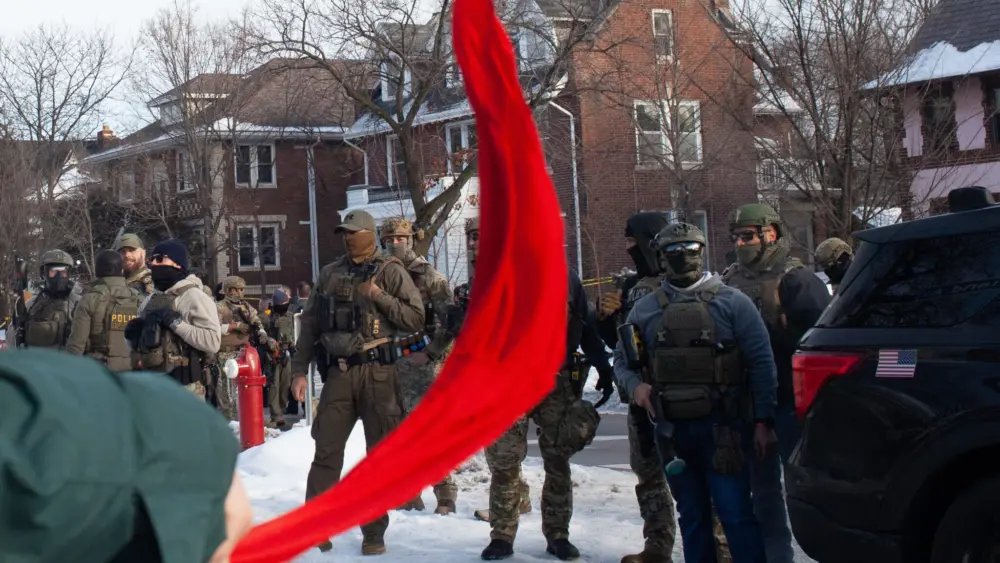
NEW YORK – A First Nation reservation located in upstate New York, which is also located in Canada, says it is grappling with transnational and illegal border crosser crime. One of its law enforcement chiefs came to Texas seeking help.
Ranatiiostha Swamp, chief of police of the Akwesasne Mohawk Territory, spoke with The Center Square in an exclusive interview about the challenges his community faces while joining an Operation Lone Star Task Force operation in south Texas.
His territory, which straddles the international border, has been a target of human, drug and weapons smuggling, as well as other crimes, The Center Square reported.
The territory borders the Canadian Cornwall Port of Entry, includes Cornwall Island and smaller islands on the St. Lawrence River, and a coastal region of Quebec. In the U.S., it borders the Massena POE in upstate New York, and the northernmost parts of Franklin and St. Lawrence counties. Cornwall, Ontario, is roughly a 20-minute drive to Massena; Ottawa to Messena is roughly a 1.5-hour drive. To reach either city, travelers, including residents, must go through the reservation.
Chief Swamp has jurisdiction in the province of Quebec and Ontario and transits through New York State. The reservation also has a chief of police on the New York side who receives grants to work with U.S. Homeland Security and Border Patrol. Swamp’s jurisdiction includes the St. Lawrence River; the vast amount of his region is divided by water. Because of the vast region and lack of resources, despite their best efforts, they are limited in law enforcement efforts, he says.
Each side of the reservation falls under different laws, Canadian and American, including a political, judicial and currency system. The international border divides the reservation. “The only thing that we share is our culture,” he said. Every morning, they say a prayer of unity and thanksgiving, “Ohen:ton Karihwatehkwen,” to bring their mind together as one, he said. “That is what we’re doing today,” he said, when coming to Texas to seek solutions.
Their community is facing increasing criminal threats, he said.
“Mexican cartels are buying up property along the border, that’s primarily what we’re seeing from where I’m from. It’s all on the U.S. side where they’re buying up all the farmlands connected into different farms,” Swamp said. “We’re working with U.S. Border Patrol and state police in our area.” The properties being purchased are in strategic locations where open farmland provides easy access to cross the river, he said.
He’s working to create memorandum of understandings with law enforcement agencies “to have some border law enforcement patrol on land. We have had a shiprider [maritime law enforcement cooperation] come through on the moving area on the water. I’d like to incorporate that same concept and bring it to” law enforcement cooperation on land in Canada, he said.
Dwayne Zacharie, president of First Nations Chiefs of Police Association and Chief Peacekeeper of the Kahnawake Peacekeepers, oversees law enforcement operations on a reservation roughly an hour from Montreal. “Where we are located, all of the land around us is farmland where many of the workers are migrants from Guatemala, Mexico, India and other countries. They’re coming to Canada and into our community,” also connected to an illicit tobacco trade, he said where organized criminal organizations have seized on an opportunity.
“More and more and more, our community is being inundated by immigrant traffic,” Zacharie said. “We’ve had a number of contacts from a Homeland Security office in Montreal about what they’re seeing in Montreal. The immigrants are illegal, so we see this influx in our community and all of these impacts lead to other statistics: theft, fraud, vehicle theft, all of these things are starting to rise.”
The reservations’ designations have existed since the 1700s but all of a sudden these communities are experiencing a wave of crime from illegal immigration, he said. “We’re not big, but we are in the middle of all of this. We see what the impacts are, and we see where the hole is. We see that there’s a lack of understanding at the federal and provincial level about how to combat the issue that we’re all facing.” After meeting with OLS Task Force sheriffs in Texas, he’s hoping to develop solutions and form new partnerships.
The police chiefs face legal and prosecutorial constraints stemming from the Indian Act and Immigration and Protection Act, they argue, which contribute to lack of border enforcement. Another is not receiving funding from Public Safety Canada, which is expected to cut funding for First Nation policing organizations next March, Zacharie said. Another struggle they face stems from the Canadian government refusing to designate them as essential services, The Center Square reported.
While Swamp’s community on the New York side has benefitted from U.S. federal funding, there is nothing comparable in place locally on the Canadian side, which is a goal of his, he said. “I continue to spearhead that and that’s part of the reason why I’m here [in Texas] so I can learn from what’s going on here and bring it back home. Because of the border that goes straight through the Akwesasne reservation, it divides our community despite us saying that we are one community,” he said.
As a result of their trip, Texas policy makers and OLS Task Force members are working on border security solutions with First Nation police chiefs.