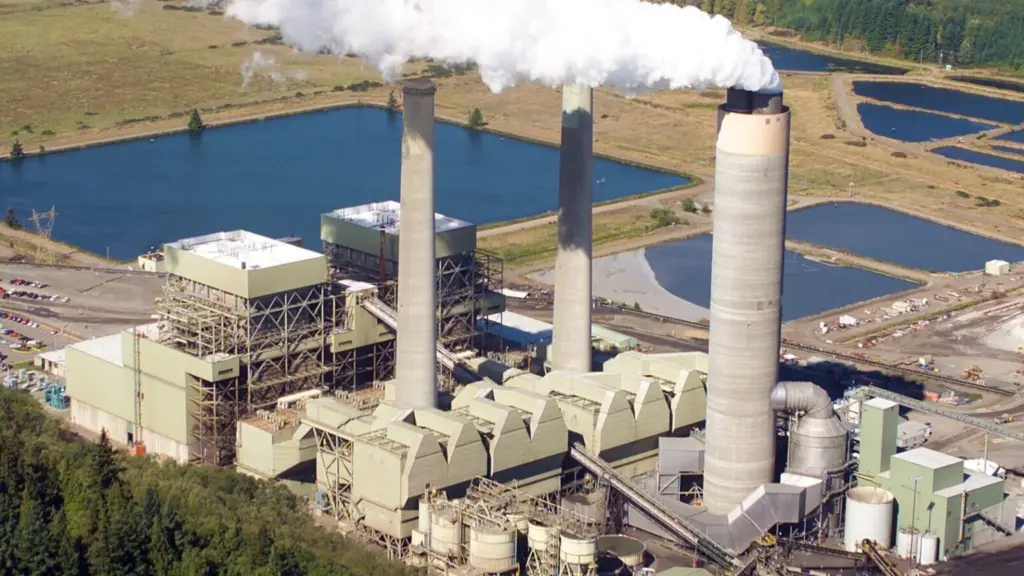
OLYMPIA, WA – The Trump administration has ordered Washington’s last coal-fired power station to continue burning coal, just weeks before it was scheduled to shut down and convert to natural gas fuel.
This has sparked yet another clash between the federal government and Washington state, where leaders are aiming to get coal power out of the electricity grid by year-end. Officials here aren’t ruling out the possibility of a lawsuit over the move.
Tuesday evening’s emergency order by the U.S. Department of Energy would keep TransAlta’s coal unit going in Centralia for 90 more days. The order comes amid Washington’s broader shift to use cleaner energy, such as solar and wind power, while reducing power from fossil fuels.
U.S. Secretary of Energy Chris Wright wrote in the order that, “the emergency conditions resulting from increasing demand and accelerated retirement of generation facilities will continue in the near term and are also likely to continue in subsequent years.”
The Canada-based TransAlta and then-Gov. Christine Gregoire’s administration negotiated the Centralia plant’s end-of-year shutdown schedule more than a dozen years ago. The Washington state Legislature passed that negotiated agreement into state law.
This week’s federal order throws a wrench in that plan and raises questions about what exactly will happen in the near future at the plant.
A statement by TransAlta said the company is evaluating the directive and will work with the state and federal governments.
“The coal-to-gas conversion project, announced on December 9, 2025, remains a priority for TransAlta,” the company added.
In an interview Wednesday, a senior state House Democrat who helped craft Washington’s clean-energy laws had choice words about the federal order.
“I thought it was so transparently stupid that I hoped they’d have thought better of it,” said House Majority Leader Joe Fitzgibbon, D-West Seattle.
Washington’s Clean Energy Transformation Act, passed by the Legislature in 2019, requires utilities to stop providing coal power to Washington customers by the end of this year.
Fitzgibbon, who helped craft Washington’s clean-energy laws, said he doubted utilities in Oregon and California would want to buy coal power from Centralia. He called Canadian-owned TransAlta the “obvious loser” under the federal order.
“They don’t have coal there, they’re using up their coal by the end of the year,” Fitzgibbon said. “So are they going to have to buy new coal and bring it in and store it in Centralia? They don’t have employees ready to run this plant.”
Fitzgibbon also raised the specter that the plant would have to burn coal that doesn’t even generate power just to satisfy the federal order.
“It’s completely unclear and I think those will be some of the issues that it will take a court to figure out,” he added.
‘No emergency here’
The office of Washington Attorney General Nick Brown is “still discussing our legal options in response to this action,” spokesperson Mike Faulk wrote in an email.
In a joint statement Wednesday, Brown, along with Gov. Bob Ferguson and State Ecology Director Casey Sixkiller, blasted the federal order, saying: “Let’s be clear: there’s no emergency here.”
“The administration does not care about energy affordability and reliability for consumers,” the officials wrote in prepared remarks. “In fact, electricity prices have gone up nationwide over the first year of this administration. Instead of helping states diversify their energy economy, the administration wants to keep a dirty, dying energy source on life support.”
Ferguson and Brown are both Democrats and have sparred repeatedly with Republican President Donald Trump.
This week’s order in Washington comes after a similar Trump administration order in the spring to keep a coal plant burning in Michigan, according to news reports. That 90-day order was extended in August and again in November.
In July, Michigan Attorney General Dana Nessel filed a petition with the U.S. Court of Appeals for the D.C. Circuit to challenge the federal order, calling it “arbitrary and illegal.”
That legal challenge is still pending, a spokesperson for Nessel’s office said Thursday.
Environmental groups in Washington reacted swiftly to the TransAlta order. In a statement, Lauren McCloy of the NW Energy Coalition described the move as “federal overreach” and “incredibly unproductive.”
The NW Energy Coalition is a group of roughly 100 business, government, civic and environmental organizations working to advance affordable, equitable and clean energy policies.
“The closure of this plant has been planned for over a decade, and keeping it running beyond its useful and economic life is not the answer,” said McCloy in prepared remarks. “This order takes resources and focus away from addressing the real challenges we have.”
Feds point to utilities’ analysis
In his emergency federal order, Wright cited the same analysis used by Puget Sound Energy to justify TransAlta’s proposed conversion to burn natural gas.
That analysis, commissioned by Puget Sound Energy, Tacoma Power, Avista, Seattle City Light, and others, argues that Washington could get hit with an electricity crisis.
Released in September, the report contended that the move toward wind and solar has prompted the retirement of fossil fuels faster than they are being replaced by clean energy.
A spokesperson for Puget Sound Energy said the utility is reviewing the federal order.
On Thursday, state Senate Minority Leader John Braun, R-Centralia, said he thought the Trump administration had valid concerns about a power crisis.
But, “logistically, can you get more coal? Who would buy it? Those are questions nobody has the answer to,” said Braun, whose district includes the plant.
Braun said he didn’t think the federal order would derail the transition to natural gas.
“I don’t think it helps,” Braun said. “I don’t think it hurts, either.”
Washington State Standard is part of States Newsroom, a nonprofit news network supported by grants and a coalition of donors as a 501c(3) public charity. Washington State Standard maintains editorial independence. Contact Editor Bill Lucia for questions: info@washingtonstatestandard.com.