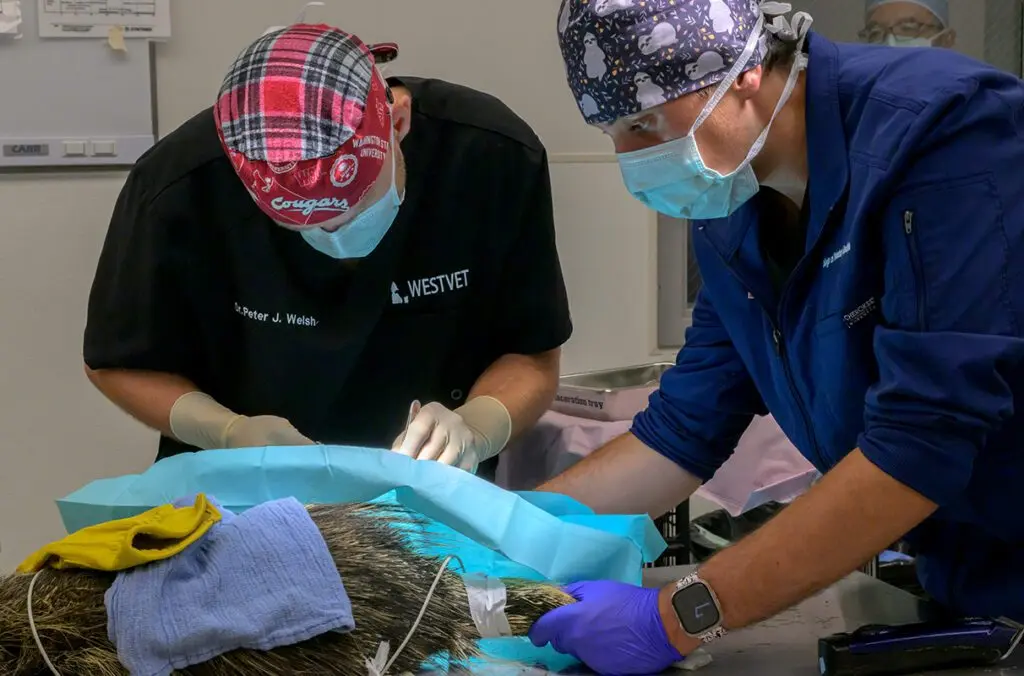
PULLMAN, WA – For 107 days, Dr. Hassan Hanna and Washington State University’s wildlife service exhausted every option in an effort to save an injured porcupine that arrived at the university’s Veterinary Teaching Hospital with a broken leg.
What initially appeared to be a straight-forward case, however, grew more complicated by the day and ultimately drew in nearly every specialty in the hospital as the animal’s health mysteriously worsened. The outcome wouldn’t be what anyone hoped for, but the case demonstrated WSU’s commitment to caring for and rehabilitating wildlife while also training the next generation of veterinarians.
“These cases aren’t easy, but they teach us so much,” Hanna said. “Every animal that comes through this hospital reminds us to be kind, to be compassionate, and to work as a team to give them their best chance. That’s the experience that shapes you as a wildlife veterinarian.”
WSU operates one of the region’s only 24-hour wildlife care centers, treating roughly 1,000 injured or orphaned animals each year with the goal of a return to the wild. Hanna, having recently completed his veterinary studies at the University of Illinois, joined WSU’s wildlife team on July 1 when he began the first leg of a year-long wildlife veterinary internship to gain additional training in the field.
Every animal that comes through this hospital reminds us to be kind, to be compassionate, and to work as a team to give them their best chance. That’s the experience that shapes you as a wildlife veterinarian.
Dr. Hassan Hanna
Washington State University
After six months in Pullman, he will head west to wrap up his internship at the Progressive Animal Welfare Society Wildlife Center in Snohomish. Ultimately, he aims to complete an additional specialty internship in aquatic and wildlife medicine, with the long-term goal of returning to academia, where he can integrate clinical care, research, and teaching.
Just days after Hanna arrived in Pullman, the young male porcupine was brought to WSU after being attacked by a dog in Spokane. The animal was infested with fleas and had a severe flesh wound and fractures to the tibia and fibula of one of its hind legs. It was the first of seven porcupines Hanna has treated during his internship.
“People started calling me Dr. Porcupine,” Hanna said, adding his caseload has also included a steady flow of other wildlife, ranging from waterfowl and songbirds to raccoons and even a turtle and a Pacific tree frog.
This porcupine, though, would be his longest tenured case and the most perplexing.
Collaborating with WSU’s orthopedic surgery service, Hanna participated in a fracture repair procedure and was honored to contribute to what the team believes may be the first documented surgical procedure of this type in a porcupine.
While the surgery was a success, soon after, the porcupine began to develop painful sores on his hind feet, became progressively more lethargic and began displaying concerning neurological signs. Despite a battery of diagnostic tests, intensive care and the efforts of the brightest minds at the hospital, the symptoms only worsened.
The wildlife team began to suspect a parasitic infection such as Baylisascaris, commonly known as raccoon roundworm, which can cause fatal brain disease in wildlife and is difficult to diagnose in a living patient, much less treat. With his condition declining, the difficult decision to euthanize was made. A necropsy would discover larva consistent with Baylisascaris in the porcupine’s brain.
“Even though it wasn’t the outcome we hoped for, we know we did everything possible to save the animal,” Hanna said. “Cases like this show just how hard wildlife medicine can be. We can’t always fix everything — but we learn from every patient, and we do what’s fair and humane for the animal.”
In addition to hands-on clinical work during his internship at WSU, Hanna has gained experience in wildlife disease monitoring, rehabilitation strategies and the complex decision-making that comes with treating wild patients.
Hanna’s mentors — exotics and wildlife veterinarians Drs. Nickol Finch and Marcie Logsdon — have also encouraged him to grow as an educator, involving him in student teaching and leading rounds.
“They’ve pushed me to think critically, try new approaches and develop my skills as both a clinician and a teacher,” he said. “Their support has been invaluable, and the staff here are an amazing team to learn from.”
Overall, Hanna’s experiences at WSU have shown him how much there is to learn from each animal and how essential teamwork is in wildlife medicine.
“This porcupine needed nearly every specialty in the hospital, and that’s what makes WSU unique,” he said. “As we did with this patient, we can bring together orthopedics, radiology, neurology, anesthesia, integrative medicine, soft tissue surgery — everyone — to give these animals their best chance.”