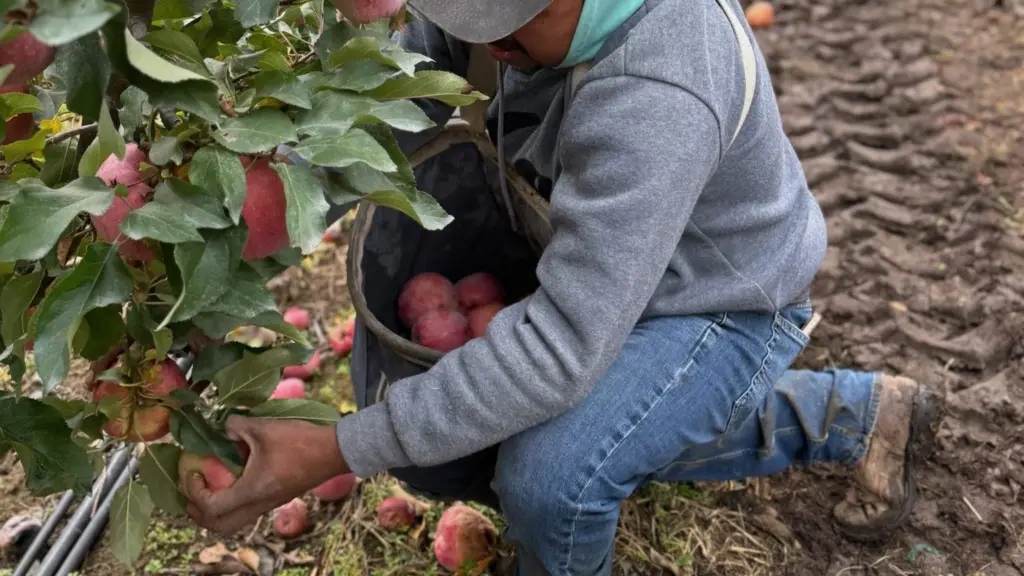
UNION GAP, WA – On a chilly fall morning, farmworkers fanned out through an orchard here to pick rose-hued apples from green rows of trees that flank this central Washington valley’s irrigated slopes.
These Pink Ladies were one of the last varieties to ripen in a harvest season that began in late summer amid the Trump administration’s immigration crackdown.
Local farmworkers — many of them immigrants without legal status — were on edge, while growers worried the federal deportation push could worsen chronic labor shortages.
In a harvest that stretched from August to early December, federal agents did not make large-scale arrests in workplace raids in the orchards. Instead, as in other parts of the country, people often were targeted as they ventured from their homes to shop or commute.
These tactics added a new element of risk and a big dose of fear to many workers’ lives. Still, most continued to make the daily trip to the orchards, where skilled pickers can make from $20 to more than $40 an hour.
“Everybody has work. They got to pay their bills. So, it makes it hard to not come,” said Raul Arroyo Rosas, a Yakima Valley horticulturist working in the Pink Lady orchard.
Stalled federal legislation
Immigrants not legally authorized to work in the U.S. represent an estimated 40% of the people who help to produce many fruits, vegetables and other labor-intensive crops.
In central Washington, many arrived decades ago amid earlier waves of illegal immigration, and settled in communities such as Wapato, Granger and Toppenish, providing much of the workforce for an expanding agricultural industry with apple orchards that in 2024 provided nearly 70% of the nation’s crop.
The economic importance of these farmworkers — and their vulnerable legal status — has long been recognized by central Washington Republican U.S. Rep. Dan Newhouse. His family’s farm in Sunnyside grows hops, which require a lot of labor to train vines.
Four times, most recently in May, Newhouse co-sponsored the “Farm Workforce Modernization Act,” which includes a provision that would offer farmworkers a pathway to legal residency in the United States.
Many farmworkers use fraudulent documents, such as Social Security cards with numbers that belong to other people, to get hired. Many growers and farmers who employ these people do not use E-Verify, an online system that can detect such fraud. The bill Newhouse has supported includes a requirement that this system be used.
Newhouse was one of 10 House Republicans who voted to impeach Trump after the Jan. 6, 2021, attack on the U.S. Capitol. This has complicated Newhouse’s relationship with the president, who has not endorsed the farm workforce bill.
Within the Trump administration, farmworker labor policies have been caught up in a broader tug-of-war over immigration.
Trump’s deputy chief of staff, Stephen Miller, has continually pushed the Department of Homeland Security to step up deportations of all immigrants who lack legal status, including those in agriculture.
Agricultural representatives, many from staunchly Republican regions such as central Washington, have urged federal officials to forego workplace raids in fields and orchards. And, at times, they appear to have gotten through to Trump.
“We’re not going to do anything to hurt the farmers, and we’re working on that, and we’re going to be coming out with rules and regulations,” Trump said in an Aug. 5 CNBC news interview in which he called farmworkers “very, very special people.”
But, so far, Trump’s talk has not led to any administration plan to offer a legal path for farmworkers.
And in Congress, Newhouse’s legislation has not made much headway.
Newhouse announced Dec. 17 he will not seek reelection next year but told reporters he would continue to work on farm labor issues through the end of his term.
The lack of legislative progress on the bill frustrates Jamie Ortiz, whose husband was arrested in September while on the way to work in a central Washington apple orchard.
“That would be so awesome if that would have passed,” Ortiz said. “To be able to have your work permit. To be able to work, and not be afraid.”
Many apple growers also are eager to see their workers free from the threat of deportation. They include Aaron Clark, a vice president for Price Warehouse & Cold Storage, a Yakima-based operation that grows fruit on some 3,500 acres, including the Pink Lady orchard near Union Gap.
“It’s no good for people to live in the shadows. It’s a bad deal,” Clark said. “Everybody understands this system is broken. We just gotta figure out how to get it fixed. But there isn’t the political capital to do it right now.”
Relying on immigrant labor
In the 21st century, the challenges of recruiting U.S. farmworkers have intensified, prompting a shift in Washington and other states to hire more foreign contract workers with short-term H-2A visas who receive free housing while in the United States.
In 2024, Washington farmers and growers hired nearly 36,000 H-2A workers, up from less than 4,000 in 2011, according to U.S. Labor Department statistics.
In Grant County east of the Columbia River, shortages of domestic workers have intensified amid a surging economy that has offered more employment opportunities, including construction jobs building data centers.
“We can’t get workers to come out,” said Kent Karstetter, grower who operates 450 acres of orchards outside the town of Quincy. “If I didn’t have my guest workers, I would be in big trouble.”
Growers have tagged higher labor costs tied to the H-2A program as part of a broader financial crisis that has been compounded by low prices for their apples. They joined with farmers in other parts of the country to lobby the Trump administration for changes to the H-2A program that would help them cut costs.
In October, Labor Department officials proposed new rules intended to make it easier and less expensive to hire H-2A workers. This plan would also result in a more than $2.4 billion transfer of wealth from agricultural employees to their employers, according to the Labor Department.
The United Farm Workers and others sued in November over the Trump administration’s move, arguing the rules would reduce wages paid to U.S. workers in violation of federal law.
Central Washington’s Yakima County, with a population that is more than 50% Latino, has some of the greatest concentrations of Pacific Northwest farmworkers. That has enabled Clark, the Price Warehouse & Cold Storage field manager, to avoid shifting to H-2A workers.
This year, the company hired at harvest peak some 600 people for orchard work, largely from the Yakima Valley.
“We decided a long time ago to, you know, to do what we could to kind of keep the money in the community,” Clark said.
During a November visit to the Pink Lady orchards, there were ample workers to keep pace with the harvest. They made repeated passes through each row of trees to pick each apple at its peak color and sweetness.
Through the course of a workday, a picker harvests thousands of apples, filling bin after bin, before finally heading home.
Rising unease among workers
This year, immigration arrests have added stress for workers.
At the Pink Lady orchard, one was detained after he had left his home, while another had her husband picked up, according to Arroyo Rosas, the foreman at the orchard.
At a nearby orchard, one worker reported his uncle and two cousins were taken away by federal agents during a gas station stop. That worker then decided it was too risky to keep going to the orchard and dropped out of the harvest. And that increased the unease of other crew members.
“They hear rumors — and they are afraid,” said Jaime, a 52-year-old foreman who has been working in orchards since he came to the Yakima Valley from Mexico at the age of 18.
During the past year, central Washington has emerged as a hub of grassroots groups that have organized to help watchdog the movements of U.S. Immigration and Customs Enforcement agents.
Such activism can hold risks.
Ortiz is the administrator of a Facebook group with some 25,000 followers that posts sightings of immigration authorities in the Yakima Valley. She believes her social media posts drew the attention of federal agents, who then shifted their focus to her husband Jose.
Jose had resided in the U.S. since the age of 19 and was trying to legalize his status, Jamie Ortiz said.
Jose Ortiz was held at the immigrant detention center in Tacoma for six weeks, then deported. He now resides in Hidalgo, Mexico, and has been banned from entering the United States for the next 20 years. Jamie Ortiz, who still has three children ages 16 to 20 living at home, plans to split her time between Mexico and central Washington, where she has a business marketing seasonal cherries.
Through much of the fall, the pace of immigration arrests increased.
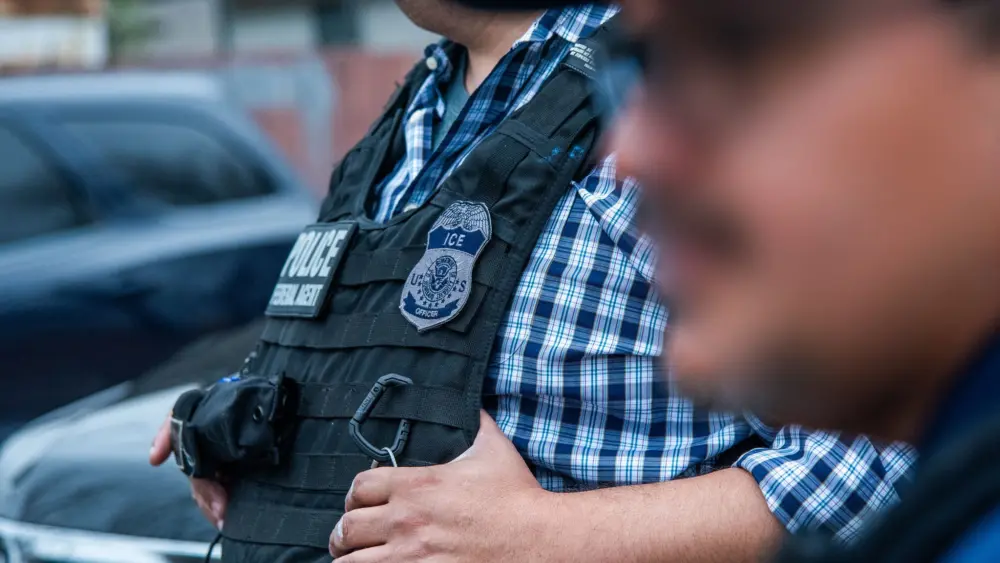
By late November, about five to 10 people a day were being arrested by ICE agents, compared to one or two a day in late summer, according to David Morales, an attorney who works with the Yakima Immigrant Response Network, which offers support to families dealing with arrests and detentions. That dropped to about three to five arrests a day in December.
“There’s just been a steady drumbeat, and a lot of people detained are farmworkers,” Morales said.
ICE officials did not respond to an email requesting comment about the pace of arrests in central Washington.
Some people are so spooked that they have balked at shopping, or even visiting a food bank, fearing federal surveillance. One family even barricaded themselves in their home, according to Noemi Sanchez, a Yakima Valley immigrant rights advocate.
It can also sting when some commenters on social media sites cheer the arrests and expanded ICE presence.
Amid this turmoil, many Latinos would like growers to be more vocal in offering support for workers, according to immigrant rights advocates.
But for growers, there may be risks to speaking out, said Erik Nicholson, a farm labor consultant. Nicholson said he asked several growers why they had not taken more public stands.
“The response is ‘we do not want to be targeted for retaliation by this administration,’” Nicholson said.
Meanwhile, the immigration arrests continue.
So, too, does the labor in the orchards. This month, shortly after the harvest was completed, many workers began a marathon of pruning to prepare the apple trees for the next year’s crop.
This story first appeared on Washington State Standard.