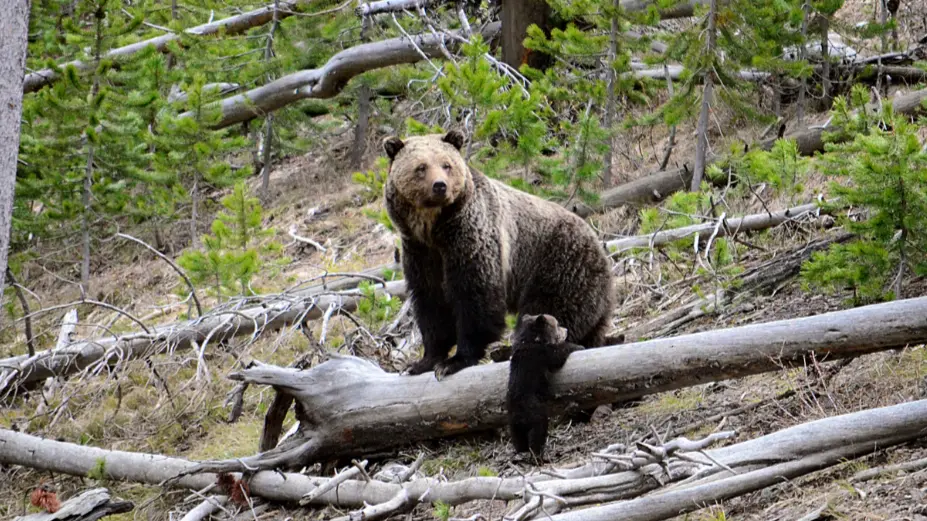
HELENA, MT – In Yellowstone National Park and areas just outside the park, at least 72 grizzly bears have died in 2025, mostly at the hands of humans.
That’s according to preliminary data released by the U.S. Geological Survey and a group of researchers that focus on the species across the rocky mountain region.
The database lists 72 grizzly mortalities this year, after Matthew Gould, the Interagency Grizzly Bear Study Team’s leader, confirmed one more death before the holidays and updated it, tying the highest recorded annual mortality among grizzlies. In 2024, published USGS data also shows around 72 known or probable grizzly deaths, though the numbers are routinely updated as wildlife managers continue to investigate some incidents.
The last two years are a roughly 35% increase from the 10-year average of 54 deaths, and a jump from 2022 and 2023 which each saw 47 recorded deaths, according to the data
Grizzly bears are classified as a threatened species under the Endangered Species Act, though members of Congress have pushed to delist them in recent years.
One grizzly scientist said people should remember the high number of deaths also comes with a high number of total grizzly bears. But some conservationists said the count means grizzly bears need federal protection now more than ever despite the push to delist the species.
Not just numbers
Gould said that the mortality data doesn’t tell a complete story, and other data indicate a conservation success story.
“What should be noted is that looking at just the frequency of mortalities — although it can be informative — can be misleading at times,” Gould told the Daily Montanan. “As we’ve seen record mortalities occur, we’ve also seen record population abundance, and the population is still growing.
According to Gould, the latest population estimate from 2024 was 1,050 bears in the ecosystem, an increase of around 3% from the previous year, and a vast increase from early population targets of around 500 bears during the early recovery days.
“We’ve been reporting for a number of years that we have a large, healthy grizzly bear population that has demographically recovered and that is a conservation success,” Gould said. “I don’t think many folks 40 years ago, when the population was perhaps as low as 250 individuals, thought we’d ever be over 1,000 bears.”
A vast majority of grizzly bears deaths in the Greater Yellowstone Ecosystem, or GYE, are related to humans — whether directly or indirectly. In 2025, 50 of the 72 listed deaths were human caused.
Nine grizzlies were struck by vehicles and two grizzlies were shot and killed by humans, one from a case of mistaken identity and one from self defense.
Wildlife agency officials killed 21 bears due to livestock predation — mostly cattle, but one instance of pig and one of alpacas as the target — and another 18 bears were killed due to other human conflicts — such as getting into garbage cans, aggressive behavior and property damage, or becoming habituated to humans and food.
Gould said the record-high grizzly population, along with Yellowstone drawing record crowds in recent years, creates a high probability of those two entities meeting.
“You’re kind of burning the candle at both ends,” he said. “You have a growing population and distribution of grizzly bears and an increasing human footprint in the ecosystem, and when those two elements meet, you have conflict.”
Gould said that because the species continues to grow — even though the bears’ occupied range contracted slightly this year — it’s likely the region is reaching a carrying capacity for grizzlies.
“We predicted this in a 2016 paper, that we’d see slowing population growth, and a fluctuation around a mean rate,” Gould said. “As well as a slowing of expansion, it falls in line with the population filling up the ecosystem.”
Some conservation organizations that are advocating for continuing federal protections, including Human World for Animals, argue the high mortality numbers around Yellowstone should be viewed with greater concern.
“When record numbers of grizzly bears die, it can be incredibly difficult for that population to bounce back,” Wendy Keefover, senior strategist for carnivore protection with Humane World for Animals, said in a statement. “Delisting would result in trophy hunting, exacerbating Yellowstone grizzly bears’ struggle to survive. Given the dangers grizzly bears are facing, now is not the time to take away their federal protections — they need them now more than ever.”
Montana’s management role
In Montana, the state department of Fish, Wildlife and Parks has its own grizzly mortality information dashboard, launched in 2024, to track human-caused grizzly deaths.
FWP said in a news release at the time that the dashboard is part of an effort to increase transparency, educate Montanans on why grizzlies are killed or die when they are currently federally protected, and to prove that the state is ready to manage grizzly bears on its own.
According to the dashboard, there have been 32 human-related grizzly mortalities this year, up from 29 in 2024. Some of those deaths overlap with the data from the GYE.
Similar to the GYE data, the majority of deaths are human-related.
Nine recorded deaths were due to vehicle collisions, including one from a train collision, seven were considered self-defense, and 10 were management removals due to livestock depredation, other human conflicts or a diseased or injured animal.
The number of self-defense grizzly deaths has raised concerns among some wildlife biologists and habitat managers in the state.
In an opinion piece published last month in the Flathead Beacon, a group of 31 professionals led by former U.S. Fish and Wildlife Service Grizzly Bear Recovery Coordinator Chris Sevheen wrote that with nearly a quarter of grizzly deaths coming in “defense-of-life,” the state should be more forthcoming with the circumstances of those incidents.
“Reports on each defense-of-life grizzly death need not be as detailed or time-consuming as reports on human fatalities, but even a basic accounting of the circumstances could help agencies understand why the incident happened, reduce future grizzly deaths and improve public safety,” the group wrote.
Montana politicians have pushed for delisting the grizzly bear and turning management of the species over to state control for years.
The state previously petitioned the U.S. Fish and Wildlife Service to delist the species in the GYE and the Northern Continental Divide Ecosystem, centered around Glacier National Park and the Bob Marshall Wilderness, but the agency rejected the petition early this year. A similar petition from Wyoming was also rejected in the final weeks of the Biden administration.
But Montana’s all-Republican federal delegation has pushed legislation to delist the species through an act of Congress instead.
U.S. Reps. Ryan Zinke and Troy Downing introduced a bill with Wyoming Rep. Harriet Hageman in January seeking to remove the Greater Yellowstone Ecosystem population of grizzlies in particular from the Endangered Species Act, restoring a ruling issued by the U.S. Fish and Wildlife Service during the first Trump administration in 2017.
That rule was ultimately vacated by a federal circuit court, and the agency reversed its stance under the Biden administration.
In July, the U.S. House Committee on Natural Resources narrowly voted in favor of the legislation, which has yet to go before the full chamber.
Daily Montanan is part of States Newsroom, a nonprofit news network supported by grants and a coalition of donors as a 501c(3) public charity. Daily Montanan maintains editorial independence. Contact Editor Darrell Ehrlick for questions: info@dailymontanan.com.