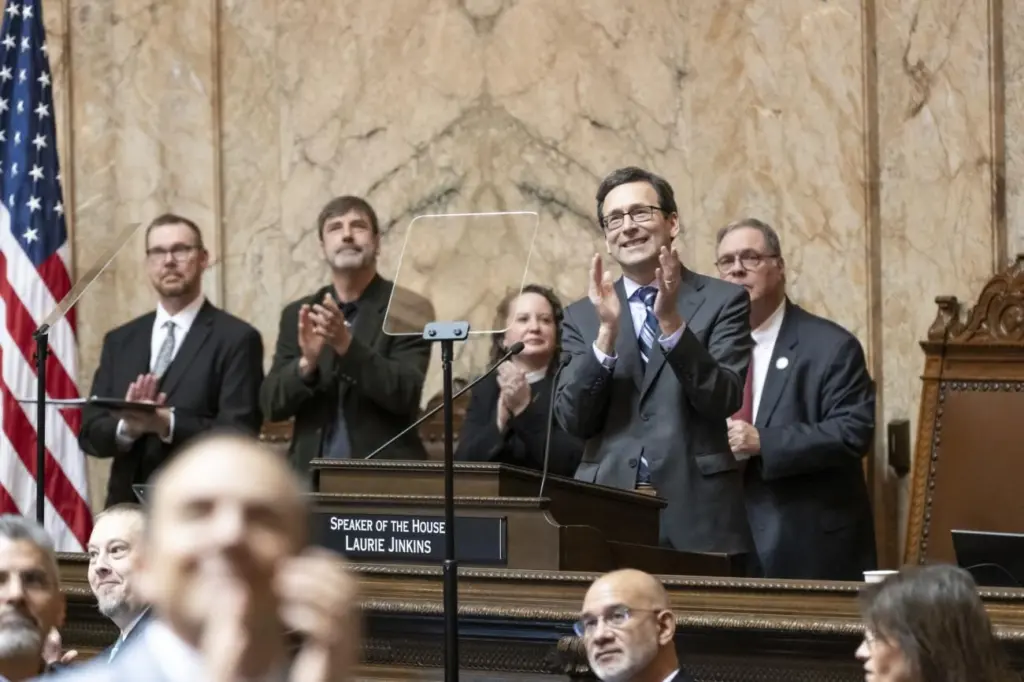
OLYMPIA, WA — Gov. Bob Ferguson delivered his first State of the State address Tuesday during a joint session of the Washington State Legislature, outlining budget priorities, policy goals and challenges facing Washington.
Ferguson addressed historic flooding in December 2025, citing damage and hardship in communities including Sumas, Concrete, Skykomish and areas along the Nooksack River. He thanked first responders, National Guard members, and state and federal agencies for emergency response efforts, and said Washington State Department of Transportation crews reopened 97 roads within four weeks, including Highway 2.
He said Washington has the ninth-largest economy in the nation and a triple-A bond rating. Ferguson cited growth in new business applications, population gains based on recent U-Haul migration data, and investments in clean energy, aerospace manufacturing and scientific research.
Ferguson outlined infrastructure proposals in his budget, including more than $1 billion for bridge preservation without raising taxes, $164 million for road paving in the near term, and $756 million over 10 years for additional paving projects. He also proposed funding to build three new state ferries to replace aging vessels and reduce service disruptions.
On housing, Ferguson proposed $244 million for affordable housing, which he described as the state’s largest single budget investment in housing. The funding would support construction and preservation of housing units, first-time homebuyers and faster housing development timelines.
Ferguson criticized federal immigration enforcement practices involving masked agents and urged passage of legislation that would prohibit law enforcement officers from wearing masks and require identifying information on uniforms. He also cited staffing losses and policy changes at the Centers for Disease Control and Prevention and announced participation in a West Coast Health Alliance to coordinate public health guidance.
He reiterated support for a proposed millionaires’ tax, defined as applying to individuals earning more than $1 million in annual income. Ferguson said revenue would be used to expand the Working Families Tax Credit, reduce business and occupation taxes for small businesses, and increase funding for K–12 education.
Ferguson also highlighted bipartisan legislation passed in the previous session related to public safety, Climate Commitment Act rebates for farmers, limits on out-of-state National Guard deployments, and protections for children in crisis. He referenced executive orders aimed at reducing permit and license processing times and increasing completion of the Free Application for Federal Student Aid (FAFSA).
A transcript and video of the address were released following the speech.