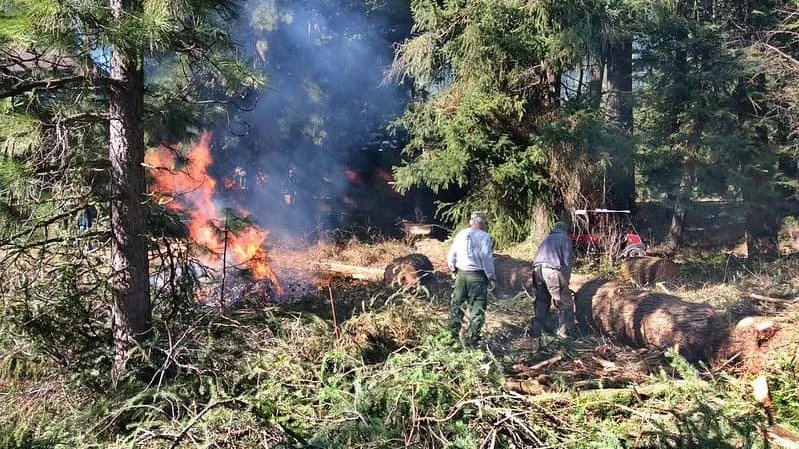
SALEM, OR – Oregon homeowners who take steps to protect their homes from wildfire could pay less for property insurance under a southern Oregon state senator’s proposal to require insurers to consider fire prevention efforts when setting rates.
Sen. Jeff Golden, D-Ashland, modeled his new bill after a similar Colorado law. It follows years of rising property insurance premiums and policy cancellations or nonrenewals across the country, particularly in the wildfire-ridden West.
Growing wildfire risk and the costs of rebuilding have driven premiums up in Oregon by more than 27% since 2020, according to recent data from the Consumer Federation of America.
Under current state law, insurers must provide policy holders with information about whether and how they consider property-level wildfire prevention efforts, such as installing fire-resistant siding and roofing, in underwriting and rating decisions. But they’re not required to offer policy holders any incentives for those efforts.
The bill would require insurers who use catastrophic event and wildfire risk modeling formulas and scenarios to calculate what insurance premiums customers pay, to demonstrate that their models and formulas take policy holders’ wildfire prevention investments into account.
“Despite homeowners investment in home hardening and defensible space, and despite public investments in community-level mitigation, many, if not all, insurers are not taking these mitigation measures into account in the computer models they use to price and to decide whether to write or renew insurance, what’s called underwriting,” Dave Jones, former California insurance commissioner, told lawmakers at a Wednesday meeting of the Senate Natural Resources and Wildfire Committee.
Golden’s bill would require insurance companies to reward home-hardening and defensible landscaping efforts that meet standards approved by the Insurance Institute for Business and Home Safety, an independent nonprofit backed by major insurers including State Farm and Farmers Insurance.
“So the bill is grounded in an empirically based standard developed by the insurance industry,” Jones said.
Oregon’s State Fire Marshal also recently signed an agreement with the Insurance Institute to offer homeowners certificates for undertaking specific wildfire prevention work around their homes in exchange for lower rates and premiums.
Incentives required
Under Golden’s bill, insurers would need to file their rate-setting models and other explanatory information with the Oregon Department of Consumer and Business Services, where they would be treated as confidential to protect the intellectual property associated with each insurer’s modeling.
The bill doesn’t require insurers use catastrophic planning models, but if they don’t use such models, the bill requires the insurer to give the policyholder some discount on their premium, or another incentive, when the policyholder demonstrates that they’ve undertaken property-specific wildfire mitigation to reduce the risk of loss.
Golden previously championed a much-maligned and since-repealed wildfire risk map by state fire experts and experts at Oregon State University that drew the ire of some Oregonians who were identified as living in high wildfire-risk areas. Some blamed the new risk maps for insurance cancellations and premium increases, but insurers’ statements filed with the Department of Consumer and Business Services revealed many had not used the state’s maps, but their own risk maps and modeling tools.
Kenton Brine, president of the industry group Northwest Insurance Council, offered a note of caution and optimism about the aim of Golden’s latest bill and the future of policy rates in Oregon. He said it would build on big strides the state has made in recent years when it comes to ensuring additional rights for policy holders.
Those include requiring insurers cover longer rebuilding times, cover more living expenses in the aftermath of a fire and that insurers provide policy holders with information about whether and how they consider wildfire prevention in ratesetting.
But, he said the proposal has “some bugs to be worked out,” such as more precise language about the scope and scale of premium discounts and incentives insurers will be expected to offer and for what specific wildfire prevention actions.
“While there are still challenges for homeowners in portions of Oregon, we believe the insurance market is showing signs of greater stability, with a slowing rate of non-renewals and cancellations and premium increases that are coming closer to the overall rate of inflation,” Brine said.
Oregon Capital Chronicle is part of States Newsroom, a nonprofit news network supported by grants and a coalition of donors as a 501c(3) public charity. Oregon Capital Chronicle maintains editorial independence. Contact Editor Julia Shumway for questions: info@oregoncapitalchronicle.com.