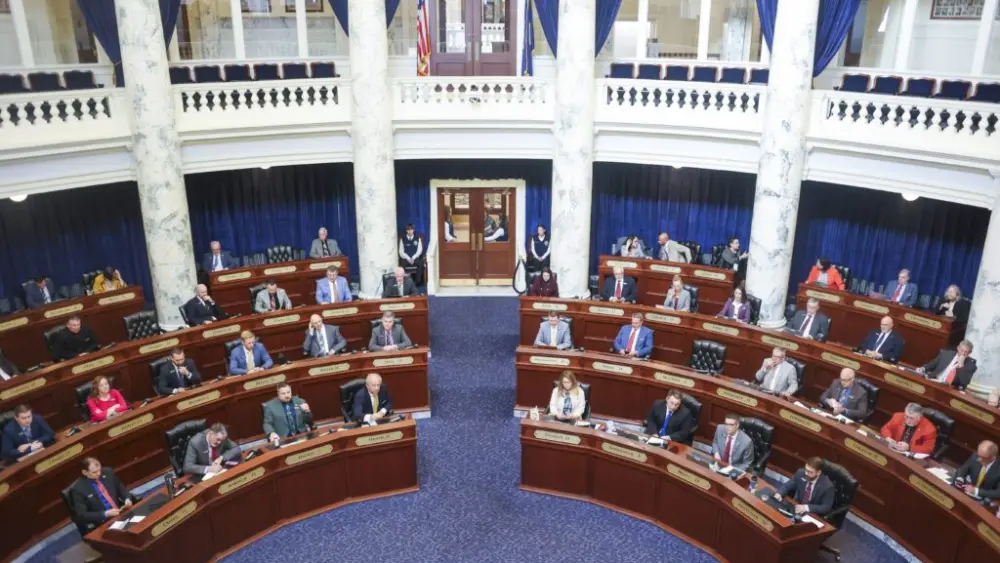
BOISE, ID – The Idaho Legislature’s budget committee voted unanimously Monday to adopt a more optimistic revenue projection than Gov. Brad Little recommended to base the state budget around.
After delaying the vote by one day on Friday, the Idaho Legislature’s Joint Finance-Appropriations Committee voted to adopt the Economic Outlook and Revenue Assessment’s recommended revenue projection of more than $5.6 billion for the current fiscal year 2026 and about $5.8 billion for next year’s fiscal year 2027.
In both cases, the revenue figures were higher than the revenue projections Little recommended in conjunction with his State of the State address last week.
JFAC’s adopted revenue total is about $152.5 million, or 2.8% more than Little’s this year, and $137.4 million, or 2.4% more than Little’s next year.
The Joint Finance-Appropriations Committee, or JFAC for short, is a powerful legislative committee that sets all of the budgets for every state agency and department.
January revenue report for Idaho looks strong
Adopting a revenue figure is an important part of the budget-setting process because the revenue figure essentially represents the upper limit of what can be spent in the state budget. The Idaho Constitution requires the state to pass a balanced budget where expenses do not exceed revenues.
Rep. Josh Tanner, an Eagle Republican who serves as one of the two co-chairs of JFAC, said he felt safe adopting the Economic Outlook and Revenue Assessment Committee’s recommendation because the projection is lower than the Idaho State Tax Commission’s $6.3 billion projection for fiscal year 2027.
Tanner also referenced a strong new January state monthly revenue report that showed a dramatic increase in corporate income tax collections and now projects the state budget to end the current fiscal year 2026 with a budget surplus of $106.2 million.
December revenue collections were so strong that they reversed a projected $40 million budget deficit, to the point Idaho is now projecting a budget surplus for the first time in months.
“So we’re sitting heavy as we sit right now,” Tanner said.
Although all JFAC members eventually agreed to adopt the same revenue targets unanimously, there was some confusion along the way to reaching agreement. Shortly before voting to adopt the revenue projection, JFAC members voted down an earlier motion to accept the revenue report from the Economic Outlook and Revenue Assessment Committee.
In the end, different members of JFAC appeared to have different reasons for supporting the higher revenue figure they all agreed to vote for.
Senate Minority Leader Melissa Wintrow, D-Boise, said she appreciated the more optimistic revenue number because it may mean the Idaho Legislature does not have to cut programs and services as deeply in order to balance the budget.
Sen. Jim Woodward, R-Sagle, said he hopes the higher revenue figure means Idaho will have more money to invest in wildfire suppression and transportation infrastructure.
Rep. Kyle Harris, R-Lewiston, said he favored the higher revenue target because it leaves more room in the budget for tax cuts and full compliance with federal tax cuts championed by President Donald Trump in the One Big Beautiful Bill Act.
Rep. Rod Furniss, R-Rigby, said after Monday’s meeting adjourned that he favored the higher revenue figure because it gives legislators more of a cushion to leave a larger ending cash balance at the end of the budget year to guard against economic uncertainty.
This year, JFAC adopted a revenue projection much earlier in the year than during the last two legislative sessions. While Monday marked the eighth day of the 2026 legislative session, JFAC did not adopt a revenue target last year until March 5, which was 59 days into the legislative session. Last year, some members of both political parties criticized JFAC for setting the revenue projection after passing major budgets and tax cuts.
Revenue projections by the numbers
Fiscal year 2026
Gov. Brad Little’s projection: $5.512 billion
Joint Finance-Appropriations Committee: $5.665 billion
Difference: $152.5 million/2.8% above Little’s projection
Fiscal year 2027
Gov. Brad Little’s projection: $5.679 billion
Joint Finance-Appropriations Committee: $5.816 billion
Difference: $137.4 million/2.4% above Little’s projection
Idaho Capital Sun is part of States Newsroom, a nonprofit news network supported by grants and a coalition of donors as a 501c(3) public charity. Idaho Capital Sun maintains editorial independence. Contact Editor Christina Lords for questions: info@idahocapitalsun.com.