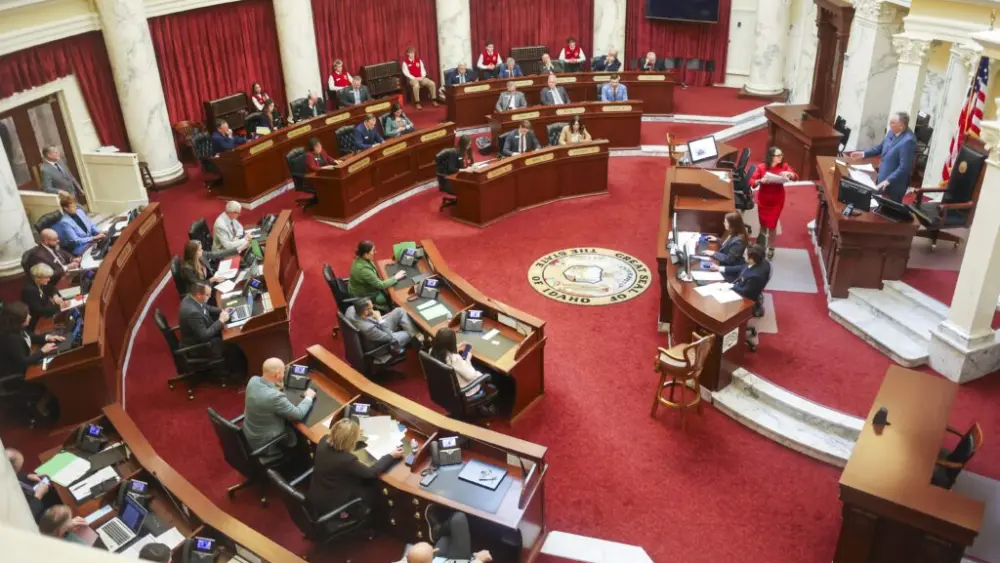
OLYMPIA, WA – The largest tax proposal facing state lawmakers this session received a public hearing on Thursday, with more than 12,000 people signed in against the idea from a Seattle Socialist.
Rep. Shaun Scott, D-Seattle, laid out his plan on the steps of the Capitol last month. If approved, House Bill 2100 would impose a 5% payroll tax on employers with more than 20 employees, subject to change, and with over $5 million in sales. It wouldn’t apply to payrolls of less than $7 million in the prior year.
Modeled after Seattle’s JumpStart tax, which generated $47 million less than projected in 2024, Scott said his proposal would create the “Well Washington Fund.” Supporters claim HB 2100 would fill holes left by President Donald Trump’s “One Big, Beautiful Bill,” despite state spending doubling since 2015.
Republicans argue that the state deficit is the result of the majority party’s policies. Gov. Bob Ferguson placed the budget hole at $2.3 billion last month, though other reports estimate it as high as $4.3 billion.
If approved, the revenue from HB 2100 would flow entirely to the general fund until July 2027. After that, 51% would go to the Well Washington Fund for health care, education, housing, and other priorities that Democrats claim Trump’s economic policies would put at risk. The rest would stay in the general fund.
HB 2100 would exempt major companies like Amazon, which already pay the Seattle JumpStart tax.
Former state Sen. Joe Fain, now president and CEO of the Bellevue Chamber of Commerce, said that Seattle has lost about 5,500 jobs since passing its payroll tax, while Bellevue has gained about 4,000.
The state proposal targets employers offering salaries of $125,000 or more, charging a 5% payroll tax on total wages exceeding $7 million annually. However, the tax proposal wouldn’t close the current deficit on its own. Scott frames the measure as more of a long-term response to the Trump administration.
HB 2100 prohibits employers from passing the costs on to their employees, raising several concerns.
Critics worry that HB 2100 will lead to higher prices, diminishing wage growth and increased spending.
Joe Nguyen — who recently left Ferguson’s cabinet as director of the Department of Commerce to join the Seattle Metropolitan Chamber of Commerce as its president and CEO — testified against HB 2100.
“I do want to recognize how difficult it is to balance the budget right now, especially after the session that you had last year,” Nguyen said, alluding to the $12 billion tax hike that Democrats passed last year to fill another budget gap. “What I’ll say is that this proposal is moving us in the wrong direction.”
Scott initially estimated that his tax proposal could raise $2 billion annually. The state’s original fiscal note estimates that it could raise $11.8 billion during the 2027-29 biennium and then $9.3 billion over the 2029-21 biennium. State operating costs would range from $11.5 million to $16.7 million per biennium.
“I heard from many employers that had similar concerns, so we are talking about exempting hospitals, health care providers,” Scott said, referencing some new changes, “as well as school districts and major universities — the employee threshold in the bill was also increased tenfold from its original version.”
Some people thanked Scott for raising the employee threshold to 250 but still expressed grave concerns.
“Even with the 250-person threshold, that is really not a large business in the construction industry,” Michele Willms testified in opposition on behalf of the Associated General Contractors of Washington.
She said the payroll tax will lead to higher bids, resulting in taxpayers paying more for fewer projects.
Nguyen noted that the substitute could also still extend to grocery stores and other major industries.
The Washington Roundtable, AWB, Bellevue Chamber of Commerce, Seattle Metropolitan Chamber of Commerce, and Greater Spokane Inc. issued a joint statement ahead of Thursday’s public hearing.
“Washingtonians across the state are facing an affordability crisis,” the statement said. “Families are struggling with rising housing costs, groceries, childcare, utilities, and uncertainty in the job market. Employers of all sizes are facing the same pressures, compounded by a growing tax burden that makes it harder to hire, expand, or even keep jobs in Washington.”
Scott has rejected concerns that HB 2100 may lead to capital flight, meaning the wealthy leaving the state, and companies potentially relocating and taking their jobs with them. He previously attributed job losses to artificial intelligence, despite Jeff Bezos saving billions in taxes after moving to Florida.
More than 15,000 people signed in virtually to state a position on HB 2100 ahead of the hearing, with over 12,000 opposing the payroll tax. Dozens of people on both sides of the issue testified on Thursday.
The committee will likely hold an executive session in the coming days to consider advancing HB 2100.
“We already know there’s a budget that is being drawn up based upon these,” one private citizen, Eric Lundberg, testified on his own behalf. “We the people will be trapped to make up the difference.”