BOISE, ID – Idaho’s rising rates of incarcerating state prisoners in county jails and out of state have led to skyrocketing costs. The price for operating the state’s 10 prisons are also on the rise, according to the correctional agency director.
Idaho Department of Correction Director Bree Derrick presented the agency’s budget on Monday to the state budget writers on the Legislature’s Joint Finance-Appropriation Committee.
“The inflationary cost that we’ve experienced related to inmate supplies has been pretty staggering, so we have some examples where basic things – toilet paper, paper towels – going up between 25% and 26% over the last two or three years,” Derrick said. “So that for us is a huge impact. We also have a population spike that we haven’t seen before at the Department of Correction.”
Under the governor’s recommendations, the agency’s budget for county and out-of-state placement of people who are incarcerated is expected to grow just over 69% from the current fiscal year.
How much does it cost to house Idaho inmates when state prisons are full?
Gov. Brad Little in his proposed budget recommended the state pay a supplemental payment of $15.2 million in the current fiscal year to cover the difference in what was allocated last year to cover costs of housing people who are incarcerated outside of state prisons, compared to the projected actual costs. Little’s recommendation was based on the incarcerated population numbers through November.
Little’s budget also calls for $25 million in additional spending in the next fiscal year, which begins July 1.
As of Jan. 1, there were 10,023 total people incarcerated by the Department of Correction, according to the agency’s population dashboard. The in-state capacity is just over 8,200, according to the dashboard. The state operates 10 prisons.
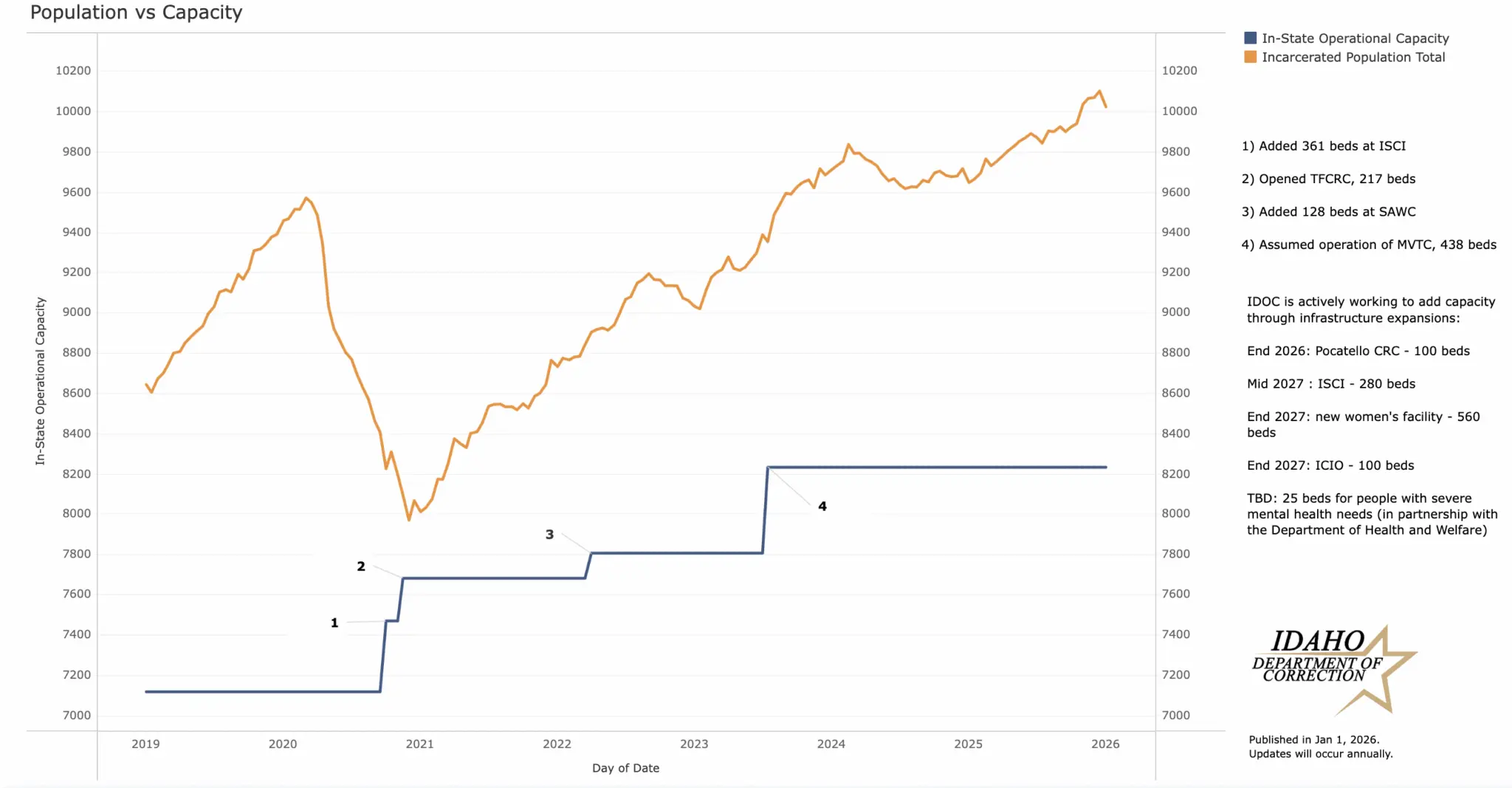
The available population data shows the inmate population has remained the state’s capacity since 2019, when the data starts. The capacity has increased from around 7,100 in 2019 through a number of projects.
When the state prisons are full, people who are incarcerated serve their terms either in county jails or out-of-state facilities.
The reimbursement rate to county jails is set in state code at $55 per resident per day for the first seven days of confinement, and then $75 per resident per day thereafter. The state pays an additional $2.50 per resident per day for medical costs.
The reimbursement for out-of-state facilities is set by contract. The average daily rate per resident is projected to be about $83 for these contracts, according to the legislative budget book.
Derrick said Monday that the state’s contract with a facility in Arizona costs the state about $85 per resident per day.
Based on the October populations, the agency projected the state would house 991 inmates in county jails monthly, and 761 residents in out-of-state facilities monthly. The governor’s budget included higher costs than the agencies’, based on more up-to-date data available through November. The governor’s updated cost projection didn’t include exact numbers of residents.
The expected total cost of incarcerating people outside of state prisons is expected to be around $51 million.
Why is the Idaho prison population rising?
Rep. Brooke Green, D-Boise, on Monday asked what was behind the state’s unprecedented prison population spike.
Derrick said the agency has recently been trying to determine this. She said the number of people entering facilities has grown, while the rate at which people are released has remained stable. She said that the average length of stay at a facility also seems to be remaining largely unchanged.
“But there hasn’t been one trend that has really stood out to us,” Derrick said.
Sen. Phil Hart, R-Kellogg, said “each year the Idaho Legislature creates a new crime, or proves an enhancement or passes some kind of mandatory minimum legislation.”
He asked if the department had a model to predict the impact of those legislative decisions.
Derrick said the agency uses a mathematical model to try and predict the impact. Hart also asked how Idaho’s incarceration rate compared to neighboring states.
Derrick said the state’s rate of incarceration is high compared to national averages and to Idaho’s neighboring states. In 2023, Idaho had the fifth highest rate of incarceration in the nation, at 490 people in prison per 100,000 residents, according to U.S. Bureau of Justice Statistics reported by USA Facts.
Montana’s rate that year was 438, and Wyoming’s was 378. Oregon and Washington’s rates were much lower, at 291 and 181 respectively.
Senate Minority Leader Melissa Wintrow, D-Boise, said she would encourage legislators to look at more programs that may incentivize good behavior in facilities with early release and other policies that may reduce prison populations.
IDOC nearly had to furlough entire staff to comply with governor’s budget holdbacks
The Idaho Department of Correction, known as IDOC, would have had to temporarily furlough its entire staff to comply with mid-year budget holdbacks ordered by the governor earlier this year, according to its director.
In August, the state faced projected revenues that were $39.1 million behind what had been budgeted for, the Idaho Capital Sun reported at the time. In response, Gov. Brad Little signed an executive order calling on all agencies outside of K-12 public schools to immediately cut their current fiscal year budgets by 3%.
Little’s office told agencies in September to extend those reductions into the next fiscal year and beyond.
“We got to a place where we were very seriously considering furloughing all of our staff, so 2,200 staff, most of whom are law enforcement officers in the state, which I don’t think is good for public safety,” Derrick said. “But those are the real types of decisions we’re being faced with at this time.”
The governor exempted IDOC’s budget from the cuts to avoid the mass furloughs. However, the agency is still working to reduce its budget where possible.
She said planned upgrades through a software meant to track and help reduce recidivism have been slowed. Other software has been reduced or eliminated.
The governor’s recommendation for the agency’s entire budget — which includes its divisions for management, community corrections, and medical services — totals $388 million of state general funds. The request is about 10% above what was provided by the Legislature last year.
Idaho Capital Sun is part of States Newsroom, a nonprofit news network supported by grants and a coalition of donors as a 501c(3) public charity. Idaho Capital Sun maintains editorial independence. Contact Editor Christina Lords for questions: info@idahocapitalsun.com.