PULLMAN, WA – A new tool developed by Washington State University researchers could someday provide daily or weekly forecasts of water availability in the mountains similar to a weather forecast that agencies could use for important water management decisions.
The researchers recently presented their forecast tool for snow-water equivalent, which predicts potential water availability, at the Association for the Advancement of Artificial Intelligence Conference on Artificial Intelligence in Singapore.
Compared to existing approaches as well as state-of-the-art models, the researchers found that their tool works better than current snow-water equivalent measurement forecasting methods for about 90% of locations for daily forecasts and about 70-80% of locations for weekly forecasts.
“Snow-water equivalent is critical for decision making because it tells you how much water would be available from the melted snow, which would go through streamflow or watersheds,” said Krishu Thapa, first author on the work and a graduate student in WSU’s School of Electrical Engineering and Computer Science.
In the mountains of the Western U.S., 50–80% of annual streamflow originates from melting winter snowpack. A forecast of the snow-water equivalent is critical both for short- and long-term water management, such as for more accurately predicting short-term flooding events during storms or for better long-term planning for summer irrigation, hydropower, and fisheries needs.
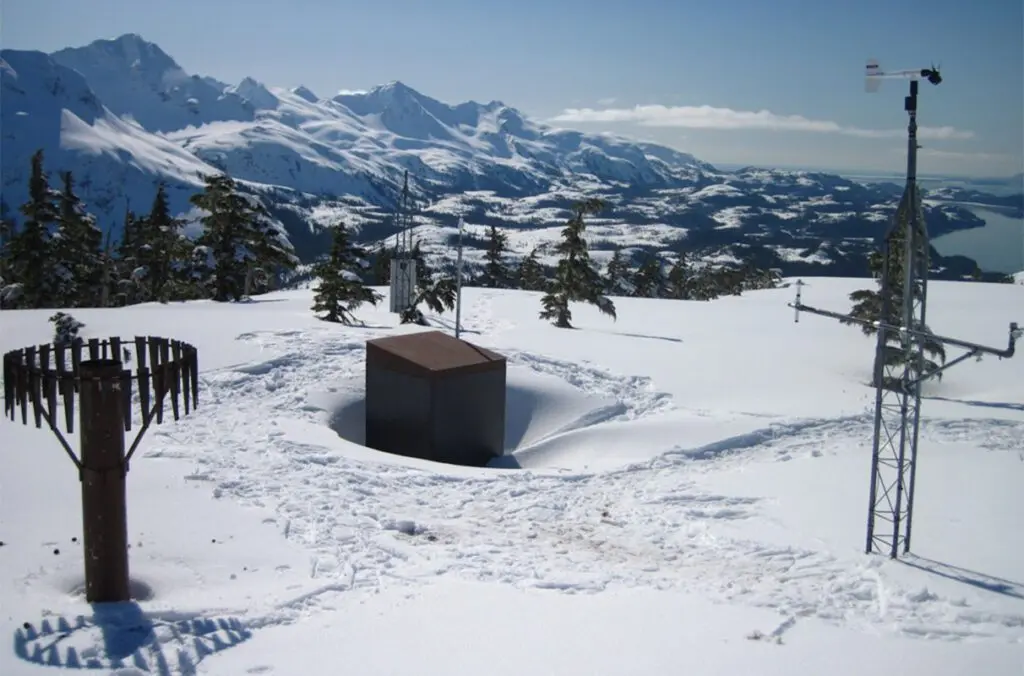
There are 822 snow measurement stations throughout the Western U.S. that provide daily information on the snow-water equivalent at each site. However, the stations are sparsely distributed with approximately one every 1,500 square miles. Even a short distance away from a station, snow measurements can change dramatically depending on factors like the area’s topography. Water managers take information on the current snow-water equivalent and stream flows and look at information from past events to help them inform their decision making.
“What this forecasting does is take that to the next level,” said Kirti Rajagopalan, assistant professor in the School of Biological Systems and a co-author on the paper. “Instead of just looking at years in the past, we can fine-tune our model into a smaller subset of future states that are relevant.”
For their work, the researchers used artificial intelligence to develop a forecast model to predict the daily and weekly snow-water equivalent. They evaluated the model on data from more than 500 snow measurement sites around the U.S. West. The model performed well because the researchers brought together both temporal and spatial aspects of the data.
“We are trying to include information in both space and time,” said Thapa.
In the work, the researchers were also able to provide valuable information on the uncertainty of their forecasts. Like with a weather forecast, having information on how certain the forecast is can help people make better decisions.
“The most important thing is how confident we are about those predictions because the decisions that water managers make are going to impact people,” said Bhupinderjeet Singh, another co-author who completed his doctorate on this work at WSU.
The researchers next are working to build a dashboard to provide the real-time forecasting that managers will eventually be able to use. They also want to be able to integrate weather forecasting and streamflow forecasts into their model. Once their work is in an easy-to-use dashboard, they will continue to track how well it does.
“I think that having an integrated way of being able to forecast interdependent variables is important,” said co-author Ananth Kalyanaraman, director of the School of Electrical Engineering and Computer Science. “The current technology is to mostly predict variables individually. If we can tie that up in a much more integrated fashion, that would represent an advancement in the current way in which this information is being used.”
Nghia Hoang, assistant professor in the School of Electrical Engineering and Computer Science, and Supriya Savalkar a recent graduate from the Department of Biological Systems Engineering also contributed to the work. The work was funded by the USDA National Institute of Food and Agriculture and the WSU-led AgAid Institute.