This story was originally posted on IdahoEdNews.org on Jan. 30, 2026.
BOISE, ID – A federal appeals court on Thursday delivered welcome news for opponents of the Idaho Legislature’s 2024 law that established civil penalties for libraries and schools that allow children to access “harmful” material.
The U.S. Court of Appeals for the 9th Circuit on Thursday narrowly reversed a decision from the U.S. District Court of Idaho to deny a preliminary injunction that would have stopped the law from going into effect. The circuit court’s decision on Thursday sided with the plaintiffs, reversed the district court’s decision and returns the case back to the lower court to consider “the scope of a limited preliminary injunction” and to “conduct further proceedings consistent with our opinion.”
The district court “abused its discretion” by denying the injunction, wrote 9th Circuit Court Judge Milan D. Smith, Jr.
“We are happy the 9th Circuit agreed that a key provision of the law is unconstitutional,” McKay Cunningham, a constitutional law professor and lawyer representing the plaintiffs, said in a statement to EdNews on Friday.
The conservative Christian nonprofit Idaho Family Policy Center wrote parts of House Bill 710 and led a campaign urging the governor to sign it. President Blaine Conzatti provided a written statement to EdNews on Friday pointing out that the law is still in effect while the matter plays out in the courts.
“While we disagree with the reasoning of the 9th Circuit on how the context clause should be interpreted, we’re pleased that the 9th Circuit instructed the lower court to enter a narrow preliminary injunction only on the context clause issue, leaving our Children’s School and Library Protection Act in effect,” Conzatti wrote.
HB 710’s “context clause” requires courts and other reviewers to consider if the allegedly offensive content in libraries and schools possesses “serious literary, artistic, political or scientific value for minors.” The court concluded that the plaintiffs — a coalition of private schools and libraries and their patrons — showed a “likelihood of success” because the bill’s context clause is “overbroad on its face” and threatens to regulate a substantial amount of expressive activity.
“Our First Amendment jurisprudence counsels that the remaining preliminary injunction factors follow suit, and the district court erred in concluding otherwise,” Smith wrote in the court’s opinion.
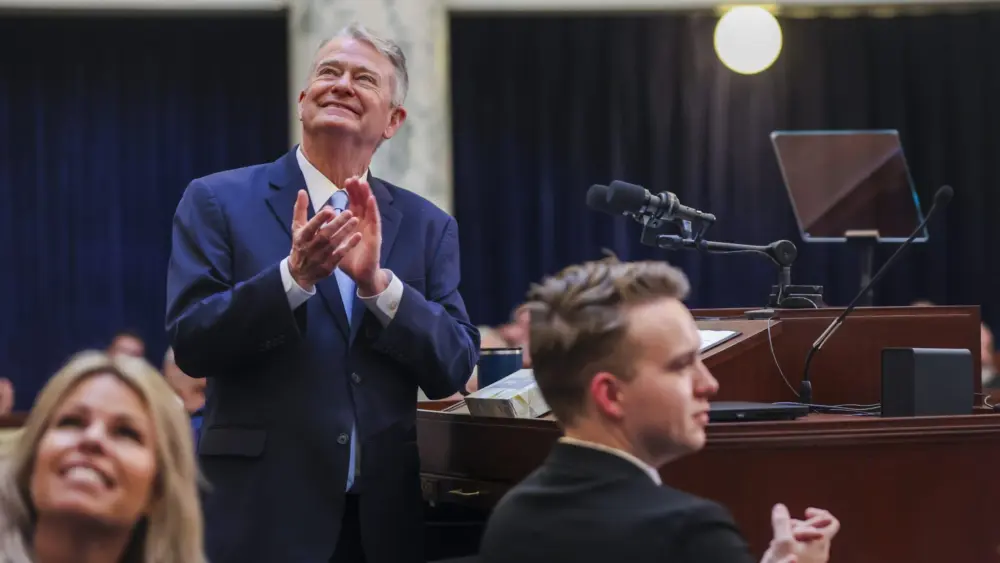
Gov. Brad Little signed HB 710 into law on April 10, 2024, and it went into effect that summer. Sen. Cindy Carlson, R-Riggins, and Rep. Bruce Skaug, R-Nampa, sponsored the bill.
The law prohibits libraries and schools — both public and private — from allowing children to access “harmful” material. A book, movie or other content is considered “harmful” when it depicts nudity, sexual conduct, homosexuality, sexual excitement or sado-masochistic abuse in a way that “appeals to the prurient interest” or is “patently offensive to the prevailing standards in the adult community.”
The plaintiffs include the Northwest Association of Independent Schools, Sun Valley Community School, Foothills School of Arts and Sciences, the Community Library Association, and Collister United Methodist Church.
The coalition appealed the district court’s decision to deny their motion for a preliminary injunction, arguing that HB 710 overbroadly suppressed free speech rights under the First Amendment.
Idaho Capital Sun is part of States Newsroom, a nonprofit news network supported by grants and a coalition of donors as a 501c(3) public charity. Idaho Capital Sun maintains editorial independence. Contact Editor Christina Lords for questions: info@idahocapitalsun.com.