New cuts could force Idaho prisons to operate at modified-secure status, state officials say
IDAHO – The state of Idaho could be forced to furlough all commissioned Idaho State Police troopers and more than 1,200 prison staff if the Idaho Legislature enacts additional new budget cuts of 2% that legislators asked state agencies to plan for, new state documents released Friday indicate.
In addition to furloughing staff by 19 hours during every two-week pay period for the rest of this fiscal year, additional new state budget cuts could also force Idaho State Police to reduce positions for security operations at the Idaho State Capitol and – if 2% cuts are implemented in fiscal year 2027 – eliminate the Idaho State Police’s SWAT team, state documents show.
“The implementation of furloughs within the Idaho Department of Correction (IDOC) will have far-reaching consequences across prison operations, administrative functions, and probation and parole supervision,” Idaho Department of Correction officials wrote in a statement released Friday. “Reduced staffing will compromise safety, disrupt essential services, and increase legal and fiscal risks for the state.”
On Friday, state education leaders also pushed back on how the additional 2% cuts would affect students and educators. Idaho Superintendent of Public Instruction Debbie Critchfield declined to recommend additional cuts for K-12 education.
“I will not be recommending further cuts to the public school budget for FY 2026 or FY 2027,” Critchfield wrote Friday in a letter to state budget committee leaders and staff. “The public schools budget is more than numbers on a spreadsheet. It represents every one of our students, classrooms, teachers and communities.”
Why is Idaho planning for budget cuts?
Idaho state revenues fell short of projections for several consecutive months until a rebound in December.
There is a state budget crunch following five years of tax cuts passed by the Idaho Legislature that reduced funding available for the state budget by a combined total of $4 billion, the nonprofit Idaho Center for Fiscal Policy found in a report issued late in 2025. Additionally, Idaho is facing an estimated cost of $155 million per year – or more – to comply with federal tax cuts championed by President Donald Trump in the federal One Big Beautiful Bill Act.
Earlier this week, the leaders of the Joint Finance-Appropriations Committee, or JFAC, told all state agencies to submit plans by Jan. 30 to cut their budgets by up to an additional 2%, the Idaho Capital Sun previously reported. These cuts would be in addition to the 3% cuts that Little implemented last summer and then made permanent to avoid a state budget deficit. If the additional new 2% cuts are implemented, that would bring the total impact of the cuts to 5% for most state agencies and departments.
Under modified-secure status, people who are incarcerated would lose access to statutorily required programs
Furloughing all prison staff would force prisons to operate on a modified-secure status, Idaho Department of Correction officials wrote Friday.
“Modified-secure status means that most inmates remain locked in their cells or sleeping barracks without access to statutorily required rehabilitative programming,” Idaho Department of Correction officials said. “Lack of program access causes delays in parole-readiness and extends incarceration, ultimately increasing long-term costs.”
If an additional 2% cut was implemented for fiscal year 2027, Idaho State Police officials said they would need to eliminate their SWAT program.
“This would prevent our agencies from deploying a specialized team to respond to high-risk incidents or assisting local law enforcement with tactical operations and specialized response requests,” state police officials said.
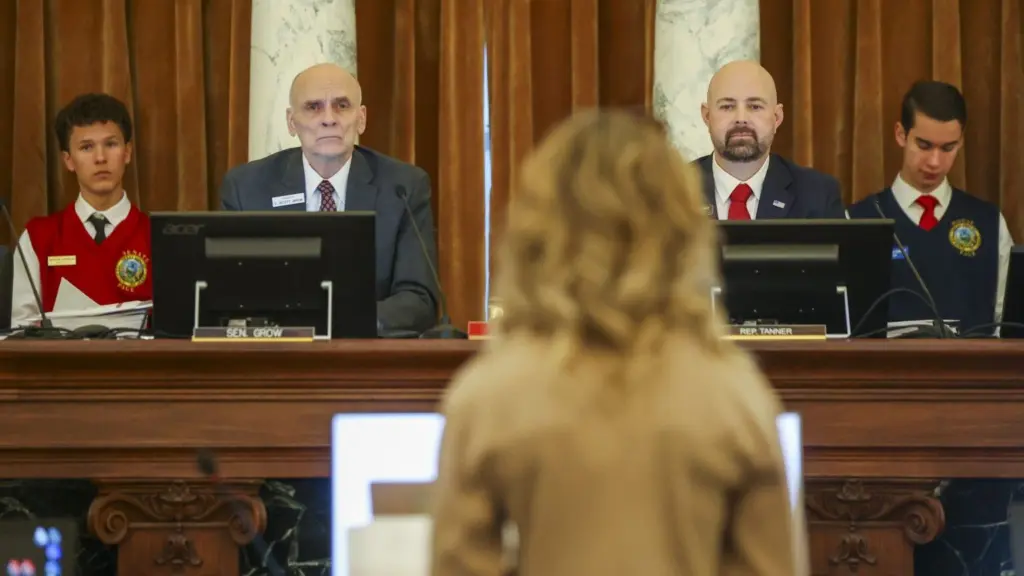
Rep. Josh Tanner, a Republican from Eagle who is a co-chair of the Idaho Legislature’s Joint Finance-Appropriations Committee, said he knew additional budget cuts would hit the Idaho State Police and Idaho Department of Correction hard, and he hopes the Idaho Legislature does not have to cut those budgets.
“Those two agencies I am extremely nervous with,” Tanner said in a phone interview Friday afternoon. “Those two agencies – I do not think it would be wise to cut either one of those agencies, but it is smart for us to have all of the cards on the table so when we make a decision we can look at it as a whole and then go down from there.”
Idaho governor’s budget chief: Little doesn’t support additional 2% cuts
Idaho Division of Financial Management Administrator Lori Wolff said additional new, across-the-board cuts would hurt state employees and Idahoans who depend on government programs and services.

“These are the things that impact Idahoans,” Wolff said Friday at the Idaho State Capitol in Boise. “It’s how we teach our kids, it’s the roads and congestion and its housing and its affordability and its health care, and public safety. It’s what they expect their government to do. I think there’s an expectation that government operates efficiently, but it’s also the expectation that we operate effectively. And sometimes effective government requires investment in those things that keep communities strong.”
Wolff said Gov. Brad Little is not recommending these additional cuts.
“These cuts are going to be pretty detrimental to agencies’ operations and, likely, services,” Wolff said. “It’s really late in the year to be doing an additional 2% cut, and it’s likely going to look like either layoffs or furloughs (for many state agencies).”
Wolff said Little submitted a plan with the State of the State address to balance the state budget without implementing additional across-the-board cuts.
The Idaho Department of Health and Welfare anticipates the options for cuts would make the most vulnerable people in Idaho “less safe, less healthy, and less stable.”
“Additional cuts would be felt directly by Idahoans who rely on state services to meet basic health and safety needs,” the agency wrote in an unsigned memo released Friday night.
Cuts could include:
- Delaying Medicaid payments, “which could force providers to leave the Medicaid network, reduce services, or close their doors entirely.”
- Eliminating Medicaid services not required by law — like those on the governor’s list of Medicaid cut options — including dental services, occupational therapy and home and community-based services, which are meant to help people with developmental disabilities live outside institutions
- Cutting financial support for families that adopted kids in foster care
- Cutting funding for the crisis and suicide prevention hotline
Public schools head refused to plan cuts. State Board of Education expects deep harms.
Initially, K-12 public school leaders were told they would be kept from being included in the budget cuts, but JFAC leaders on Wednesday asked Idaho’s K-12 public school system and Medicaid program officials to submit plans to cut their budgets by up to 2% as well.
“Whether we are talking about the biggest district in the Treasure Valley or the one-room schoolhouse in Lowman, schools are deeply woven into the fabric of Idaho communities,” Critchfield said. “When funding is cut too deeply or carelessly, student opportunities shrink, programs disappear and costs shift to local taxpayers.”
Idaho Education News first reported Critchfield’s letter.
Idaho Superintendent of Public Instruction Debbie Critchfield with Students
She warned that funding cuts would have wide-ranging consequences, including laying off teachers and cutting programs like athletics and arts.
“What does that look like? Larger class sizes; ending shop programs; cutting support for math and literacy; outdated textbooks and instructional materials; cuts to interventions; removing athletic, music, art and debate programs; laying off teachers and support staff; hiring freezes; declaring emergencies to break teacher contracts; increasing fees; and a heavier reliance on local taxpayers,” Critchfield wrote.
In emailed statements, Senate and House Minority Leaders Melissa Wintrow and Ilana Rubel, both D-Boise, decried any cuts to the public education system and called on the Legislature to reverse course on the $50 million in tax credits Republicans approved in 2025 that support students in private and religious schools.
“There is a clear and responsible alternative to cutting public schools, and it starts with repealing the $50 million private-school voucher program,” Wintrow said in a statement. “At a moment when every dollar is being scrutinized, it is indefensible to protect an unaccountable subsidy for private and religious schools while asking public classrooms to absorb a $55 million hit. That money could keep teachers in classrooms, preserve programs, and honor the promise made to Idaho families that K–12 funding would be protected. Idaho Democrats will continue to fight for budgets that put public schools, working families, and Idaho communities first.”
The head of the Idaho State Board of Education, which oversees the state’s public colleges and universities, said the cuts would deepen harm already seen from the governor’s 3% budget holdbacks ordered last summer. And the cuts are coming while Idaho’s public higher education institutions are bracing for record student enrollment.
“We have prepared good faith submissions, but do not recommend or support further reductions, particularly under a compressed timeline that limits responsible assessment and increases the likelihood of unintended, cumulative harm,” Idaho State Board of Education Executive Director Jennifer White wrote in a letter. “… When timelines are shortened, the margin for error narrows, and the likelihood of compounding harm increases — particularly for institutions that have already absorbed permanent reductions.”
Here are the cuts White highlighted:
- The University of Idaho, the state’s land-grant university in Moscow, would cut staff and faculty or pause hiring, which would impact several research programs, including potato variety development, nutrient management and meat and food sciences. Faculty and laboratory components would be cut for veterinary programs and medical education.
- Idaho State University, based in Pocatello, “would be forced to impose mandatory furlough days for all employees making over $60,000.”
- Boise State University would cut its maintenance budget for athletic facilities, suspend a high-demand minor in construction management, and limit expanding its program for advanced medical imaging.
- The state’s community colleges would also feel the cuts. The College of Eastern Idaho “would be forced to reduce the student cohort size” of its Licensed Practical Nurse Program and make other cuts. The College of Southern Idaho would cut general education faculty and partnerships with high schools. The College of Western Idaho “would delay new high-demand and high-cost programs.”
Idaho’s Graduate Medical Education programs “are unable to sustain these additional cuts,” the State Board of Education’s Graduate Medical Education Committee wrote in a joint letter.
“The legislature has made it clear that developing the health care workforce, including undergraduate medical medication” and graduate medical education “are key in solving Idaho’s physician workforce. Cutting funding for this priority simply doesn’t make sense,” wrote Drs. Ted Epperly, Moe Hagman and Lisa Nelson, who serve on the committee.
‘Everybody has to play in the sandbox’: Republican leadership responds to plans from state agencies
Reached Friday afternoon, Sen. Scott Grow, a Republican from Eagle who serves as a co-chair of JFAC, said he had not yet seen the state agencies’ new plans for budget cuts. Grow told the Sun he was empathetic to the situation agencies are in, and he hopes agencies cut bureaucratic programs rather than adversely affecting people.
“We’re hoping people don’t have to do furloughs,” Grow said Friday afternoon.
JFAC’s other co-chair, Tanner, said he is committing to passing a balanced state budget, which will require additional new cuts.
“Everybody has to play in the sandbox, and these are tough decisions that the Legislature has to make this year for sure,” Tanner said. “I agree with a lot of people – we do want to hold K-12 (schools) harmless but do have to work on balancing out our budget.”

Speaker of the House Mike Moyle, R-Star, said Friday afternoon he had not seen any of the plans for additional budget cuts that state agencies submitted.
“Next week we will start to look through that stuff,” Moyle said.
“Everybody is just looking for more information, and we will see how it plays out,” Moyle added. “We will try to find the low-hanging fruit and do the least amount of damage as possible.”
When asked what his personal priorities are in terms of areas to either cut or protect, Moyle said his priority is protecting funding for K-12 public schools.
“Since the start of the session I’ve said we’re going to do all we can to keep K-12 education whole,” Moyle said. “Everything else, we will look for the best places where we can save money, but absolutely my priority is making sure we keep K-12 (schools) whole.”
House Minority Leader Rubel said leaders in the GOP “knew better” when they promised earlier this year that public school funding would be unaffected by state budget cuts.
“Even before this latest directive, public schools were feeling the impact. Districts are struggling with rising costs, including increases to teachers’ health insurance, transportation, and direly underfunded special education services,” Rubel said in a statement. “Now my Republican colleagues want districts to map out even deeper cuts, cuts that will mean fewer educators, fewer supports, and fewer opportunities for Idaho students. Idaho is not in a recession. This crisis was caused directly by repeated tax giveaways to the ulra-wealthy the supermajority passed without a responsible plan to pay for them. Public schools are not a piggy bank to be raided to backfill the budget crisis created by bad decisions.”
On the first day of the 2026 legislative session on Jan. 12, Moyle previously said it would be “easy” to navigate the cuts necessary to balance the state budget.
“This isn’t a big deal,” Moyle said during a Jan. 12 press conference. “It’s going to be easy to get through.”
Editor’s Note: This is a developing story the Idaho Capital Sun will continue to follow during the 2026 legislative session. All of the state agencies’ plans for cutting budgets were not publicly available as of this article’s deadline on Friday evening.
YOU MAKE OUR WORK POSSIBLE.
Idaho Capital Sun is part of States Newsroom, a nonprofit news network supported by grants and a coalition of donors as a 501c(3) public charity. Idaho Capital Sun maintains editorial independence. Contact Editor Christina Lords for questions: info@idahocapitalsun.com.