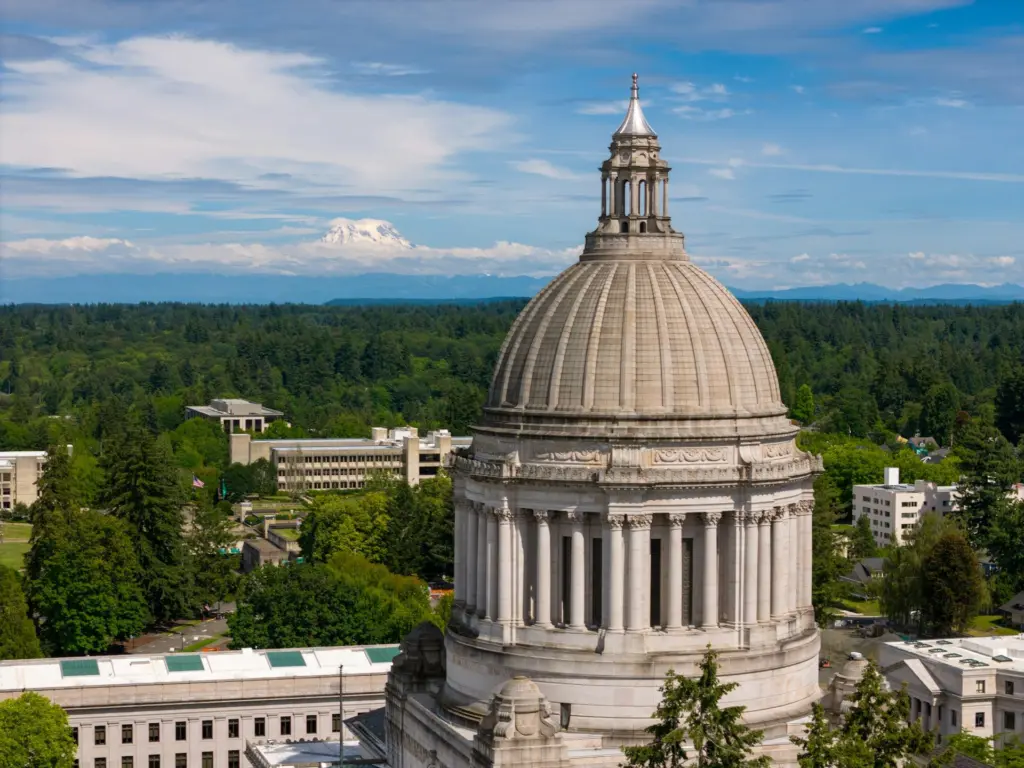
OLYMPIA, WA – Majority Democrats in Washington on Tuesday rolled out the much-anticipated income tax bill.
Senate Bill 6346, with Senate Majority Leader Jamie Pedersen, D-Seattle, as the prime sponsor, is being called by supporters the ‘millionaire’s tax’ as it’s a 9.9% tax on income over one million dollars.
Opponents say while it may start out as a tax only on millionaires, it will expand eventually to a tax on all Washingtonians.
“I think that goes absolutely in the wrong direction on affordability,” said Sen. Minority Leader John Braun, R-Centralia, during a Tuesday media availability. “It’s an attack on small and medium-sized businesses and they’re going to damage our economy, and ultimately, set the stage for driving up affordability for everyone.”
The measure’s introduction is certain to spark immediate heated debate and, if it passes, legal challenges and ballot measures to potentially repeal it are expected.
During Tuesday’s Democratic media availability, Rep. Joe Fitzgibbon, D-West Seattle, the House Majority Leader who has sponsored the House version of the income tax, said the constituents in his district are among the wealthy who will pay the tax.
“Those folks are really uncomfortable with hurting poor people so that they can save some extra money on their taxes,” said Fitzgibbon. “We have a broken upside-down tax system that we have been stuck with for 90 years. We have a generational opportunity in front of us to change that trajectory.”
Most of the money generated from the tax would go into the state general-fund budget, with 5% of the proceeds going into a new fund to help counties cover rising public defender expenses.
It is projected to generate approximately $3 billion to $4 billion annually for government services, K-12 education, health care and human services.
“Contrary to claims by the majority and the governor, initially that this would involve significant tax reductions of regressive taxes currently in place in Washington, [there are] almost no tax reductions of any means,” said House Republican Leader Drew Stokesbary, R-Auburn.
He noted the bill includes a carve out for large companies in ending a Business and Occupation surcharge a year early.
“And some other very minor tax cuts for a few others. It adds up to less than 5% of the total revenue collected by this tax bill,” Stokesbary said. So, this is not living up to their promises.”
When Governor Bob Ferguson initially voiced support for the income tax, he said he would only get behind a bill that included significant tax savings for most Washingtonians.
“I appreciate the hard work that went into drafting this initial proposal. It’s a good start, but I cannot support it in this form,” Ferguson said in a statement.
“I have repeatedly insisted that a significant percentage of the revenue generated by the Millionaire’s Tax must go back into the pockets of Washingtonians to make life more affordable. This proposal does not come close to doing that,” he said.
Fitzgibbon told reporters Tuesday he was “a little surprised” at Ferguson’s statement, given leadership was meeting with the governor late Monday, but added the final version of the bill that reaches the governor’s desk will not be the same bill they introduced.
The Washington Roundtable, Association of Washington Business, Bellevue Chamber of Commerce, Seattle Metropolitan Chamber of Commerce, and Greater Spokane Inc. issued the following joint statement in response to the income tax measure.
“As leaders representing employers of all sizes across Washington state, we are carefully reviewing the income tax proposal introduced today. Though framed as a personal income tax, this legislation has clear and significant implications for business activity. We appreciate its complexity and are committed to thoroughly evaluating its details and assessing its full impact on Washington’s economy.”
Fitzgibbon said he does not believe the income tax will deter new businesses from setting up in Washington.
“If you look at the other states that have thriving tech sectors, California, Massachusetts, Colorado, Oregon, New York, New Jersey, Virginia, they all have income taxes,” he said. “We are an outlier in not having one. I think Washington’s competitive advantage lies in the fact we have a high quality of life. This is a desirable place to live.”
During the Tuesday Republican media availability, Sen. Drew MacEwen, R-Shelton, was asked what he thinks is the worst part of the income tax bill.
“I would say the whole bill. I think it just flies in the face of the will of the voters,” MacEwen said. “This is a non-starter for us.”
Pedersen said his bill is scheduled for a public hearing at 1:30 p.m. Friday, Feb. 6, in the Senate Ways and Means Committee.
Fitzgibbon says his bill on the House side likely won’t be the vehicle for getting the income tax passed.