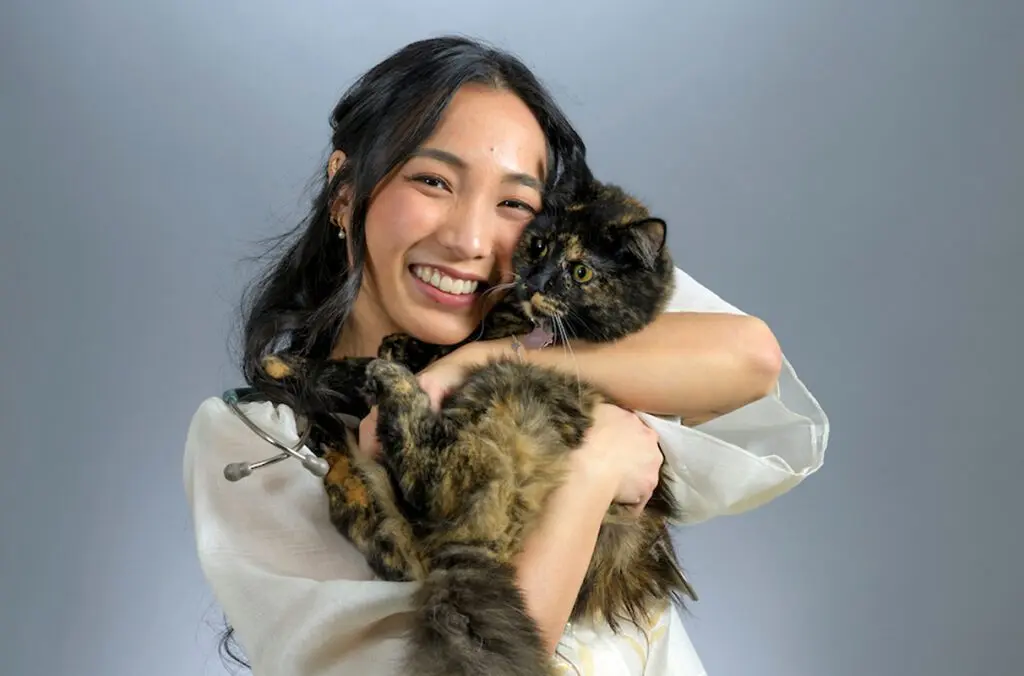
PULLMAN, WA – Children who had never considered college a possibility are now aspiring to careers as veterinarians, scientists and scholars thanks to the efforts of Washington State University veterinary student Anjelica Bautista.
Now in her second year of WSU’s intensive four-year Doctor of Veterinary Medicine program, Bautista devotes much of her time outside of the classroom to introducing grade-school students in Pasco, Washington, to STEM fields, expanding their understanding of higher education and showing them futures they never realized possible.
For her efforts, she was recently recognized with a prestigious Merck Animal Health Diversity Leadership Scholarship, a competitive $10,000 award presented to veterinary students who demonstrate exceptional leadership in advancing inclusion at Association of American Veterinary Medical Colleges member institutions.
The honor recognizes her campus leadership in equity-focused initiatives, commitment to increasing representation within veterinary medicine and efforts to create pathways for students who have historically been excluded from the profession.
“Promoting equity begins with challenging the barriers that keep talented students from entering the field,” said Bautista, who spent much of her childhood living with her grandparents in the Philippines. “This starts with ensuring kids can see people who look like themselves in fields they dream of going into — helping them recognize career opportunities they never thought were possible.”
Promoting equity begins with challenging the barriers that keep talented students from entering the field.
Anjelica Bautista, veterinary student
Washington State University
Bautista began volunteering with youth in Pasco in 2019, soon after earning her undergraduate degree and accepting a chemist position with the U.S. Department of Energy at the Pacific Northwest National Laboratory in Richland, Washington. While Richland is home to one of the most highly educated populations in the state, just across the Columbia River, Pasco’s schools have some of the lowest testing scores. More than 80% of the students in the Pasco School District are minorities, including many who live in economically disadvantaged households.
“When I worked at the lab, I saw our outreach efforts were concentrated in Richland with students who were already college-bound,” Bautista said. “I started taking some of the resources and going to Pasco.”
Now that she’s moved on to WSU, that work hasn’t stopped.
Sometimes it’s as simple as making introductions. Bautista helped link youth in a Pasco robotics club with WSU archaeologist John Blong, who in turn spent time coaching and mentoring the students. The team recently advanced to a state level competition and one of its members is now hoping to pursue a career in archaeology.
She also looks for creative ways to spark curiosity. When Día de los Muertos — a Mexican holiday honoring and remembering those who have died — was approaching, Bautista worked with Dr. Steve Lampa, who leads anatomy labs for WSU veterinary students and directs the Worthman-Johnson Veterinary Anatomy Teaching Museum, to borrow anatomy specimens for an educational presentation in Pasco.
“All of a sudden you have these kids getting excited and interested in these subjects,” Bautista said.
Many of the students she meets grow up around animals and are familiar with agricultural work, yet few see veterinarians who share their backgrounds. Even fewer have ever considered the profession as a possibility, but now students who once imagined futures as ranch hands are picturing themselves as veterinarians.
“The smallest shift in mindset can make such a difference,” Bautista said. “For many of these kids, their parents didn’t go to a university. Some don’t even know what a university is, but when you expose them to it and treat them like they are capable of going, it changes everything.”
Bautista has also piloted a bilingual reading incentive program that rewards students who show the most growth with a field trip to WSU. She hopes the experience — touring campus, visiting the Veterinary Teaching Hospital and meeting faculty — will help students envision themselves in higher education.
Her commitment to access extends beyond Washington. Bautista and her mother have built an animal shelter in the Philippines that will provide spay and neuter services, community resources and hands‑on learning opportunities. Bautista said her passion for spay and neuter services was heavily inspired by WSU alumna Dr. Heather Rae (’14 DVM), who is currently practicing in Kennewick, Washington.
This summer, a group of WSU veterinary students will volunteer at the shelter. Bautista hopes the experience will expose students to new cultural contexts and deepen their understanding of the complexities of global veterinary care.
“We need more veterinarians who understand different cultural contexts and the real-world barriers people face when it comes to animal care,” Bautista said. “Pets are part of families across all communities, and access to care matters.”
Bautista is currently raising money for the shelter by selling her artwork, including ceramics created in her Pasco studio, where she is designing a mosaic that supporters can help build piece by piece.