BOISE, ID – With tensions ratcheting up in the Idaho State Capitol in Boise, the co-chairs of the Legislature’s budget committee are defending new across-the-board cuts the committee approved last week.
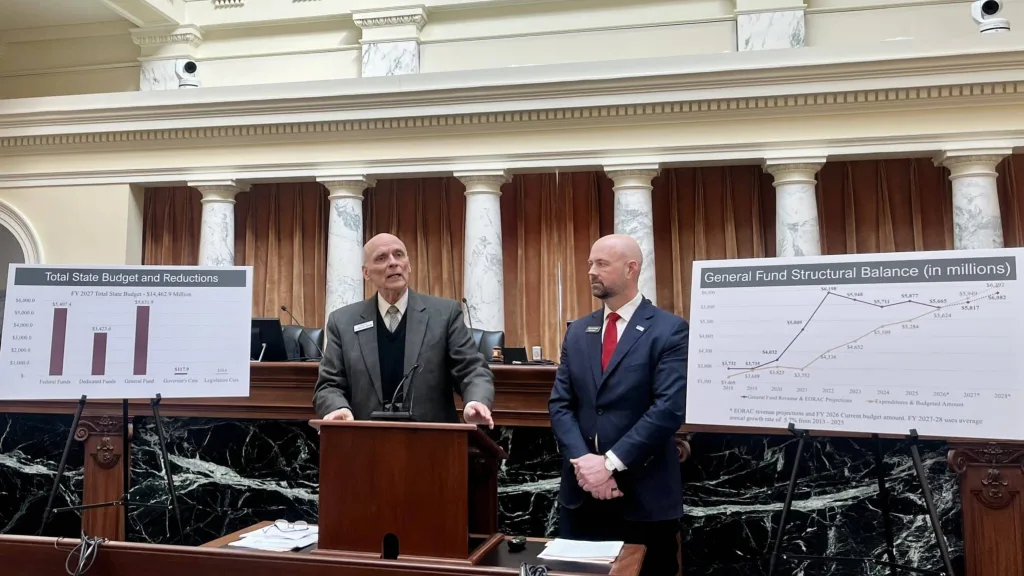
Sen. Scott Grow and Rep. Josh Tanner, both Republicans from Eagle, conducted a press conference Thursday in response to what they said is growing angst over new budget cuts that state agency directors and officials have said can do long-term, structural damage to core services and programs the state provides.
Grow and Tanner serve as the co-chairs of the Idaho Legislature’s Joint Finance-Appropriations Committee, or JFAC, which sets every budget for every state agency and department.
“Our goal is to have ongoing revenue match ongoing expenses,” Grow said. “When you start dealing with one-time (fixes and transfers), then we put ourselves in jeopardy.”
Why is Idaho looking at state budget cuts?
Concern over the state budget and state revenues have dominated the first 40 days of the 2026 legislative session, which started Jan. 12.
The budget issues first surfaced last summer, well before the legislative session. In response to revenue shortfalls, Idaho Gov. Brad Little ordered 3% cuts last summer to all state agencies – other than K-12 public schools – to avoid a potential budget shortfall.
Amid concern over cuts, Idaho Gov. Brad Little says setting the budget is the Legislature’s job
Fast forward to the 2026 legislative session, and JFAC approved additional cuts of 1% and 2% for most state agencies, which are on top of Little’s cuts.
JFAC passed the new cuts after the Idaho Legislature passed a law that complies with most of the tax cuts President Donald Trump championed in the federal One Big Beautiful Bill Act and implements some of the cuts retroactively.
Tanner and Grow said uncertainty over the cost of conforming to Trump’s tax cuts and uncertainty over state revenues are driving the need for the new cuts. They also referenced the Idaho Constitution’s prohibition against spending more money than the state collects in revenue.
“That’s what we should continuously try to do,” Tanner said. “Bringing government under control is some of the hardest jobs to do.”
Tanner and Grow also used their press conference to push back against Little and try to reclaim some of the narrative surrounding the budget cuts. The co-chairs said Little’s initial 3% cuts are what caused Idaho to reduce reimbursement rates for providers who treat Medicaid patients by 4% and eliminate peer support services for people with severe mental illness.
Are there alternative proposals to avoid new budget cuts?
Tanner and Grow called their press conference at a significant juncture in the 2026 legislative session.
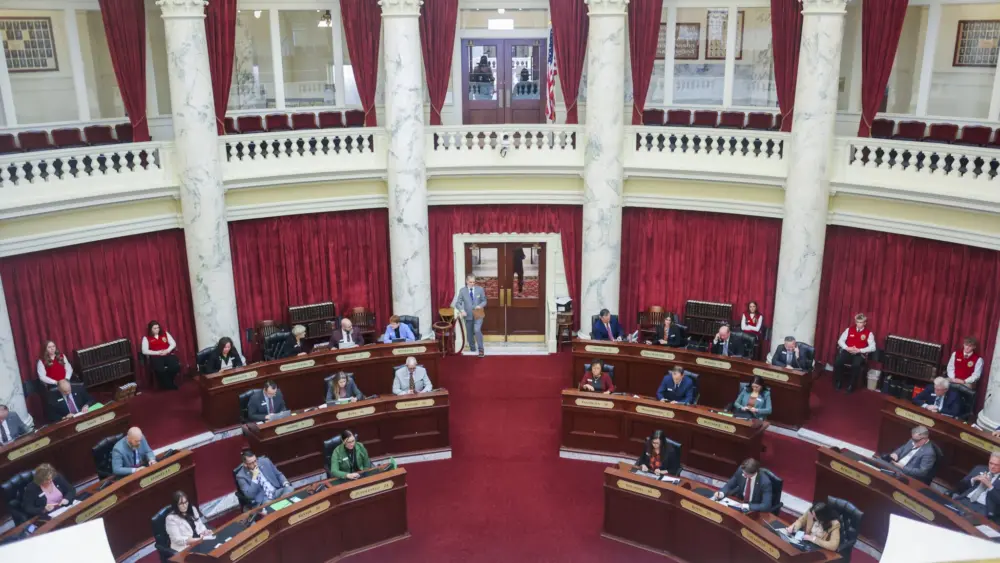
The debate over the cuts is moving from the budget committee level to the full Idaho House of Representatives and Idaho Senate, which still must vote on the budgets.
A recent series published by the Idaho Capital Sun found that the additional new cuts would endanger the state’s crisis response system, lead to hiring fewer state wildland firefighters and increase wildfire risk, jeopardize mental health court and treatment courts that have helped thousands of Idahoans turn their lives around, lead to less water quality monitoring and more.
New state budget cuts could hinder Idaho’s ability to fight wildfires, increase safety risk
Meanwhile, there is growing division within the Legislature and multiple perspectives on how to handle the budget.
Gov. Little and his budget chief, Lori Wolff, opposed the additional new cuts, which they say are not necessary because Little submitted a plan with the State of the State address in January to balance the budget using a combination of one-time cuts, fund transfers and interest transfers. Wolff, in particular, has vocally warned against cutting too deep, too soon – saying cuts could cripple essential services and take years to grow out of in a healthy economy.
Idaho Democrats also oppose the additional new cuts, saying the Republican-controlled Legislature created the budget crunch by passing a combined $4 billion worth of income tax cuts that reduced state revenue over the past five years. Democrats have publicly put forward a plan to avoid the budget cuts by withdrawing about $533 million from rainy day savings accounts to stabilize the state.
Idaho Gov. Little’s budget director asks JFAC to restore funding for some services that were cut
Tanner and Grow oppose the proposal to dip into savings accounts, saying that Idaho’s economy is healthy and the state shouldn’t spend vital reserve accounts in a healthy economy. Tanner and Grow maintain that Idaho has a spending problem that they are addressing through the additional new cuts.
However, budget documents presented to JFAC last fall show that – when adjusting for inflation and Idaho’s population growth – state spending has essentially remained flat for 21 years. Between fiscal year 2005 and fiscal year 2026, the general fund portion of spending in the state budget increased by an average of just 0.4% per year when adjusted for population growth and inflation, state records show.
Inflation Adjusted Per Capita Spending
What is the timeline of Idaho’s budget cuts?
While budget cuts and revenues have dominated much of the debate during this year’s legislative session, all of the moving pieces can make it difficult to keep track of.
The following timeline includes key dates for fiscal years and important legislative action that has happened so far.
To better understand the cuts and when they will apply, it is important to know that Idaho runs on a fiscal year calendar that begins July 1 and ends June 30.
- Fiscal year 2026: started July 1, 2025, and ends June 30. For fiscal year 2026, most state agencies face a total state budget cut of 4%.
- Fiscal year 2027: begins July 1 and ends June 30, 2027. Most state agencies face a total state budget cut of 5% for fiscal year 2027.
- Jan. 12: The 2026 legislative session begins and Little issues a proposal to balance the state budget through a mix of one-time cuts, funds transfers and interest transfers.
- Feb. 6: JFAC passes the fiscal year 2026 Budget Rescission Act, which includes 4% cuts for most state agencies.
- Feb. 13: JFAC took action to pass budget cuts totaling 4% for most state agencies for the current fiscal year 2026 and totaling 5% for most state agencies in fiscal year 2027.
- Feb. 20: JFAC is scheduled to continue budget setting, including considering supplemental funding to help the Idaho State Tax Commission conform to the federal “Big, Beautiful” tax cuts.
The fiscal year 2026 and fiscal year 2027 cuts that JFAC approved will be sent next to the full Idaho House of Representatives and Idaho Senate to be voted on, but it wasn’t clear Thursday when those votes will take place.
When reporters asked when the 2026 budget rescission act and the 10 fiscal year 2027 maintenance of operations budgets with the cuts will be introduced, Grow said said those details are still being negotiated with House Speaker Mike Moyle, R-Star, and Senate President Pro Tem Kelly Anthon, R-Rupert.
When they do reach the House and Senate, it will take a simple majority vote from legislators present to pass the rescission act and the maintenance of operations budgets.
If the full House and Senate pass the rescission act and the maintenance of operations budgets, they would then go to the governor’s desk for final consideration.
Once they reach his desk, Little will have five days to sign them into law, veto them or allow them to become law without his signature.
Idaho Capital Sun is part of States Newsroom, a nonprofit news network supported by grants and a coalition of donors as a 501c(3) public charity. Idaho Capital Sun maintains editorial independence. Contact Editor Christina Lords for questions: info@idahocapitalsun.com.