Lolo National Forest example of where flexibility seen for ‘roadless’ acres
ROCK CREEK, MT — Punch more roads through the forest, and you’ll get more people starting fires, fewer bull trout and an even heftier maintenance bill.
Keep the 2001 Roadless Rule in place, and you’ll ensure elk have a healthy habitat, and you’ll still be able to reduce wildfire risk.
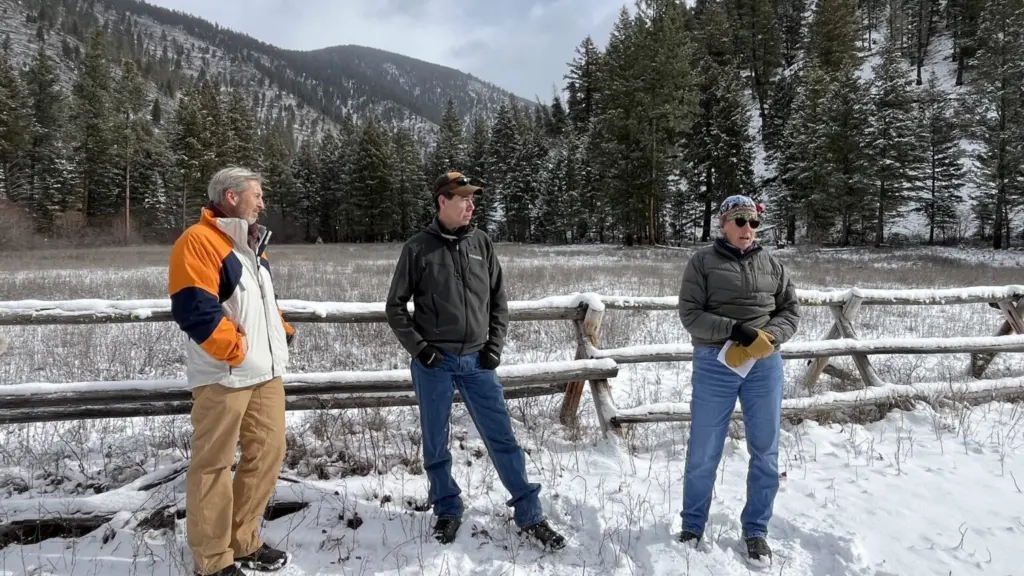
Those were some of the arguments former U.S. Forest Service employees made Friday at the edge of the Silver King Inventoried Roadless Area east of Missoula.
Montana Trout Unlimited and the Montana Chapter of Backcountry Hunters and Anglers hosted the event as the Trump administration takes steps to repeal the 2001 Roadless Rule.
The rule prohibits building roads and harvesting timber on 30% of Forest Service land in the country, or 60 million acres. In Montana, that’s 6.4 million acres, or 37% of Forest Service land in the state.
In June, the U.S. Department of Agriculture, parent agency of the Forest Service, announced plans to rescind the rule, enacted at the end of the Clinton administration.
Secretary of Agriculture Brooke Rollins said doing so would help protect communities from fires, remove “burdensome” regulations, and help create productive forests.
A comment period in the fall resulted in 223,000 comments, with 99% opposed to repealing the rule, according to Trout Unlimited and Backcountry Hunters and Anglers.
Opponents of the rule, including Republican politicians from Montana, have argued it’s outdated and hamstrings forest managers’ abilities to do their jobs in a landscape that’s changed.
Proponents of the rule, including the groups that participated in the media event at Rock Creek, said the “roadless rule” is sometimes misunderstood, and it’s been effective for ensuring land is productive for wildlife and to protect social values.
They also noted it came to pass in 2001 after public meetings across the country.

At the time, the Forest Service held more than 600 public meetings, including 34 in Montana, the groups said. This time, it has no public meetings scheduled, so the groups also are putting on seven public meetings in Montana in March.
Jeff Lukas, with Montana Trout Unlimited, said roadless areas are some of the most productive for fish and wildlife habitat, and they support clean water and offer social and economic benefits.
“The rule is vital to protecting the backcountry experiences so many Montanans enjoy,” Lukas said. “It helps ensure good habitat for deer, elk and fish, it protects clean drinking water, and contributes to our quality of life in Montana.”
The rule still allows the Forest Service to plan timber harvests and fuel reductions, but it does so while upholding values Americans have expressed as a priority, such as preserving natural scenery and offering a place to get away, rule proponents said.
Brian Riggers, former Region 1 Roadless Coordinator for the Forest Service, said in his six or seven years working in roadless areas, he ran into few people who didn’t value those unique, untrammeled landscapes.
“Most people have sort of a heartfelt connection to those places,” Riggers said.
But he said those hunters, anglers, backpackers, even people just driving along and enjoying the view, don’t always know much about how the rule works.
And he said it’s important to know because once you develop an area, you can’t go back.
“The rule provides for science-based conservation of the characteristics that make unroaded areas unique — high water quality and wildlife habitat, scenic integrity, remote recreation opportunities and buffers” from more developed areas, Riggers said.
At the same time, Riggers said, the rule is flexible. If a fire is imminent, and a road is needed in an emergency, the rule won’t prohibit it.
“I’ve not seen any fire projects not allowed to move forward due to the rule,” Riggers said.
Montana’s congressional delegation has supported the repeal of the “roadless rule,” as has Gov. Greg Gianforte, all Republicans. They argue it gives the federal agency more tools to manage the forest and helps rural economies.
Riggers said the rule was born out of controversy and was meant to help resolve it.
In the past, Riggers said, every time the Forest Service would propose a project, people would fight about it, and the rule was meant to help eliminate individual fights and provide a framework that would take care of people’s concerns for the long term.
The group spoke near the Tyler’s Kitchen Fuels Reduction and Forest Health Project to point out the “roadless rule” in action, an example of the exceptions the rule offers to actively manage forests.
Finalized by the Lolo National Forest in December, the Tyler’s Kitchen project includes a timber harvest, a prescribed burn and thinning on more than 2,000 acres to reduce wildfire risk and improve the forest.
Speakers noted the benefits of the rule, but they also pointed to problems with roads on Forest Service land and the idea of building more roads.
For one thing, roads cost money, and the Forest Service doesn’t have the dollars to pay for maintenance on the ones already built, said Riggers — the cost of the backlog is $6.4 billion nationally, according to Pew Charitable Trusts.
Roads also hurt fish, said Shane Hendrickson, a fish biologist who formerly worked for the Forest Service. In fact, he said, roadless areas are “imperative” for native fish species, such as bull trout, which need clear cold water to survive.
Cutting roads into forest land “drastically” affects the watershed, taking away its resiliency, he said. He said protected bull trout aren’t present in waterways in roaded areas in a sustainable way.
Some politicians argue roads are needed to increase fire responsiveness, but Julie Shea, a former fire planner for the Forest Service with 39 years and 10 months of service, said she doesn’t wholly buy the argument.
Some places that already have roads aren’t accessible for fire anyway depending on the terrain, she said. Also, especially in the West, more than 75% of fires are caused by humans, so more roads could mean more fires in the places they’re built, she said.
The main thing, though, is the rule represents the will of the people, and people are smart, Shea said.
The recent Conservation in the West poll showed 84% of voters believe the rollback of laws that protect land, water and wildlife is a serious problem.
“It’s about the right of all Montanans and United States citizens to have a voice,” Shea said.
Public meetings
Montana Trout Unlimited and the Montana Chapter of Backcountry Hunters and Anglers are organizing public meetings to hear from the public on the rescission of the “roadless rule.”
The meetings are scheduled as follows:
- Kalispell: 6-7:30 p.m. Wednesday, March 4, Flathead Valley Community College AT-139 (Arts and Technology Building)
- Libby: 6-7:30 p.m. Thursday, March 5, K.W. Maki Theatre, 724 Louisiana Ave.
- Missoula: 6-7:30 p.m. Monday, March 9, Missoula Public Library, Cooper Space A/B
- Hamilton: 6-7:30 p.m. Tuesday, March 10, Rocky Mountain Grange #116, 1436 South 1st St (Hwy 93)
- Butte: 6-7:30 p.m. Wednesday, March 11, Butte Archives, 17 W Quartz St
- Bozeman: 6-7:30 p.m. Thursday, March 12, Gallatin Valley Fairgrounds, Exhibit Building #2, 901 N Black Ave.
- Helena: 6-7:30 p.m. Friday, March 13, Holter Museum of Art, 12 E Lawrence St
Daily Montanan is part of States Newsroom, a nonprofit news network supported by grants and a coalition of donors as a 501c(3) public charity. Daily Montanan maintains editorial independence. Contact Editor Darrell Ehrlick for questions: info@dailymontanan.com.