WASHINGTON, D.C. – Nearly two decades ago, progressives fought to include a so-called public option — a government-run health plan — in the broad health care overhaul known as Obamacare. That effort failed, defeated by heavy lobbying from the insurance industry and opponents who decried it as a government takeover of health care.
But the final Affordable Care Act, which President Barack Obama signed in 2010, didn’t bar states from adding a public option plan to their state-run insurance marketplaces. In recent years, several states have done so — and others might follow as rising health care costs, the expiration of federal subsidies and Medicaid cuts make coverage less affordable and available for millions of Americans.
This year Nevada became the third state, after Colorado in 2023 and Washington in 2021, to add a public option plan to its marketplace. So far, 10,762 people have signed up, according to figures provided by the Nevada Health Authority.
The goal of such efforts, said Christine Monahan, an assistant research professor at the McCourt School of Public Policy at Georgetown University, is to provide an alternative to profit-driven private insurance companies, “and to give people an option that doesn’t have that kind of capitalistic incentive in place.”
Some states are helping to make Obamacare plans more affordable
The results so far have been mixed, however. It’s still too early to say whether the states’ public option plans, which are public-private partnerships rather than purely government-run, will significantly lower costs for consumers or pay enough to providers to ensure their continued participation.
Meanwhile, other states’ efforts to create public options have stalled. In 2024, Minnesota delayed the creation of a public option amid concerns about the lack of a dedicated funding source. Efforts in Maine and New Mexico also have faltered.
“It’s really too early to see what the right combination of design of a public option is,” said Andrew Shermeyer, a doctoral candidate in health policy at the University of Minnesota and the author of a study on the Colorado plan. “We don’t know what works and what doesn’t. So that’s a real challenge for policy makers.”
Different approaches
As public-private partnerships, the public option plans in Washington, Colorado and Nevada rely on the participation of private insurers as well as health care providers. And they have to compete for customers with the purely private plans offered on the exchanges.
“We all know health insurance is extremely, extremely unaffordable and expensive. So the challenge behind it is you have to find something that’s attractive to consumers,” Shermeyer said. “You have to find something that insurers will comply with, and you have to find something that providers will feel adequately compensated for.”
States have used a combination of carrots and sticks to make sure those things happen.
In Washington state, private insurers that sell plans on the state marketplace can choose to offer the public option plan, which is called Cascade Select, but they don’t have to. To keep costs down and premiums low, the state mandates that participating insurers pay providers within a certain range.
In the first two years that Cascade Select plans were available, many providers were unwilling to participate. So in 2023, Washington began requiring that hospitals contract with at least one public option plan. The change has expanded the availability of Cascade Select plans — as of last year, they were available in every county — and boosted enrollment: Last year, about 30% of Washingtonians who purchased coverage on the marketplace enrolled in a Cascade Select plan, up from 1% in 2021.
We don’t know what works and what doesn’t. So that’s a real challenge for policy makers.
– Andrew Shermeyer, researcher at University of Minnesota
Laura Kate Zaichkin, director of market competition and affordability at the Washington Health Benefit Exchange, said that figure is up to 40% this year. In 2021, Zaichkin said, Cascade Select premiums were a bit higher than for many other plans on the exchange. This year, they are about $100 per month cheaper, she said.
Zaichkin said the public option is more important than ever, because of the recent expiration of federal tax credits that had dramatically lowered the costs of purchasing marketplace coverage, as well as looming Medicaid cuts.
“I would say that it is a really important lever,” she said. “It always has been, and it is even more so right now, when individual market coverage is under threat and when customers cannot afford their premiums.”
Unlike in Washington, every private insurer that participates in Colorado’s marketplace must offer versions of the state’s public option plan, which is called the Colorado Option, in every county where it sells its own plans. Colorado Option plans all offer the same benefits across insurance carriers, so companies compete based on premiums, their networks of providers and customer service.
To keep premiums relatively low, participating health insurers are required to negotiate with providers to keep costs down. If state regulators think premiums are getting too high, they can take charge of the negotiations and mandate that hospitals or providers lower their reimbursement rates.
About 14% of marketplace enrollees chose the Colorado Option in 2023 when the plan launched. In 2025, the public option accounted for nearly half of the roughly 282,500 enrollees on the exchange, the state said.
Far fewer people buy Obamacare coverage as insurance premiums spike
But Julie Lonborg, senior vice president and chief of staff of the Colorado Hospital Association, said limiting payments to providers could end up reducing services and access to care for patients.
“Overall, enrollment continues to grow in the program, so it is having some success from the purchasers,” Lonborg said in an email. “But it is built on a fundamentally flawed policy of rate setting on hospitals that will result in consequences. Hospitals have felt pressured into rate reductions at a time when threats to health care funding are escalating.”
One of the arguments for a public option is that it introduces competition that pushes down premiums for all marketplace enrollees, no matter what plan they choose. But in his study of the Colorado marketplace, researcher Shermeyer said the Colorado Option only lowered premiums for people who were receiving the federal subsidies; unsubsidized enrollees saw higher prices compared with people living in other states.
Kyla Hoskins, a deputy commissioner who oversees the Colorado Option program at the state’s division of insurance, disputes that finding. Hoskins cited other research that found premiums across the state, even for private plans, declined by more than $100 after the Colorado Option was introduced.
She said more people are buying the Colorado Option plan because it’s more affordable and because of its simplicity.
“Your deductibles, your maximum out-of-pocket costs, the amount you pay when you see your primary care [provider] or fill a prescription — that cost sharing is the same no matter which health insurance company is offering the plan,” Hoskins said.
“And I think that clarity that standardization provides, has been a value to consumers,” Hoskins said.
Slow start in Nevada
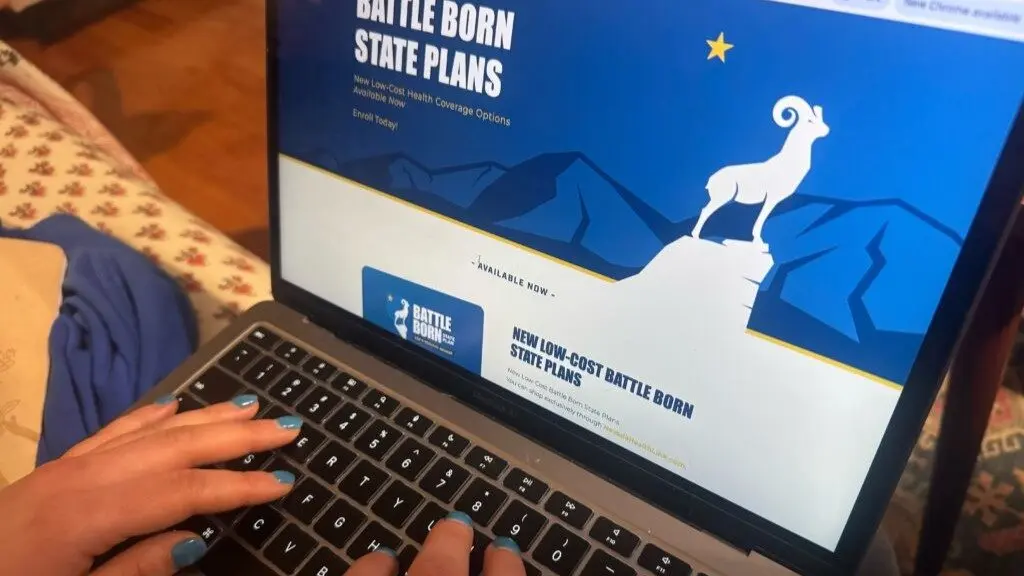
Like in Washington, insurers in Nevada don’t have to offer a public option plan, called Battle Born State Plans (after the state’s nickname). However, the state has given them a strong incentive to do so by tying it to Medicaid.
Around 75% of Nevada’s Medicaid enrollees receive coverage through managed care. In order to remain eligible for Medicaid managed care contracts, insurers have to submit a bid to offer a public option plan that meets certain requirements.
Health insurance will cost more for millions of Americans — especially rural residents
Those Medicaid contracts are worth “millions if not billions to carriers,” said Stacie Weeks, director of the Nevada Health Authority, which oversees the state’s Medicaid program and its insurance marketplace. “Essentially, this new contractual arrangement leverages the state’s purchasing power with its Medicaid carriers to get a better deal for consumers in the private market.”
To ensure the participation of providers, Nevada’s law requires them to be in-network with at least one public option plan to remain eligible for Medicaid, public employee and workers’ compensation payments, according to the Century Foundation, a liberal-leaning think tank. Instead of regulating reimbursement rates, Nevada hopes to keep premiums low by mandating that they be at least 5% below those of private plans.
Nevertheless, enrollment has been slower than expected.
State officials predicted that around 35,000 people would sign up in the first enrollment period. The actual number is less than a third of that. And so far, only three out of the state’s eight health insurance companies on the state’s exchange have picked up the plan.
“We expect to see this number grow over time as public awareness increases and as Nevadans continue to seek quality coverage options that help reduce their monthly costs, regardless of their income,” Weeks said. She added that many Nevadans automatically reenrolled in their previous health plans, and may not know about the public option yet.
Stateline reporter Shalina Chatlani can be reached at schatlani@stateline.org.
Stateline is part of States Newsroom, a nonprofit news network supported by grants and a coalition of donors as a 501c(3) public charity. Stateline maintains editorial independence. Contact Editor Scott S. Greenberger for questions: info@stateline.org.