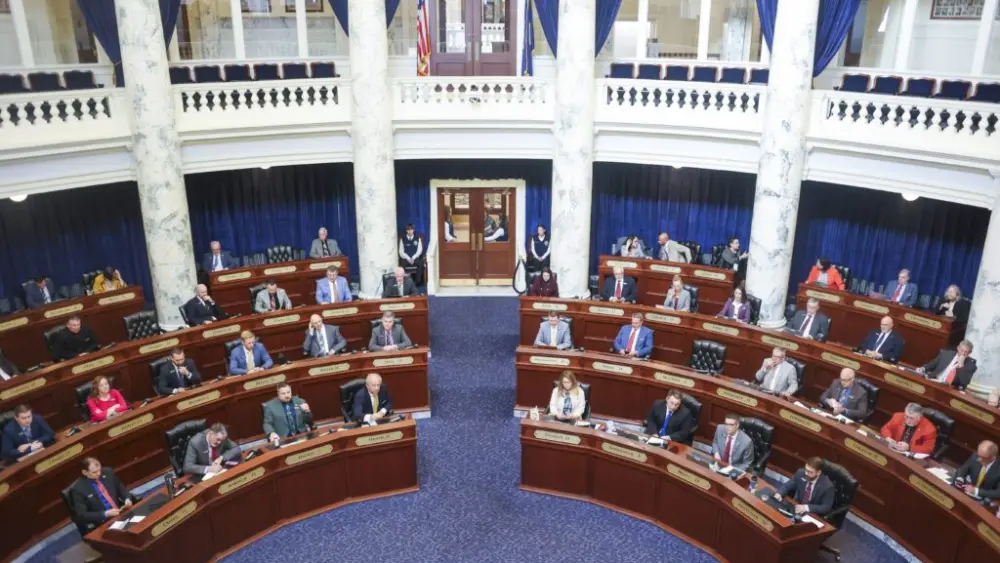
The 2026 short session that began in early February ended on Friday in a flurry of final votes that will impact Oregonians in every corner of the state
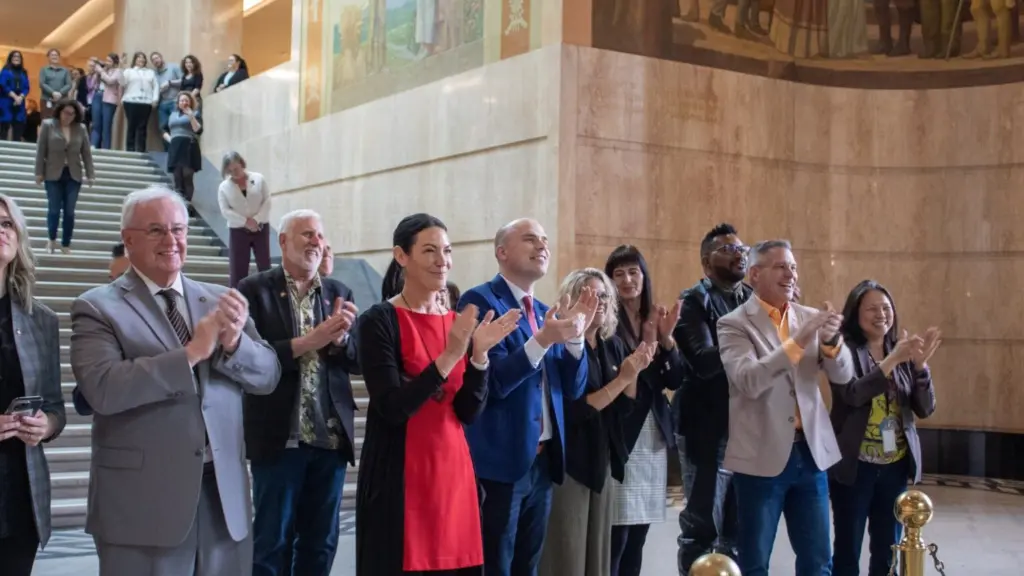
SALEM, OR – For the first time in years, Oregon lawmakers in Salem’s newly-reopened Capitol streamed out of the chamber floors into the rotunda to cap the end of a short legislative session that had both Republicans and Democrats claiming victories.
Responding to the federal government’s aggressive deportation campaign, safeguarding access to and funding for reproductive and gender-affirming care and filling a budget hole caused by federal tax and spending changes topped the Democratic majority’s agenda this year.
“Senate Democrats have a simple focus: protect Oregonians’ values from Donald Trump’s administration, lower costs for working families and keep the economy moving. I’m proud to report that what we did together was amazing,” said Senate Majority Leader Kayse Jama, D-Portland, in a Friday news conference following the end of the session.
Republicans, meanwhile, touted their success in gutting a wide-ranging gun bill and delaying, though not blocking, a bill to reschedule a statewide vote on transportation taxes.
“I can stand here today and say the thing I’m most proud of is that the Republicans stood strong, and we stood united as a caucus,” said House Republican Leader Lucetta Elmer, R-McMinnville. “In my four short years here, I haven’t seen us do that as well as we did this short session.”
Lawmakers also experimented with Oregon’s legal authority to strengthen the state’s decades-old, first-in-the-nation protections for immigrants, passing legislation to prevent law enforcement from wearing masks, safekeep sensitive data and empower individuals to sue officers who enter their homes without a judicial warrant.
In the meantime, Oregon legislators confronted at the beginning of the session a $650 million budget shortfall, in part due to tax cuts passed under last year’s GOP signature tax and spending law. Oregon is among a handful of states that automatically replicate federal tax provisions in state taxes. The practice left Democrats facing backlash from dueling business and progressive groups who sparred over whether to leave those tax breaks in place or completely end the practice of automatic connection.
The avalanche of complex legislation left lawmakers on both sides of the aisle frustrated and confused about their priorities by the end of the five-week session, despite adjourning two days before a constitutionally-mandated deadline. Leadership in Salem again failed to limit the number of bills lawmakers could reintroduce, watered down an ambitious gun control bill and revealed their highly-anticipated plan to temporarily keep the Oregon Department of Transportation afloat just ahead of the last week of the session.
“There might have been a little bit of confusion about what’s going on, but really it was just our ability to come together,” said Senate President Rob Wagner, D-Lake Oswego, of his colleagues in leadership. “I think the four of us as leaders, being able to have really good communication, understand that it’s important to put those values out there and see where you can come together.”

Legislators blew past a Feb. 25 recommended deadline from Oregon Secretary of State Tobias Read to sign into law legislation rescheduling a controversial gas tax referendum from November to May. While Democrats ultimately passed the rescheduling measure, opponents quickly filed separate state and federal lawsuits and it’s unclear when the vote will ultimately take place.
An effort to readjust the state’s campaign finance laws also drew the ire of good governance groups who accused the Legislature of shutting them out as lawmakers rushed wide-ranging technical amendments through both chambers.
“The goal of (the bill) that we passed is to ensure that those further conversations happen. And I think those conversations need to involve practitioners, folks like treasurers and other folks in a more active way in the actual Legislature themselves,” Fahey told reporters. “They have been involved in the secretary of state’s technical rulemaking process, but working through as the secretary of state starts to actually implement this law what are the issues that arise.”
Gov. Tina Kotek, meanwhile, returned to her newly open ceremonial office in the Capitol but made few public in-person appearances in Salem during the session compared to her predecessors, aside from a press conference and offering testimony on her priority legislation for economic development in the state as she appeals to business groups and seeks to strengthen her reelection campaign.
She also changed her tune on one of her signature pieces of legislation amid concern that the bill would further incentivize data centers in the state, supporting a year-long moratorium on a specialized tax break program that the centers often capitalize upon in urban and suburban Oregon.
“I have consistently since becoming governor, and did this when I was speaker of the house as well, met regularly with Republican leaders,” Kotek told reporters. “The difference this session is being able to do it in person in my conference room in this Capitol. So just the ability to know that people can pop down the hallway and have a meeting with me, it just creates a different environment.”
Transportation, guns see parallel fights
One of the most contentious issues this session was whether Democrats would reschedule when Oregon voters could have a say on a controversial 2025 law to raise the gas tax, vehicle registration and title fees and the payroll tax used for public transit. Republicans and some Democrats acknowledged moving the referendum vote to May could keep the measure off the same general election ballot as Democratic legislators and Kotek, who has faced intense scrutiny over her handling of the transportation package she championed last fall and polled among the most unpopular governors nationwide.
After quorum-denying Republican walkouts in the House and Senate and missing a Feb. 25 deadline to pass the bill, Democrats on Monday secured enough votes in the House to send the bill rescheduling the vote to May to Kotek’s desk.
Kotek signed it into law shortly after, but she and legislative Democrats were met with angry Republicans who promptly filed a lawsuit and alleged lawmakers were ignoring the 250,000 Oregonians who signed the petition to block those tax and fee hikes specifically asking for a November vote. A hearing in that case is set in Marion County Circuit Court next week, and another individual, Mary Martin of Klamath Falls, filed a similar lawsuit in federal court on Thursday.
Rescheduling the referendum didn’t make up for the $288 million the Oregon Department of Transportation needs to fill gaps in its current budget and to support operations at the beginning of the 2027-29 budget cycle. To cover those gaps without raising fees or taxes, the agency will leave 130 positions vacant.

Lawmakers on Friday also passed Senate Bill 1601 to repurpose funding for infrastructure improvement projects that haven’t yet begun and cut funding for marine and aviation projects, as well as efforts to make safer walking and biking routes for schoolchildren.
Some House Republicans also harkened back to an incident last year where Sen. Chris Gorsek, D-Gresham, raised his voice at Rep. Shelly Boshart Davis, R-Albany, during a joint transportation committee hearing. The Senate Conduct Committee this session cleared Gorsek of discrimination or harassment, but concluded he was disrespectful.
But Republicans saw an echo of that incident in a tense committee dispute between Rep. Thủy Trần, D-Portland, and Rep. Jason Kropf, D-Bend, over an ambitious package bolstering the rollout of a voter-approved gun law that raised questions over whether the state should be working with the FBI and federal government to share the information of diverse gun owners.
Republicans decried the legislation as yet another attack on gun rights in the state, and they staged a walkout ahead of a vote on the gun bill. They framed their walkout as a “pause” after what they described as Democrats sweeping an instance of a female legislator being targeted by a male colleague under the rug, though some acknowledged they were also trying to delay a vote on the transportation referendum schedule.
Senate Minority Leader Bruce Starr, R-Dundee, confirmed Friday that Republicans secured amendments from leadership in the Senate, which stripped the gun control legislation of any significant changes to the permit-to-purchase process while solely delaying the implementation of Measure 114 until 2028 as the Oregon Supreme Court decides whether to uphold the law. Voters originally approved the measure in 2022 by a narrow margin, and the measure’s authors are urging lawmakers to revisit the matter in the 2027 legislative session.

“I believe if that bill had been scheduled for a work session without a commitment to amend it, that there would not have been enough Republicans to operate and do business,” Starr told reporters.
New economic conditions after years of budget surpluses
Most Democratic Oregon lawmakers voted to disconnect some of the state’s tax code from the federal tax code to keep $291 million in revenue the state otherwise would lose by replicating federal tax cuts. Republicans, in turn, have threatened to send it to Oregon voters in November via a ballot referral, though they will be hard-pressed for time.
Coupled with several budget rebalance bills that cut spending on supplies and services, and that leave more than 130 jobs vacant at the Oregon Department of Transportation, Oregon lawmakers have closed what they said began as a $650 million budget deficit going into the session. The moves will spare the transportation agency from hundreds of layoffs during the next 18 months, until lawmakers can come up with more sustainable funding during the long session in 2027.
Social services and education funding were largely untouched, despite Democratic leaders warning they’d be among casualties of congressional Republicans’ tax and spending megalaw passed during the summer. Although new provisions in the law that shift many new costs for safety net programs to states will come with a high price tag, the state’s most recent revenue forecast showed more corporate income tax revenues helped soften the blow.
Campaign finance still unfinished
A controversial bill changing a 2024 law limiting campaign contributions passed with nearly two-thirds of lawmakers in both chambers, though none were happy about it. House Bill 4018 providing technical fixes to the 2024 law was necessary, lawmakers said, to ensure the Secretary of State’s Office can enforce political spending limits by January of next year. They also passed Senate Bill 1502 to require the secretary of state to report back with campaign finance ideas next year.
Opponents said HB 4018 was written with the input of business industry and union lobbyists while explicitly cutting out campaign finance reform advocates. Those activists had agreed in 2024 to shelve a ballot measure on political spending limits and to work with lawmakers on a legislative solution. Leaders from the groups have vowed to take the bill to Oregon voters in a ballot referendum in 2028 if Kotek signs it.
Kotek said Friday she was not involved in the bill negotiations and that she is still considering whether or not to sign it into law.
“I kept reminding people that we need to stay the course that was established in the 2024 session to establish contribution limits and not delay their implementation” she said, adding: “There are other things in that bill that I need to understand.”
Both chambers also hosted candidates for the GOP’s nomination for the governor’s race: Sen. Christine Drazan, R-Canby, and Rep Ed Diehl, R-Scio. Drazan, a former House Republican leader, managed to avoid the House’s rules restricting campaign fundraising during legislative sessions by taking the spot of former Senate Minority Leader Sen. Daniel Bonham, R-The Dalles. State records show her campaign has more than $1.2 million in the bank.
Diehl, meanwhile, earned a stern rebuke from Fahey for continuing to accept donations to his gubernatorial campaign during the session. However, Fahey has yet to offer a concrete punishment for the prominent conservative, who has pointed to legislative legal guidance suggesting the rule is unconstitutional. Diehl has more than $100,000 in campaign funds, according to records as of Friday.
Curtain call for several lawmakers
Along with Diehl and Drazan giving up their chances to run for reelection by running for governor, three Republican senators who participated in the longest walkout in state history in 2023 over bills related to abortion, transgender health care and gun rights cannot seek reelection this year. Sens. Cedric Hayden of Fall Creek, Kim Thatcher of Keizer and Suzanne Weber of Tillamook will finish their terms in January. Reps. Jeff Helfrich, R-Hood River, and Jami Cate, R-Lebanon, meanwhile, are leaving the House to run for vacant Senate seats.
Five retiring members of the House and one retiring senator, Democrat Jeff Golden of Ashland, wrapped the final floor sessions of their careers on Friday.
Rep. Rick Lewis, R-Silverton, retires after nearly a decade and Rep. Boomer Wright, R-Reedsport, wraps up his time in the Legislature after six years.
Rep. Annessa Hartman, D-Gladstone, who has been fighting stage 3 cervical cancer since the fall, will also wrap her time in the Legislature at the end of the year. Hartman has been mostly absent from the House floor while she undergoes treatment, but has said she’s fully committed to continuing her term in the state House and her campaign for an open seat on the Clackamas County Commission.
Rep. Ken Helm, a Democrat, will retire at the end of 2026 after 12 years representing the Beaverton and Cedar Hills area. And Rep. John Lively, D-Springfield, will retire after 14 years in office. The two are well known for bipartisan work on policies, and got teary on the floor thanking their colleagues for the collaboration over the years.
“I really enjoyed serving my constituents, working with a wide range of elected officials here,” Lively told the Capital Chronicle, “and I do feel very good about being respected, and respecting others, on both sides of the aisle.”
Oregon Capital Chronicle intern Robin Linares contributed to this report.
GET THE MORNING HEADLINES.
Oregon Capital Chronicle is part of States Newsroom, a nonprofit news network supported by grants and a coalition of donors as a 501c(3) public charity. Oregon Capital Chronicle maintains editorial independence. Contact Editor Julia Shumway for questions: info@oregoncapitalchronicle.com.