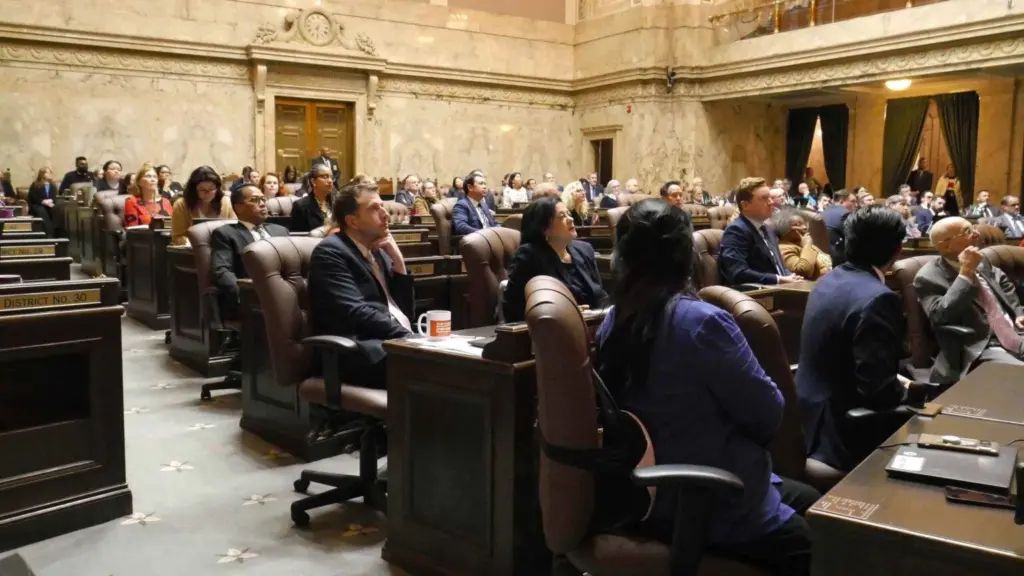
OLYMPIA, WA – It took over 24 hours of grinding floor debate, but Democrats in the Washington House approved an income tax Tuesday on households earning over $1 million a year.
The state is now closer to enacting a tax on wages than it has been in nearly a century.
For the bill to become law, it must first return to the Senate for agreement on changes before going to Gov. Bob Ferguson, who has said he’ll sign it. After that, challenges in court and at the ballot box are expected.
Powerless to stop a policy they despise, Republicans filibustered with a barrage of nearly 60 amendments, many decided with time-sapping oral roll call votes. Democratic lawmakers proposed nearly two dozen amendments of their own, further extending the clock on one of the longest debates on a single bill in recent memory.
But in the end, Senate Bill 6346 passed 51-46 with eight Democrats joining 38 Republicans in opposition. The final vote was cast at 6:10 p.m. Tuesday, concluding an unbroken stretch of floor action that began around 5:30 p.m. the day before.
Democratic dissenters
Listed below are the eight Democratic House members who voted against the income tax bill.
Dan Bronoske, Lakewood; Melanie Morgan, Tacoma; Adison Richards, Gig Harbor; Kristine Reeves, Federal Way; Clyde Shavers, Clinton; Joe Timmons, Bellingham; Alicia Rule, Blaine; Amy Walen, Kirkland
As the vote began, a wave of excitement rolled through the Democratic side of the House chamber.
A smiling Democratic Rep. Natasha Hill of Spokane said she was ready to cast an “epic” vote for the tax.
“Forty-one other states have an income tax. Red states, blue states, purple states. This is more progressive and fair than any of our neighbors,” she said in her floor speech.
Several Democrats cast the bill as a step toward reengineering a state tax code that forces lower-income residents to pay an outsized share of their income in taxes compared to the wealthiest.
“It has been a long journey here to this moment, not just the over 24 hours that we’ve spent on this floor debating this proposal, but the 93 years that Washingtonians have struggled with a grossly outdated tax structure that falls by far the heaviest on the lowest income,” said House Majority Leader Joe Fitzgibbon, D-West Seattle, one of the architects of the legislation.
There was no joy on the Republican side of the aisle as the vote neared.
Rep. Matt Marshall, R-Eatonville, said he could not face his constituents on this proposal.
“The people that have been opposed to this not only don’t feel their voice was heard, they see the joy about new taxes and they see no objective benefits,” he said. “We have lost the trust of the people. This is a dark day in Washington’s history.”
Republicans argued that an income tax is unconstitutional in Washington, that it would hurt families and businesses, and could one day be expanded to cover households earning less than a million dollars a year.
“While the title of the bill is a tax on millionaires, I believe it is a tax on Washingtonians.
It is just a matter of when we will be paying it,” said Rep. Joshua Penner, R-Orting.
They also pressed to give voters the chance this year to embrace or reject the transformational tax policy. Democrats rebuffed their efforts, leaving in place a so-called necessity clause pre-empting a referendum.
“This is like the granddaddy of taxes and the people should have a chance to weigh in,” said Rep. Ed Orcutt, R-Kalama, whose amendment would have automatically put it on the ballot in November.
After the vote, Ferguson, standing in the House wings, said it’s an “exciting day, you know, that’s an understatement obviously.”
“It’s not too often in this line of work that you have a vote that’s truly historic,” he told reporters. “By any definition, that’s what this was.”
Sen. Noel Frame, D-Seattle, a lead lawmaker on the bill, said after the House vote she saw no issues with the Senate concurring with the House changes.
Pulling an all-nighter
The legislation would impose a 9.9% levy on adjusted gross household income above $1 million a year. It would take effect Jan. 1, 2028, with tax payments due from an estimated 21,000 filers starting in 2029. The threshold would be adjusted for inflation every two years.
The income tax is projected to bring in between $3.5 billion and $4 billion annually.
Tuesday’s outcome was never in doubt, given Democrats’ near supermajority. How long it would take was the question. The end of this year’s 60-day legislative session is on Thursday.
Republicans first maneuvered to set the bill aside until a future session, saying there was a lack of time to thoroughly vet new provisions made public last Friday.
“What we’re considering is generational seismic change in tax policy. We shouldn’t be doing it at all and we shouldn’t be doing it at the very end of a short session,” said Rep. Travis Couture, R-Allyn, the lead Republican on the House Appropriations Committee.
Democrats defeated the GOP request on a party-line 58-38 vote.
From there, the two sides settled in for nonstop floor debate through the evening, overnight and all day Tuesday.
Unbending attempts at amending
One amendment Democrats did accept aims to prevent the tax from being levied on any household with an income below a million dollars. It clarifies a provision exempting the bill from the prohibition on new statewide personal income taxes that the Legislature adopted in 2024 is only effective “so long as the standard deduction is at least $1,000,000 for a household.”
Other agreed upon changes would exempt libraries from paying a new sales tax on services and give certain licensed health care services a break from a business tax surcharge.
Democrats rejected efforts to put the measure on the ballot for voters to ratify or reject, and to remove a clause at the end preventing a referendum. One of the amendments considered late Tuesday afternoon would’ve made the levy contingent on voters approving a change to the state constitution allowing for the tax. It was rejected on a 46-49 vote.
“The people of Washington have a right to know what’s in this bill. The people of Washington have a right to know what’s not in this bill and they have a right to decide,” said Rep. Peter Abbarno, R-Centralia.
Other failed proposals sought to reduce the state sales tax, lock in a large swath of funding for subsidized child care, earmark half of future tax proceeds for basic education, and double the income threshold to $2 million for couples filing jointly.
There were also attempts to commit 51% of tax receipts for the operating budget and 49% for tax relief for low-income families and tax breaks for businesses.
Other amendments aimed to provide a range of targeted carveouts, including for military pay, retiring farmers selling assets and small forestland owners logging trees.
Arguably, the most unique offering came from Rep. Alex Ybarra, R-Quincy, to prohibit the bill from going into effect until the NBA approves a team in Washington. It did not pass.
Tax history
If enacted, Washington would shed its status as one of nine states without an income tax on personal wages and salaries.
For the policy to go before voters, opponents will need to gather more than 300,000 signatures for a ballot initiative, double what’s needed for a referendum.
Republicans argued stridently that an income tax isn’t allowed under the state Constitution unless it is applied uniformly on all wage earners, pointing to a 1933 state Supreme Court ruling. That decision overturned a ballot measure creating an income tax voters passed the prior year.
That 1932 result was the lone time Washington voters have said “yes” to having the state tax one’s earnings. Voters last said “no” in 2010, rejecting a statewide initiative for an income tax on individuals with adjusted gross income above $200,000. That measure went down by a margin of 64% to 36%.
Democrats are confident the state’s high court will undo the 93-year-old legal decision. They’re also bullish on the tax’s prospects on the ballot, pointing to signals like voters in 2024 upholding a tax on capital gains.
Bill basics
Proceeds from the income tax are pledged to expand the state’s Working Families Tax Credit to cover people who are at least 18 years old, and make other eligibility revisions to open the program to more people. The credit is available to lower-income residents.
As proposed, it is estimated the credits, which range from $50 to $1,330 a year, would be available to 810,000 households, up from the current 350,000.
The bill earmarks 5% of annual tax proceeds for the state’s Fair Start for Kids Act. Starting in 2029, this would shore up financial support for child care and early learning programs facing cuts in the current budget.
There’s a slew of tax changes in the bill.
Companies grossing less than $300,000 a year will be exempt from paying the state’s main business tax. Sales tax for diapers, personal care products, like shampoo and deodorant, and many over-the-counter drugs will be eliminated.
Starting July 1, public schools would be exempt from paying a new state sales tax on services, including for live presentations, temporary staffing and security.
And most retail sales taxes lawmakers adopted last year on services will end on Jan. 1, 2029. A tax on advertising services that drew a lawsuit from cable giant Comcast would remain in place.
Money left over after covering the cost of tax breaks would be funneled into the state’s general fund, where it could be spent in other areas, such as public schools, higher education and health care.
Monday, on a bipartisan vote, the non-binding intent section was edited to make clear tax receipts would be used to increase state funding for public elementary and secondary schools. Originally, it said the intent was to “maintain and preserve” school funding. Education activists fumed at the idea that none of the proceeds would find their way into basic education.
This story first appeared on Washington State Standard.