OLYMPIA, WA – The Washington Legislature concluded its 2026 session Thursday evening after passing a batch of budgets and navigating late-breaking drama over the elimination of a data center tax break that threatened to throw lawmakers into a special session.
Sine Die for the 60-day sprint came around 8:30 p.m.
Passage of Democrats’ signature policy for the session, a tax on household income greater than $1 million a year, dominated conversation nearly every day. It gained final legislative approval in the Senate on Wednesday night, sending the bill to Gov. Bob Ferguson, who plans to sign it.
Democrats’ attempts to shield the state from what they consider to be overreach by the Trump administration were another key theme this year.
“The big objectives were to protect the state of Washington and our people against a hostile, malevolent federal administration,” said Senate Majority Leader Jamie Pedersen, D-Seattle. “We made pretty good progress on that.”
They used their majorities in the House and Senate to ban law enforcement from covering their faces, prevent the release of voter data, and ensure vaccine guidance is tied to recommendations from the state rather than the federal government.
“That was a great session, especially considering it’s a short session, especially considering the challenges we faced,” Ferguson told reporters.
But Democratic leaders also acknowledged they left pressing issues on the table to deal with next year.
These include regulating data centers, reforming the court system to address the state’s growing lawsuit payouts, funding public defense and potentially revisiting the model for public school funding. Ferguson added more money for constructing state ferries to that list.
For Republican minorities, the session was often an exercise in resistance against policies they deeply opposed.
They at times bogged down progress, heaping onto bills piles of amendments that stood no chance, but that devoured precious floor time. The most extreme example came with the income tax, which passed the House after one of the longest debates in the Legislature’s history.
The final day
In the last hours, lawmakers’ attention turned, mostly, to approving operating, transportation and construction budgets.
The $79.4 billion operating spending plan passed without any Republican votes. Democrats in the House and Senate both approved it over GOP objections and a number of Democratic defectors.
But not before a fire alarm led to an evacuation of the Capitol, delaying action further into the evening.
“Apparently, some people think this budget is alarming,” quipped Sen. June Robinson, D-Everett, the chief Senate budget writer.
Democratic budget writers negotiated the final details of that spending plan, which makes changes to the $77.8 billion two-year budget approved last year that covers state funding from July 1, 2025, to June 30, 2027.
It is precariously balanced through the combination of one-time maneuvers, a big withdrawal from the rainy day reserves and slashing of child care and early learning funding. And there is a $878 million budget hole lawmakers will need to confront next year.
Republicans say it sets the state on a trajectory for further budget problems in future years.
“This budget is a ticking fiscal time bomb,” said Rep. Travis Couture, R-Allyn, the lead GOP budget-writer in the House. “It spends money the state doesn’t actually have.”
“We didn’t solve the deficit,” he added. “We hid it with shell games and budget gimmicks.”
Ferguson conceded there is further work to do to get the budget onto more solid ground.
“We’re not out of the woods on that by any stretch of the imagination,” Ferguson said, when asked about some of the maneuvers lawmakers used to balance the state’s finances this year. “I think we’re on a trajectory of budgeting the way that (people) expect, living within our means.”
The biggest pots of new spending deal with addressing the state’s growing lawsuit payouts for government misconduct and grappling with major federal changes to safety net programs.
The budget relies on little new revenue, just from eliminating some tax breaks. Ferguson said he doesn’t plan to return next year pushing new taxes.
“I won’t be coming back next session, at this stage where we are now, looking for new taxes,” Ferguson said. “There’s a long way between now and then. Let’s start with that. So I won’t get too far down that road.”
Unlike the operating budget, the transportation and capital budgets received more bipartisan support.
Data center drama
While the session ended smoothly, it didn’t always look like it would.
Throughout the day, House Democrats scrambled to get enough votes to pass the bill eliminating the data center tax break, claiming that the legislation’s failure would leave the budget unbalanced and potentially force legislators into a special session.
As the afternoon wore on, rumors of a special session gained volume as Democrats seemed hopelessly deadlocked. Eliminating the tax break stirred pushback from not just the large tech companies that operate data centers, but also union labor. Data center projects have become an important source of jobs for electricians.
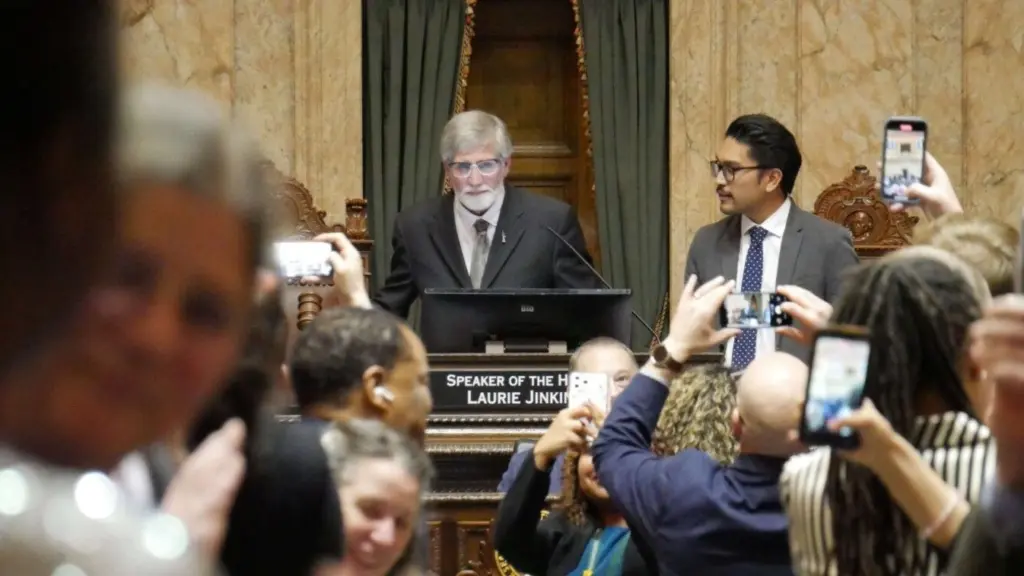
House Speaker Laurie Jinkins, D-Tacoma, admitted the bill’s fate looked in doubt. This was unfolding in the wake of a nearly 25-hour debate on the income tax that began Monday night and consumed all of Tuesday. That ate up floor time in the session’s critical final days.
“There was actually just a process of talking through with members,” she told reporters in a post-session press conference. “We did not think after Tuesday night that we would have the time to talk through with people and we did.”
The bill will eliminate one of two tax preferences for data center operators. Data center operators in most Washington counties do not pay the 6.5% sales tax when purchasing new server equipment. And, they don’t pay the tax when that equipment is replaced.
The bill approved Thursday will eliminate the replacement tax benefit, leaving in place the tax break for new data centers. It’s estimated to bring in $63 million for the current budget and more than $140 million every two years.
It passed on a 51-46 vote. Eight House Democrats ended up voting with Republicans, who claim the proposal will drive data centers, which have become economic powerhouses in some rural communities, out of the state.
“I do not believe this sector needs to be entirely tax-free in order for Washingtonians to benefit from investment and jobs,” said Rep. Joe Fitzgibbon, D-West Seattle, before the vote took place.
Ferguson, who called for the tax break repeal in December, said Thursday night he would have been “deeply concerned” if it had not passed.
This story first appeared on Washington State Standard.