Court said state lawmakers likely violate the First Amendment and fail to prove drag performances harm children
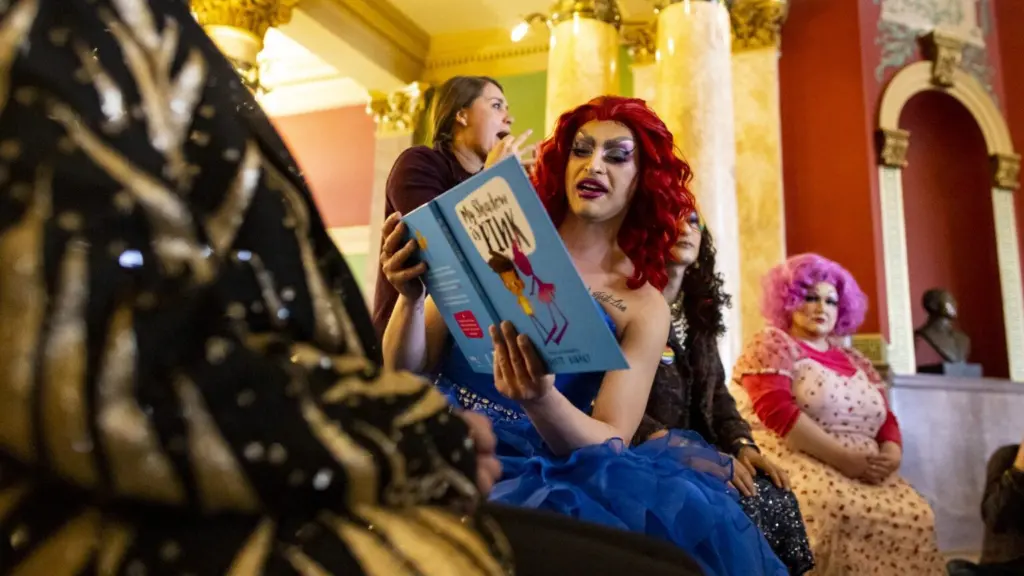
MONTANA – The U.S. Ninth Circuit Court of Appeals affirmed a federal judge’s injunction against House Bill 359, passed by the Montana Legislature in 2023, which banned drag performers and popular events like “drag story hour” under threat of criminal penalties, saying it was likely a violation of First Amendment speech.
The unanimous three-judge ruling also made it legal for Dolly Parton to perform in Montana (something judges said could have been legally questionable under the law), as well as show movies like “Asteroid City,” in which actress Scarlett Johansson is briefly seen undressing.
Using both of those performers as examples in a lengthy 97-page ruling, the appeals court pointed out numerous problems with the bill, including that it was both too vague and too specific while running afoul of First Amendment protections.
The opinion, written by Jennifer Sung, who was appointed to the federal bench by President Joe Biden, said that in addition to tripping over case after case of federal legal precedent, HB 359 didn’t pass constitutional muster, nor demonstrate the government had a compelling state interest that was tailored narrowly enough to survive judicial scrutiny.
While the decision doesn’t immediately spell the end for HB 359, which was sponsored by Rep. Braxton Mitchell, R-Columbia Falls, it means an uphill battle as the state will have to defend the case in Brian M. Morris’ federal district court at trial while an injunction stops any of the provisions from going into effect.
The judges on the panel also said the State of Montana is trying to claim power belonging to parents and use it to ban drag performers. The appellate court also repeatedly reminded attorneys for the State of Montana that even indecent speech, which often covers a range of sexual themed messaging, is still protected speech.
HB 359 is a far-reaching bill prohibiting drag story hours and “sexually-oriented shows” from any business receiving state money of any kind. Moreover, it imposes steep penalties, including the loss of professional licenses for teachers or administrators, hefty fines, and third-party enforcement, meaning individuals — not just government officials — could sue under the statute.
The state justified the action as necessary to protect children, and the law covers schools as well as other venues that have any state funding. One of the plaintiffs, the Roxy Theatre in Missoula, which has received state funding for various projects, was part of the lawsuit saying it often hosts live theatrical events that may fit the definition, even if it is just for moment. Moreover, a Billings teacher was also involved in the lawsuit because of the law’s prohibition on costuming; the teacher often roleplays various historical figures in a classroom setting and worried about the loss of her license.
Even during the brief time since it was signed into law, theaters and artistic directors across the state have cancelled plays and performances because of concerns that they may run afoul of the law and be prosecuted, something the court noted. Meanwhile attorneys for Montana argued even if the group of defendants have promoted, hosted or participated in conduct that could be a violation of HB 359, that prosecutors have not brought charges — proving that there has been “no interference” by the state.
However, the appeals court dismissed that defense.
“Performing or expressing a particular persona is indistinguishable from performing a character in a play or film or competing in a beauty pageant, all of which is undoubtedly purely expressive activity,” the court said. “We have no trouble concluding that drag story hours, as defined by HB 359, are purely expressive activity, not conduct.”
Expressive activity has broad First Amendment protections, whereas non-expressive conduct can be more easily restricted.
The court said the restrictions in the law is content based on its face — and government cannot restrict speech based on content, without very specific reasons, which HB 359 fails to meet.
“First, it applies only to people reading a particular type of content — children’s books. Second, it restricts who can read the children’s books — only certain speakers (drag kings and queens) are prohibited from conveying a message by reading books out loud,” the ruling said. “Third, (HB 359) draws a line between prohibited and permitted speakers based on the content of their expression: The statute prohibits only speakers who express ‘flamboyant or parodic’ male or female personas with ‘glamorous or exaggerated costumes or makeup.’
“A person who expresses a modest or serious male or female persona — or any other type of personal — may host a story hour.”
The state’s interest
The ruling also focuses on the state’s interest in restricting the activities like drag story hour.
For a law to survive judicial and constitutional scrutiny, the government must prove that it has a compelling interest in writing the legislation — in other words, there has to be a bonafide problem. And, then if it involves a constitutional right, it must prove that it has tailored the law in as narrow way as possible to provide the protection. In this case, the three-judge panel said HB 359 fails on both counts.
“It is rare that a regulation restricting speech because of its content will ever be permissible,” the opinion said.
Attorneys for the state argued that Montana has a “compelling interest” in protecting the well-being of minors, and also has an interest in making sure that state taxpayer funds are not used to subsidize things that harm children.
“The state does not have free license to label expression ‘indecent’ and restrict it in the name of protecting children,” the opinion said.
The court also referenced nearly a dozen G-rated movies produced by Disney, stretching back nearly a century that could be construed to violate HB 359.
“Cinderella, Elsa from ‘Frozen’ and many other Disney princesses could be described as adopting flamboyant and feminine personals when they dress up in glamorous ballgowns and bejeweled tiaras,” the court noted.
The court also pointed to other cases in which the state tried to invoke the power of parents — something it said only parents can exercise in these cases.
“(The court) doubts punishing third parties for conveying protected speech to children just in case their parent disapprove of that speech is a proper governmental means of aiding parental authority,” the court said.
The appeals court also said attorneys for the state hadn’t truly proven that there was a danger the legislation was trying to prevent.
“There is no evidence of a causal link between drag story house and harm to the physical and psychological well-being of children,” the court said.
Moreover, the judges leaned into testimony during the 2023 legislative session in which 28 people testified in support of the bill, including at least one doctor, but that none of them spoke as experts, and none cited any credible evidence of harm from drag story hours.
“Montana is trying to leverage government funding to regulate speech far beyond the confines of any government-funded program,” it said.
HB 359’s inconsistencies
The opinion also pointed out several inconsistencies with the law, for example, that the law targeted drag performers simply because of their dress, but not others from reading the same books. It also pointed out that while the law targeted the costumes of the participants or performers, it had little to say about some of the content.
“The drag story hour provision does not actually restrict ‘sexualized content’ or content that ‘sexualizes children,’” the court said.
Instead, the law targets the speaker — drag queens and kings.
“The drag-story-hour restriction is plainly over- and under inclusive when judged against this asserted justification,” the court said. “Because it covers expression that is not sexualized, it is overinclusive. Dolly Parton … could not visit a library in Montana to read one of those books to children if she wore glamorous clothing and makeup consistent with her famously flamboyant feminine persona.”
In another passage, the court said that theaters, like the Roxy, may have a legitimate concern because HB 359 is vague about certain performances. For example, the movie “Asteroid City” would be permissible because of an exclusion for all movies rated G, PG, PG-13 and R. However, a stage adaptation would fail, even if it used virtually the same script and actors, only in person.
Better options
In order to prevail on a legal challenge, the state has to prove its laws are also tailored in a way that is the least restrictive method to achieving its goals. In this case, the court pointed out that there were many other options rather than banning all performances under the threat of punishment.
For example, the court pointed out that schools or libraries could adopt either an opt-in or an opt-out system. Or, the performance could require the attendance of an adult or parent if the child was under 18.
“(HB 359) employs a blunt and draconian instrument to further that interest — heavy civil and criminal sanctions,” the court said.
Upper Seven Law Firm, which represented a diverse group of plaintiffs, cheered the ruling.
“Drag is speech. It is political commentary that does everything from expressing pure joy to offering powerful criticism to engaging with thoughtful stereotypes,” said President of the Imperial Sovereign Court of Montana Raymi Samson, who is also known as “Eunice X.” “The First Amendment protects drag as it protects all speech. We are proud to protect both the comedy of it and the essential political discourse we offer.”
Daily Montanan is part of States Newsroom, a nonprofit news network supported by grants and a coalition of donors as a 501c(3) public charity. Daily Montanan maintains editorial independence. Contact Editor Darrell Ehrlick for questions: info@dailymontanan.com.