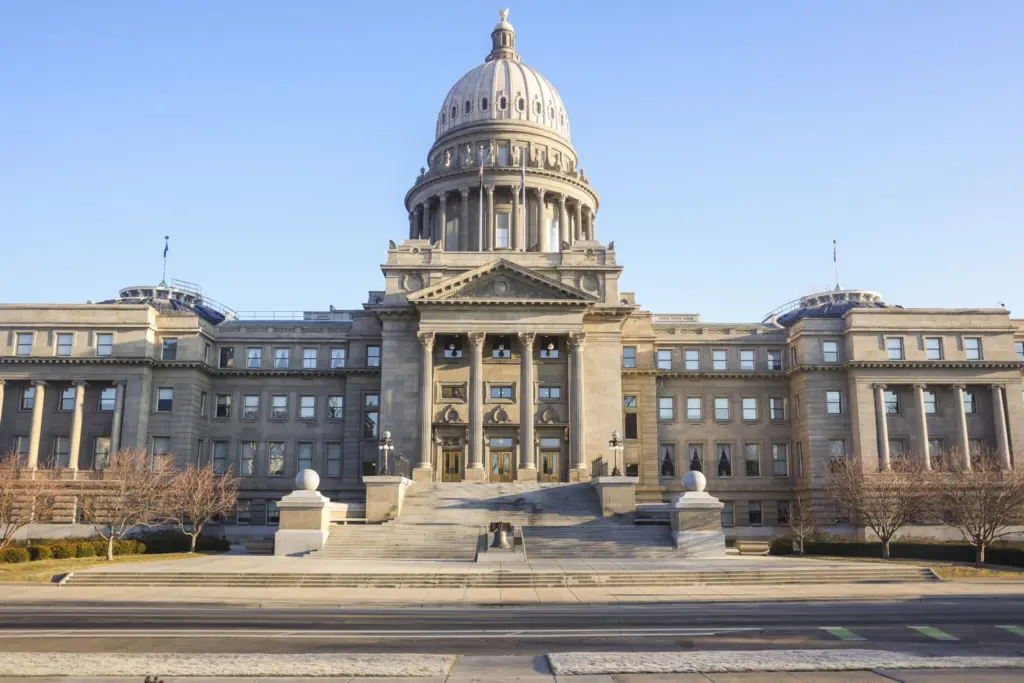
BOISE, ID – The Idaho House on Monday widely passed a bill to criminalize “willfully” entering public and government bathrooms and changing rooms designated for another sex.
The bill would effectively block transgender people from using their preferred public bathrooms in Idaho, expanding on the state’s transgender bathroom ban in public schools.
House Bill 752 would create criminal misdemeanor and felony charges for people who “knowingly and willfully” enter a bathroom or changing room designated for the opposite sex, with some exceptions. The bill would apply in government-owned buildings and places of public accommodations, like private businesses.
A first offense would carry a misdemeanor, punishable by up to one year in prison. A second offense within five years would be a felony, punishable by up to five years in prison.
Bill sponsor Rep. Cornel Rasor, a Republican from Sagle, told House lawmakers that the bill is about protecting women and girls.
“It prevents discomfort and voyeurism escalation and assaults, while preserving single-user options and narrow exceptions so no one is denied access for emergency aid,” Rasor said.
Rep. Chris Mathias, a Boise Democrat, said the bill could endanger transgender people.
“The truth of the matter is — and I know a lot of people don’t want to say it, but — forcing people who don’t look like the sex that they were born with, or transgender folks, forcing them to use other people’s bathrooms is going to put a lot of people in danger,” Mathias said.
The House passed the bill on a 54-15 vote Monday. Six Republicans joined the House’s nine Democrats in opposing the bill.
Bill was opposed by Idaho law enforcement groups
In committee last week, the bill was opposed by some law enforcement groups and several transgender Idahoans.
The Idaho Fraternal Order of Police opposed the bill, telling lawmakers in written testimony that the bill “presents significant practical enforcement challenges for law enforcement officers in the field.”
“Officers responding to a complaint would be placed in the difficult position of determining an individual’s biological sex in order to enforce the statute,” Idaho Fraternal Order of Police President Bryan Lovell wrote. “In many circumstances, there is no clear or reasonable way for officers to make that determination without engaging in questioning or investigative actions that could be viewed as invasive and inappropriate.”
The Idaho Sheriffs’ Association requested that lawmakers amend the bill to require that people who could be prosecuted under the bill be first offered a chance to leave the bathroom immediately when asked.
Rasor said he has addressed issues that law enforcement brought. But his bill has not been amended since law enforcement’s opposition last week.
The bill outlines several exceptions, including to give medical assistance, law enforcement assistance, and if a single-user facility “is the only facility reasonably available at the time of the person’s use.”
The bill now heads to the Senate for consideration. To become law, Idaho bills must pass the House and Senate, and avoid the governor’s veto.
A bathroom ban bill enforceable through lawsuits passed the House a month ago. But that bill, House Bill 607, has not received a committee hearing in the Senate.
Idaho Capital Sun is part of States Newsroom, a nonprofit news network supported by grants and a coalition of donors as a 501c(3) public charity. Idaho Capital Sun maintains editorial independence. Contact Editor Christina Lords for questions: info@idahocapitalsun.com.