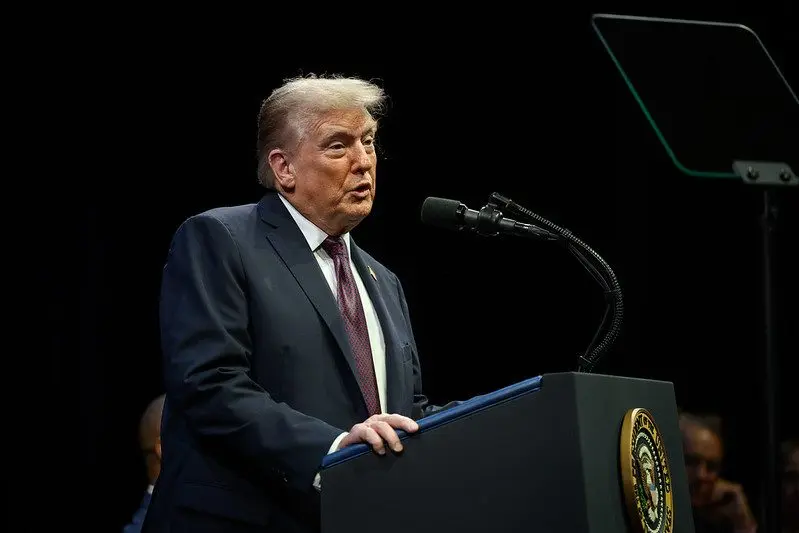
WASHINGTON, D.C. – With many travelers seeing long waits at airports because of the partial government shutdown, President Donald Trump said Saturday he would send Immigration and Customs Enforcement agents to provide security at airports to ease the strain.
“If the Radical Left Democrats don’t immediately sign an agreement to let our Country, in particular, our Airports, be FREE and SAFE again, I will move our brilliant and patriotic ICE Agents to the Airports where they will do Security like no one has ever seen before, including the immediate arrest of all Illegal Immigrants who have come into our Country, with heavy emphasis on those from Somalia, who have totally destroyed, with the approval of a corrupt Governor, Attorney General, and Congresswoman, Ilhan Omar, the once Great State of Minnesota,” Trump said in a post on social media. “I look forward to seeing ICE in action at our Airports.”
Also Saturday, billionaire Tesla and SpaceX founder Elon Musk offered to pay the salaries of Transportation Security Administration employees to help ease the long waits at airports.
“I would like to offer to pay the salaries of TSA personnel during this funding impasse that is negatively affecting the lives of so many Americans at airports throughout the country,” Musk wrote on social media.
Democrats in the U.S. Senate on Friday again refused to vote in favor of a measure to fund the Department of Homeland Security. While ICE is funded through the so-called Big Beautiful Bill passed by Congress last summer, other agencies such as the TSA, the Coast Guard, the Secret Service, and the Cybersecurity and Infrastructure Security Agency, have ceased nonessential operations and face worker shortages. This latest shutdown has lasted more than a month with no end in sight. Unpaid TSA agents have been calling in sick as the shutdown drags on.
Democrats are withholding their votes because they want to require ICE agents to wear body-worn cameras and “visible officer identification,” to identify themselves when asked, limit immigration enforcement activities at sensitive locations such as schools and hospitals, expand enforcement de-escalation training, and mandate that the department report to Congress on compliance with these rules.
• Therese Boudreaux contributed to this story.