WASHINGTON, D.C. – The U.S. Supreme Court is hearing arguments Tuesday in a case to determine at what point an immigrant can claim asylum protections in the United States.
The case, Noem v. Al Otro Lado, focuses on immigrants who were stopped on the Mexico side of the U.S. Mexico border and denied entry for asylum. The 1990 Immigration and Nationality Act allows an individual who “arrives in the United States” to apply for asylum status and be inspected by an immigration officer.
An advocacy group argued that the U.S. Department of Homeland Security instituted a policy to prevent migrants from attempting to cross the U.S.-Mexico border.
Advocates for Al Otro Lado, the immigrant advocacy organization, on Tuesday urged the Supreme Court to reverse the Trump administration’s policy.
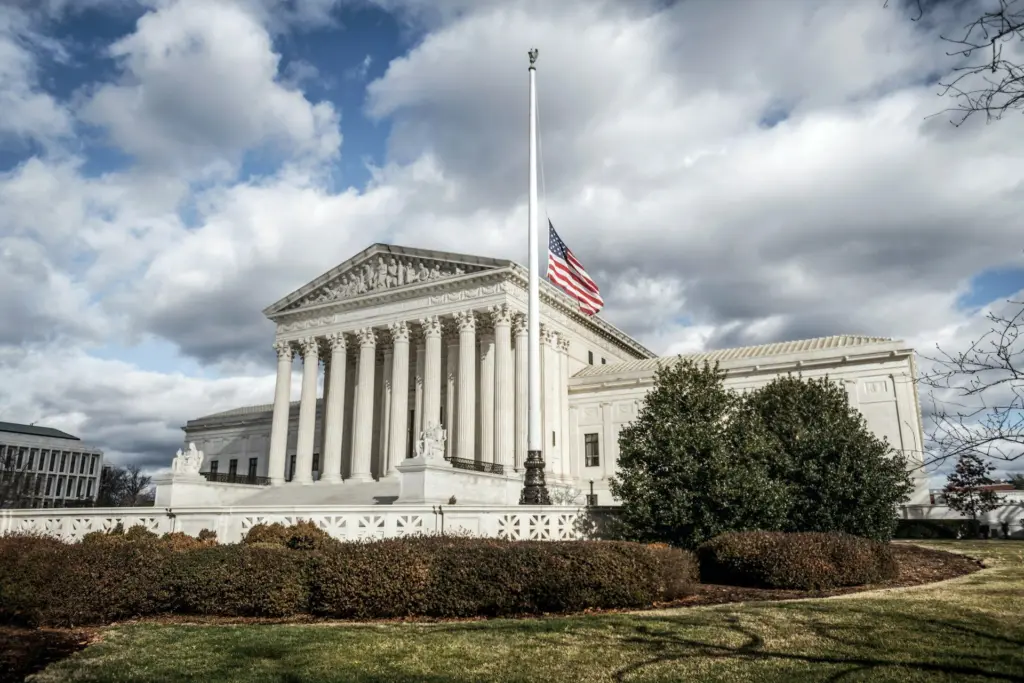
“We cannot be a country that professes to be one of laws and human rights if we allow a president and administrative policy to dictate who is desirable and who will be allowed in,” Nicole Ramos, director of the Border Rights Project at Al Otro Lado, said outside the U.S. Supreme Court building.
The advocates on the courthouse steps sang songs and chanted in support of the asylum process. Naomi Steinberg, vice president for policy and advocacy at the nonprofit group HIAS, submitted an amicus brief to the high court.
“We need to say that the Supreme Court does not get to just ignore our immigration laws,” Steinberg said. “You cannot turn people back to a place where they will be unsafe, where their lives are at risk. What is at risk is the rule of law, what is at risk is the right to seek protection.”
Lawyers for the Trump administration argued immigrants can not be considered to “arrive in the United States” when they have not stepped onto U.S. soil.
“An ordinary English speaker would not use the phrase ‘arrives in the United States’ to describe someone who is stopped in Mexico,” lawyers for the government said in a brief to the court.
Charles Du Mond, an advocate outside the court, said the asylum process should start when an individual leaves their home country for fear of danger.
“We should be welcoming people who are at risk wherever they’re coming from, and whenever it starts,” Du Mond said. “Working out the details of how officially, when someone can be considered for asylum or not, is an unnecessary complication.”