BOISE, ID – An Idaho Senate committee on Tuesday advanced a bill prohibiting health care providers that accept Medicaid funding from using “DEI” — diversity, equity and inclusion — policies in employment, training and practice.
The bill was sent to the Senate floor for further consideration. If passed by the full Senate, it would go to the governor for potential veto, signature or to allow it to go into effect without signature.
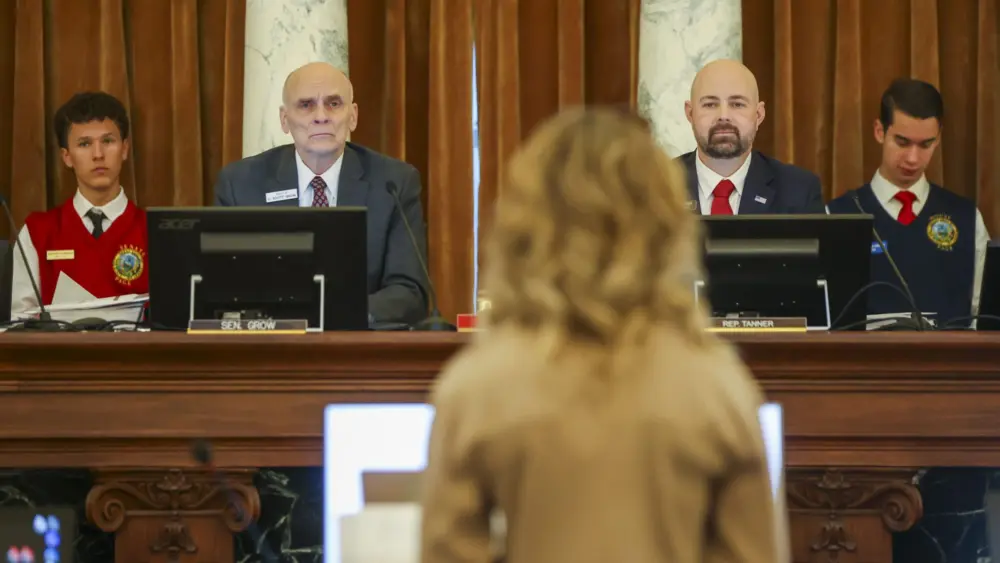
The public hearing on the House Bill 928 lasted more than an hour, with overwhelming testimony in opposition from Idaho physicians, many of whom said the kinds of training that would be prohibited are valuable to providing health care.
Six people testified in opposition to the bill and two spoke in favor.
HB 928 sponsor, Twin Falls Republican Sen. Josh Kohl, said the bill would ensure Medicaid-funded health care facilities are making decisions solely based on merit.
“This bill does not authorize discrimination, and it expressly preserves compliance with federal civil rights laws and Medicaid requirements,” Kohl said. “What it does do is reaffirm that public funds should support systems built on competition, quality and individual achievement.”
What does the bill do?
The bill would prohibit practices such as “race-based” or “sex-based” preferences; targets, benchmarks, quotas, or equity goals; mandatory bias, implicit bias, systemic bias, or “similar training that assigns responsibility, disadvantage, or professional outcomes based on protected characteristics rather than individual merit or performance” or required diversity statements or pledges.
Compliance would need to be a condition for all Medicaid provider agreements, and the Idaho Department of Health and Welfare would need to ensure network-wide compliance for any state Medicaid managed care contractors. The attorney general could enforce the requirements if a formal complaint is made, and health care providers may sue if they are retaliated against for refusing to participate in prohibited DEI conduct.
The bill would still allow compliance with federal civil rights laws, collection of demographic data for “legitimate clinical care, quality reporting, or public health purposes,” and “patient-specific medical discussions related to biological, genetic, or epidemiological risk factors.”
“Non-ideological” training for clinical competency, licensure, accreditation or federal program compliance would also be allowed.
Soda Spring Republican Sen. Mark Harris asked if the bill would prohibit a clinic from seeking to hire a woman OB-GYN if that’s what their patients would be more comfortable with.
Bill co-sponsor, Sen. Ben Toews, R-Coeur d’Alene, said it would only apply if a clinic was deciding between a man and a woman, and the woman was less qualified.
Idaho family physicians say definitions are confusing, over-broad
Idaho physicians who spoke Tuesday said they consider some of the bill’s prohibited acts, including training on subjects such as implicit bias or cultural sensitivity, valuable for their practice.
Dr. Dorothy Buening, a family medicine physician resident in Boise, said the limitations on training in the bill were confusing, and would threaten “the foundation of quality health care in Idaho.”
She said implicit-bias and health disparity training were supported by evidence to improve patient outcomes.
“I see this play out every day, whether I’m providing care in the hospitals or in the clinic, this training leads to improved patient trust and outcomes, and thus care becomes safer and more effective for all Idahoans,” Buening said.
Nampa Republican Sen. Brian Lenney asked Buening, “Do you believe in white privilege?”
Buening said, “I believe that people have very different life experiences, and that plays a role into the impact on how they perceive the world, and not everybody is afforded opportunities to learn about other people’s life experiences, and that’s why it’s extremely important in medical education to be able to learn about alternative perspectives to become a better provider for all types of patients.”
Liz Woodruff, executive director of the Idaho Academy of Family Physicians, said the organization was against it for a number of reasons. She said limitations to merit-based employment decisions were already in practice. She also said the language was confusing, and would be difficult to implement, because the bill would allow for collection of demographic data, but doesn’t specify if the data could be used.
Edward Clark, of the Christian lobbying group the Idaho Family Policy Center, supported the bill, arguing that DEI, “demands preferential treatment for politically favored groups based on race, gender and sexual orientation in clear violation of the biblical principles that undergird our constitutional system of government.”
Richard Bosshardt, a Florida-based plastic surgeon who has talked to conservative media outlets such as Tucker Carlson’s podcast about his ban from an American College of Surgeons forum for questioning new DEI policies, also spoke in support.
Sen. Lenney: ‘Implicit bias has no place in medicine”
The committee’s lone Democrat, Senate Minority Leader Melissa Wintrow, of Boise, said she saw no need for the bill.
She said she liked that the bill prohibited policies based on the idea “that one race or sex is inherently superior to another sex or race … because that’s really the basis of white supremacy.”
But she opposed the steep penalties.
“I’m not sure what problem we’re trying to solve, because I’ve not heard that we’re hiring medical physicians here that aren’t qualified,” Wintrow said.
Lenney joked his debate was the opposite of Wintrow’s.
Lenney argued “systemic racism as a clinical fact.”
“This stuff plagues, not just hospitals, but medical schools and … if this stuff’s not happening, what’s the problem? And yeah, the penalties are steep, because this stuff has a detrimental effect on actual medical care, and it has no place in medicine.”
The bill advanced with just Wintrow and Harris voting “no.”
Idaho Capital Sun is part of States Newsroom, a nonprofit news network supported by grants and a coalition of donors as a 501c(3) public charity. Idaho Capital Sun maintains editorial independence. Contact Editor Christina Lords for questions: info@idahocapitalsun.com.