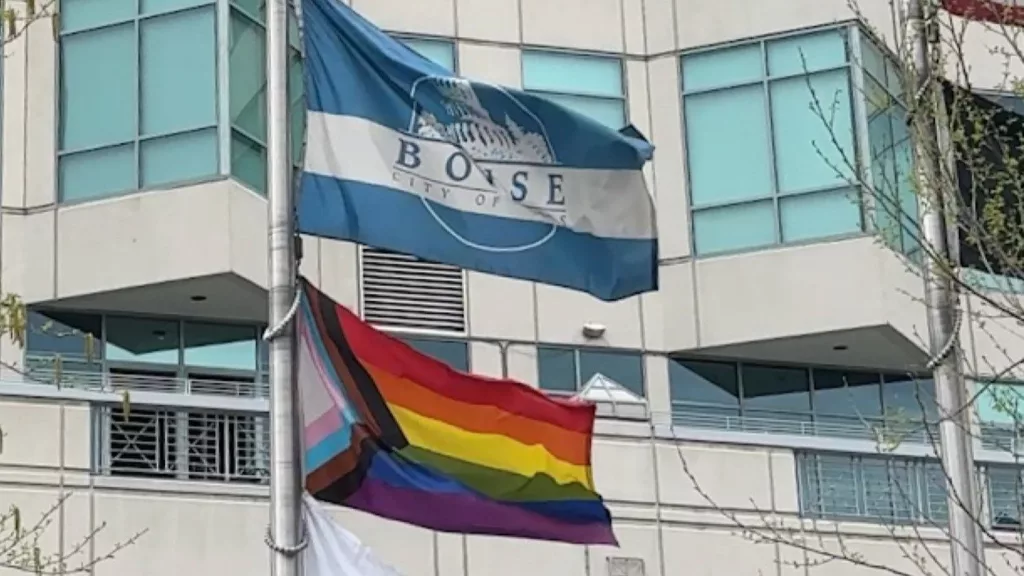
BOISE, ID – The Idaho Senate on Tuesday widely passed a bill that would fine local and state governments for flying flags that aren’t on the Legislature’s pre-approved list.
The bill’s House sponsor, Rep. Ted Hill, an Eagle Republican, has said House Bill 561 is meant to target the city of Boise for flying an LGBTQ+ pride flag. Boise’s City Council voted to declare the pride flag and the organ donor flag as official flags, in an apparent move to work around the Legislature’s flag ban law passed last year.
The bill would add a $2,000 daily fine, per offending flag, to the flag ban law from last year, which lacked an enforcement process.
The bill’s list of approved flags largely includes official flags of domestic governments or the U.S. military, with some exceptions. Only city and county flags made official before 2023 could be flown.
The Idaho Senate passed the bill on a 26-8 vote. All six Senate Democrats voted against the bill. Two Republicans — Sens. Jim Guthrie and Phil Hart — also opposed the bill.
The bill widely passed the House earlier this month. But since the Senate amended the bill, it must return to the House before it would go to Gov. Brad Little for final consideration.
Debating the legislation on the Senate floor, cosponsor Sen. Josh Keyser, R-Meridian, told lawmakers that the government isn’t an exception to the enforcement of laws.
“We hold the citizenry accountable to follow all the laws, and government’s not an exception,” Keyser said.
Senate Assistant Minority Leader James Ruchti, D-Pocatello, said the bill violates the principle of local control.
“Local control is an important principle we should stand behind. It’s good for governance. It’s always made sense. And it still does. But statutes like this shows that we are kind of losing sight of that important principle,” Ruchti told lawmakers.
The Legislature routinely blocks local governments from enacting certain policies, or requires local governments to do certain things, through preemption laws, the Idaho Capital Sun reported.
Ruchti also said that the bill doesn’t allow challenging government entities to receive attorneys fees if they sue, but the bill would let the attorney general collect attorney fees if he wins.
Guthrie, of McCammon, suggested the bill might need more work, since it’s the second iteration this year, and it has been amended twice.
“We’re going to continually miss flags and be continually adding flags. It would be cleaner if we just identified the one we don’t want,” he said.
Senate Minority Leader Melissa Wintrow, D-Boise, said the bill is clearly in response to the city of Boise flying the pride flag.
She said the state already has its own speech — by allowing license plates with statements like, “Don’t Tread on Me” and “Choose Life,” which directs fees to pregnancy resource centers, which oppose abortion.
No lawmakers debated in favor of the bill.
How the flag ban bill would work
Flag displays would be restricted on government property, which is defined as “land owned and maintained by the governmental entity, including buildings, adjoining land, parks, roads and boulevards.”
The list of flags that could be displayed on government property is largely limited to domestic government flags, including the U.S. flags; state, city or county flags made official before 2023; flags of U.S. military branches and units; the POW/MIA flag; and flags of recognized Native American tribes.
On special occasions, flags of countries besides the U.S. could be flown. The House amended the bill to allow on special occasions for the flag of the Basque autonomous community to be flown. The House also amended the bill to allow the display of flags, banners or pennants that “are not political, religious, or ideological in nature.” The Senate amended the bill to allow flags to be flown “in recognition of historic international and cross-border relations,” in an apparent reference to Idaho’s bordering nation, Canada.
Temporary parades or assemblies on government property would be exempt.
The bill would also allow Idaho Attorney General Raúl Labrador to enforce the law through lawsuits to stop cities from flying certain flags and to seek civil court fines. Before filing a lawsuit, the attorney general must warn the government entity of its violation, and allow it up to 10 days to resolve, or “cure,” the issue.
This story first appeared on Idaho Capital Sun.