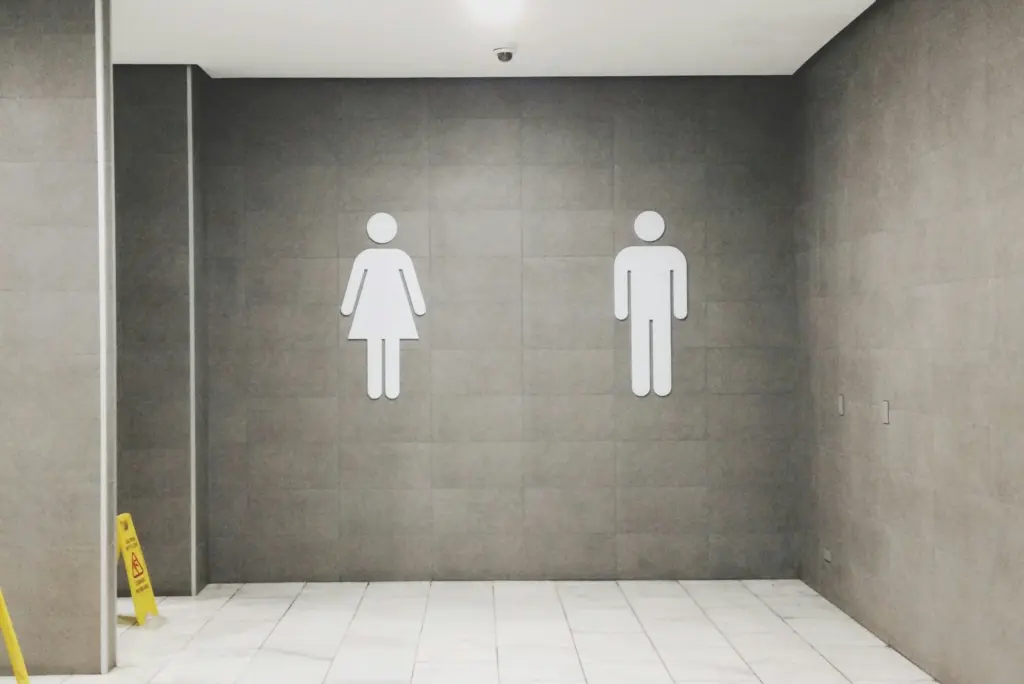
BOISE, ID – The Idaho Legislature widely approved a bill that would criminalize “willfully” entering public and government bathrooms and changing rooms designated for another sex.
The bill — which heads to Gov. Brad Little for final consideration — would effectively block transgender people from using their preferred public bathrooms in Idaho, expanding on the state’s transgender bathroom ban in public schools.
House Bill 752 would create criminal misdemeanor and felony charges for people who “knowingly and willfully” enter a bathroom or changing room designated for the opposite sex, with some exceptions. The bill would apply in government-owned buildings and places of public accommodations, like private businesses.
A first offense would carry a misdemeanor, punishable by up to one year in prison. A second offense within five years would be a felony, punishable by up to five years in prison.
Only three states — Utah, Florida and Kansas — have criminal bans on trans people using bathrooms that align with their gender identity, according to the Movement Advancement Project, an LGBTQ+ advocacy group.
In a statement, Planned Parenthood Alliance Advocates — Idaho called the bill “the most extreme anti-transgender bathroom ban in the nation.”
One Republican opposed the bill in the Senate
In the Idaho Senate, the bill passed on a near-party line 28-7 vote Friday, with all six Democrats opposing. One Republican, Sen. Jim Guthrie, from McCammon, broke with Republicans support of the bill.
He called legislation like it “harmful.”
“They go in the bathroom they’re supposed to, they upset people. If they go in the one that they now look like, they’re breaking the law, which could include pretty severe penalties” Guthrie told senators. “ … We seem to be really focused on this space and ignoring the fact that there are people that are just like us, human beings, just like us. What are they supposed to do?”
Bill sponsor Sen. Ben Toews, R-Coeur d’Alene, told senators that the bill protects “common sense realities.”
“The Legislature has a fundamental duty to protect the bodily privacy and safety of Idaho citizens,” Toews said. “House Bill 752 provides a clear, proactive tool to secure sex-separated private spaces in our state, while accommodating common-sense realities.”
Once the bill is transmitted to Little, he has five days to decide on it. He has three options: sign it into law, veto it, or allow it to become law without his signature.
In the House, the bill passed on a 54-15 vote earlier this month, with six Republicans joining the House’s nine Democrats in opposition.
‘Do I feel like going to jail today, or do I feel like being attacked?’ trans man testifies
The bill builds on a wave of anti-LGTBQ+ bills that the Legislature and the governor have approved in recent years.
In 2020, Idaho became the first state to ban transgender girls and women from competing in sports of their preferred gender. In 2023, state lawmakers made it a felony for doctors to provide gender-affirming health care to transgender youth. In 2024, lawmakers expanded the ban to apply to taxpayer funds and government property, which forbids Medicaid from covering gender-affirming care.
This week, the Legislature sent the governor a bill to fine the city of Boise for flying an LGBTQ+ pride flag, despite a state law last year banning the display on government property. The Senate is also one of the last stops for a bill that would require school officials and health professionals to out transgender minors to their parents, or face lawsuits.
And for more than a decade, efforts to add anti-discrimination protections for LGBTQ+ people to state law have failed.
“Over the last several years, legislators have gone from refusing to protect us to actively targeting us,” Nikson Mathews, who serves as chair of the Idaho Democratic Queer Caucus, said at a news conference in February.
Mathews, a trans man with a beard, told a House committee earlier this year that the bathroom bill would force him to use the women’s restroom.
“Every single day when I’m out in public, I have to decide: Do I feel like going to jail today, or do I feel like being attacked,” Mathews told lawmakers.
A 2025 study by the UCLA School of Law’s Williams Institute found “no evidence of increased harms to people who are not transgender when transgender people are allowed to use restrooms and other gendered facilities according to their identity.” But when trans people are refused access to facilities that align with their gender, the study found that trans people report verbal harassment and physical assault.
Bill is about discrimination, Democratic senator says
Sen. Ron Taylor, a Democrat from Hailey, said the bill is about discrimination. He said constituents told him that they’d move out of Idaho if it passed — because it would throw their transgender children in jail.
“Now maybe that’s what some of us want, is to chase a population that’s marginalized out of Idaho,” Taylor said. “But that’s not Idaho. Idaho was founded by a population that was marginalized.”
Sen. Brian Lenney, a Republican from Nampa, said the bill is about keeping women and girls safe from having men in their spaces.
“Trans women aren’t women,” said Sen. Joshua Kohl, a Republican from Twin Falls. “They’re men. And they need to be treated as such.”
Sen. Jim Woodward, a Republican from Sagle in North Idaho, said the bill is largely borne out of an event where he said a man was found in a women’s locker room in a YMCA in Sandpoint. He said he’d vote for the bill, but he had some reservations.
“What comes next and how much further do we venture inside of a private building?” Woodward said. “I don’t support the punitive measures in this bill, but the policy does reflect the sentiment of my community, and so for that reason, I will support it. It is the best for the most.”
Sen. Melissa Wintrow, a Boise Democrat, said she saw people crying after a recent committee hearing on the bill.
“They were crying because they just didn’t feel as if they were human. That a simple little thing they had to do, like go to the bathroom, would have to be in a law,” Wintrow said.
Idaho Fraternal Order of Police opposed the bill
The bill was opposed by some law enforcement groups and several transgender Idahoans.
The bill outlines several exceptions, including to give medical assistance, law enforcement assistance, and if someone “is in dire need of urinating or defecating and such facility is the only facility reasonably available at the time of the person’s use.”
The Idaho Fraternal Order of Police flagged that exception as concerning.
“Officers responding to a complaint would be placed in the difficult position of determining an individual’s biological sex in order to enforce the statute,” Idaho Fraternal Order of Police President Bryan Lovell wrote. “In many circumstances, there is no clear or reasonable way for officers to make that determination without engaging in questioning or investigative actions that could be viewed as invasive and inappropriate.”
Idaho Capital Sun is part of States Newsroom, a nonprofit news network supported by grants and a coalition of donors as a 501c(3) public charity. Idaho Capital Sun maintains editorial independence. Contact Editor Christina Lords for questions: info@idahocapitalsun.com.