EVERETT, WA — A new Washington state law will require local governments to allow housing for people experiencing homelessness in residential areas.
Communities across the state have pushed back to varying degrees to permitting homeless shelters and permanent supportive housing in their neighborhoods.
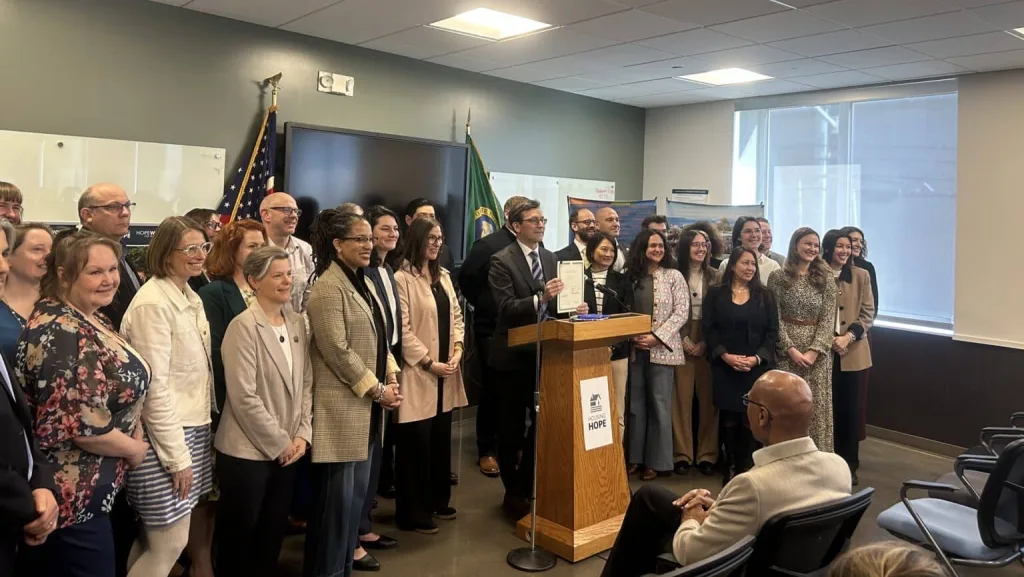
House Bill 2266, which Gov. Bob Ferguson signed Friday, limits their ability to stop these projects.
Ferguson signed the new law, and a slew of other housing-related bills, at HopeWorks Station, an affordable housing complex in Everett.
Permanent supportive housing assists people with disabilities in getting stable housing and resources, while transitional housing is temporary help before people move into something more permanent.
House Bill 2266, sponsored by Rep. Strom Peterson, D-Edmonds, requires cities to allow transitional and permanent supportive housing in residential and hotel development zones in an urban growth area. Indoor emergency shelters and housing must be allowed in zones where hotels are allowed. Under a 2021 law, cities can’t block permanent supportive housing in residential zones, and shelters in areas with hotels.
Local governments subject to the new requirement can’t impose conditions for this so-called “STEP housing” that are more restrictive than for other development. And mandates they can impose on affordable housing providers are limited to income qualification, coordinated entry, reporting and monitoring.
Counties and cities can require prospective operators of indoor emergency shelters or housing to hold a community meeting, notify local residents and provide further information. If the shelter will be within 500 feet of a school, a local government can negotiate additional “reasonable requirements” related to health and safety for the site.
Majority Democrats in the Legislature pushed through the measure with no Republican votes. Backers hope the new law, which takes effect in June, will minimize costly delays caused by local government apprehension.
Ferguson said the law “ensures that STEP housing can be built more quickly and predictably.”
“Expanding it is an important step to ensuring more residents have a safe place to call home,” he said.
Lt. Gov. Denny Heck, who has been a key adviser to Ferguson on housing, called it a “strong step forward.”
“It was a moral failing of our state that our laws did not encourage and facilitate more construction of permanent supported housing,” Heck said.
‘Giant step forward’
Ferguson on Friday signed several other new laws concerning housing.
These included legislation he requested to bar cities and counties from excluding residential development in commercial or mixed-use zones. Backers have pointed to strip malls and vacant properties as ripe for housing construction under the new policy.
“We have a glut of vacant storefronts, of boarded up big box stores and of empty strip malls, and it would be amazing to help solve our housing shortage by transforming those places into homes,” said bill sponsor Sen. Emily Alvarado, D-Seattle.
Heck called it “the most important housing bill of this session.”
Other bills signed Friday require landlords to let renters know about flood risks for their unit and allow detached accessory dwelling units outside of urban growth areas. Yet another gives local governments more flexibility in how they use tax dollars for affordable housing to, for example, fund maintenance and operations of existing buildings.
One controversial bill to implement restrictions to keep cities and counties from criminalizing camping on public property didn’t make it to the finish line this year.
On the money side, lawmakers earmarked another $200 million for housing and homelessness in the state’s construction budget. This includes $123 million for the Housing Trust Fund, the state’s primary pot of funding for building affordable housing.
The governor in December had proposed $244 million in housing investments as part of his own budget proposal before the session began. Lawmakers last year invested $600 million into the Housing Trust Fund in the state’s two-year budget. This year’s funding adds to that.
The governor is set to sign off on the spending next week.
Ferguson in December also signed an executive order to set up a task force to help establish a new cabinet-level Department of Housing. The task force must file a report by Nov. 15 with recommendations that lawmakers can consider in the 2027 legislative session.
Last year, lawmakers passed a number of marquee housing laws, including capping residential rent increases, promoting development near transit, tackling onerous parking requirements and reducing liability risks for condominium builders.
After the governor was elected in 2024, Heck led the development of a state Housing Action Plan. Heck said Friday that two legislative sessions later, “virtually every single one” of the ideas in that plan have been implemented at least in part.
“We’re making a giant step forward, but we’ve got a lot of work left to do,” Heck said. “We have a serious problem, yes, nationwide, but specifically in Washington state, and it’s going to take continued resolve.”
Washington State Standard is part of States Newsroom, a nonprofit news network supported by grants and a coalition of donors as a 501c(3) public charity. Washington State Standard maintains editorial independence. Contact Editor Bill Lucia for questions: info@washingtonstatestandard.com.