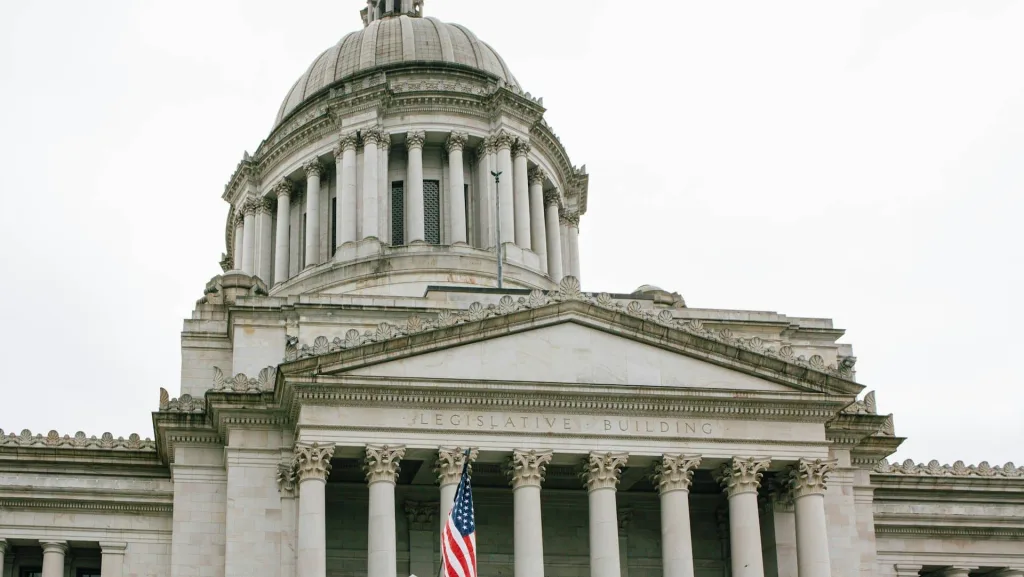
OLYMPIA, WA – Two days ago, a beaming Gov. Bob Ferguson celebrated with dozens of allies the enactment of Washington’s new tax on the income of wealthy residents.
On Wednesday, a more somber Ferguson signed a budget that depends on rainy day reserves, one-time maneuvers and deep cuts in child care funding to balance.
The roughly $79.4 billion plan makes adjustments to the $77.8 billion two-year budget lawmakers passed last year, which covers state spending from July 1, 2025, to June 30, 2027. It also leaves a looming deficit in the next budget.
Most of the new spending is to address increasing demand for public services, the state’s growing lawsuit payouts for government misconduct, and the cost of complying with major federal changes to safety net programs like Medicaid and food stamps.
The budget, for example, contains an additional $1 billion to pay for the state’s ballooning legal liability.
But bigger picture, state revenue growth isn’t keeping pace with spending. And, as Ferguson noted, collections from the new tax on households with annual incomes above $1 million won’t begin for three years.
“That does not help us for what we have to do right here,” he said, referring to the tax.
So, the budget makes some significant shifts of resources to balance. Most notably, it withdraws $880 million from the state’s rainy day reserves and transfers $375 million from the Public Works Assistance Account, which provides low-interest loans and grants to local governments for infrastructure projects.
To backfill the rainy day savings account, the Legislature and governor intend to sweep $880 million from the reserves of an overfunded pension plan for police and firefighters in 2029, at the end of the next budget cycle.
Cuts are also a big piece of the puzzle.
There’s a $143 million reduction for child care providers who serve low-income families that get state subsidies from the Working Connections Child Care program. Much of it will be achieved through a change in how the state reimburses day cares based on attendance of children. Ferguson signed a separate bill Wednesday laying out the policy change.
Public education, from pre-school through college, will see less money. The popular Transition to Kindergarten program for four-year-olds will get $27 million less. That will result in a loss of as many as one-third of the program’s 7,266 slots, supporters say.
And an expected $100 increase per student in local effort assistance, or LEA, for eligible districts is not going to happen. The extra dollars were to go to districts that cannot raise the same amount per student from local levies as property-rich districts can.
Universities and community colleges avoided a major hit as Ferguson agreed to allow a shift of $240 million from the capital budget into the operating accounts of two-year and four-year institutions. Those construction dollars will be backfilled using bonds.
Ferguson also signed the construction budget Wednesday. Its highlight is an additional $200 million for housing-related programs, including $123 million for the Housing Trust Fund, the state’s primary pot of funding for building affordable housing.
Coupled with last year’s investments, the state’s financial commitments to preserve and construct housing totals $960 million in the current two-year budget.
‘No cut is easy’
For the most part, Ferguson left intact the operating budget deal cobbled together by the Democratic majorities in the House and Senate and opposed by every Republican. Sen. June Robinson, D-Everett, and Rep. Timm Ormsby, D-Spokane, the lead budget writer in each chamber, looked on at Wednesday’s bill signing.
Ferguson did veto $500,000 for hiring a statewide organization to coordinate efforts among law enforcement and businesses to combat organized retail crime. He supported a pilot program last year and made retail crime a focus in his tenure as attorney general.
The veto didn’t sit well with Rep. Mari Leavitt, D-Tacoma.
“If the decision is made,” she wrote on social media before the decision, “it’s shortsighted and suggests that retail crime doesn’t matter in Washington.”
Ferguson said there are more resources today to bring cases against organized retail theft because of a unit he established during his time leading the state attorney general’s office.
“No cut is easy to make, no veto is easy to make, especially an area that I understand well,” he said. “At the same time, we’ve got a budget to balance.”
As he set aside this year’s budget, Ferguson said more difficult decisions lie ahead next legislative session when he and lawmakers must confront a projected $878 million deficit in 2028.
“Given the circumstances we’re facing, this is a responsible budget,” Ferguson said. “We’ll have a lot of work to do in the coming months. We’ll adapt to whatever comes our way.”
Washington State Standard is part of States Newsroom, a nonprofit news network supported by grants and a coalition of donors as a 501c(3) public charity. Washington State Standard maintains editorial independence. Contact Editor Bill Lucia for questions: info@washingtonstatestandard.com.