PORTLAND, OR – In back-to-back hearings on federal agents’ use of excessive force and chemicals on crowds outside the Portland Immigration and Customs Enforcement Facility, three federal appeals judges seemed disturbed by videos of officers’ conduct and skeptical that such force was warranted.
Judges Kenneth Lee and Eric Tung, both Trump appointees to the 9th Circuit Court of Appeals, and Judge Ana de Alba, a Biden appointee, in late March temporarily overturned lower court orders that had temporarily blocked such uses of force (on a 2-1 vote, with de Alba dissenting) while court cases were pending. But at expedited hearings in San Francisco on Tuesday, the panel seemed mostly poised to reverse course.
The judges heard arguments from lawyers representing the federal officers, as well as lawyers representing residents of a low-income apartment building near the Portland ICE facility, and journalists and protesters who claim to have been targeted by officers. Though separate cases, the judges appear to be consolidating their decision because an outcome in either will govern federal officers’ ability to use tear gas, pepper balls, smoke grenades and other less-lethal munitions on crowds outside the facility for the next several weeks.
The judges did not indicate when a decision will be reached, but likely before mid-April, when the two lawsuits will advance to the discovery stage in the lower district court in Portland.
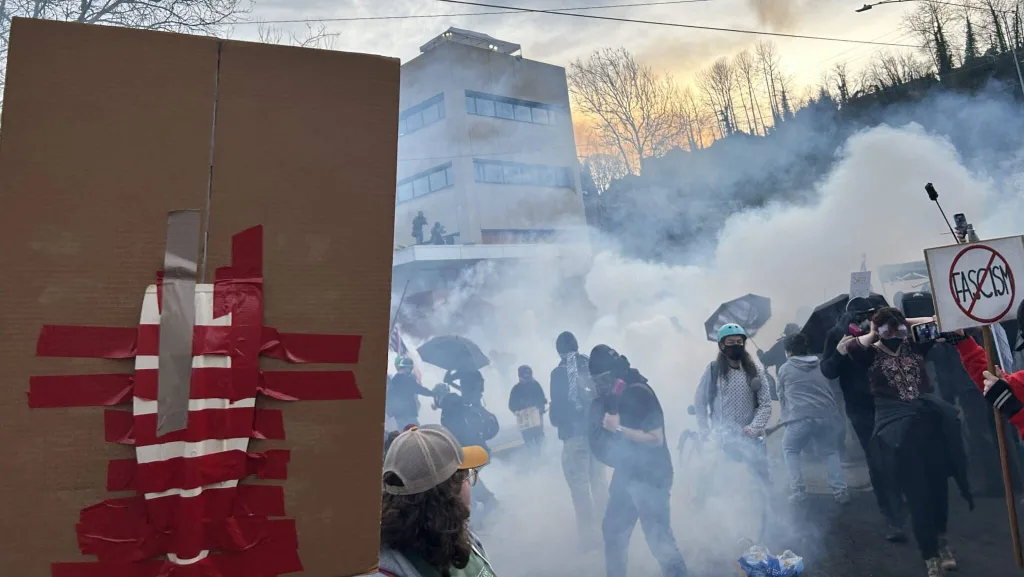
Such uses of force became common from officers for months outside the ICE facility, where groups of largely peaceful protesters have been demonstrating since June, and which escalated heavily during the fall following President Donald Trump’s attempt to deploy National Guard troops to the city. Concern about officers’ conduct rose again in late January, when they deployed massive amounts of tear gas at a Saturday afternoon march organized by labor unions and attended by kids, seniors and people with disabilities.
Protester and journalist plaintiffs in Dickinson v. Trump, represented by the Oregon chapter of the American Civil Liberties Union, argue they’ve been targeted by federal officers and retaliated against while posing no threat to officers at the facility. In Reach Community Development, et al. v. United States Department of Homeland Security, et al, residents of the Gray’s Landing affordable apartment complex near the facility argue their lives have been upended and irreparable medical harm has been inflicted by noise and chemicals seeping into their homes.
The lower circuit court in Portland has sided with plaintiffs, with one judge, Michael Simon, calling videos submitted into evidence of officers’ conduct “both unambiguous and disturbing.”
The appeals court judges on Tuesday asked few questions and gave few remarks during arguments in the REACH case, but far surpassed the 20 minutes scheduled for arguments on Dickinson.
In the REACH case, U.S. Department of Justice lawyer Brenna Scully argued that federal agents should not be subject to greater restrictions on use of force and munitions because they cannot predict the intensity of a given night of protest and must be prepared for anything.
“Chemical irritants are a critical defensive law enforcement tool, and limiting the government’s ability to use them based on facts and circumstances facing officers irreparably harms the government,” Scully said.
Stephen Wirth, lawyer for the Gray’s Landing residents, accused the government of using massive amounts of chemicals and munitions for theatrics.
“The government was creating political propaganda to post on its Instagram accounts. These are not law enforcement operations. These are propaganda operations,” he said, before inviting federal lawyers to deny that any of the excessive use of force or chemicals was for social media videos.
De Alba also challenged Scully to respond directly to Wirth’s allegation. Scully did not.
“That answer is not in the record, your honor,” she said, before explaining that because no finding of such misuse exists in the lower court record, the notion should have no bearing on the judges’ decision.
Lee, de Alba and Tung seemed to agree with plaintiffs in Dickinson that agents did not merely use force to defend themselves, but in illegal acts of targeted retaliation against protesters and journalists.
De Alba told federal lawyers she found many of the videos submitted in the case to be “quite disturbing,” as well as testimony from one of the plaintiffs describing federal agents shooting a protester in the eye with a pellet gun.
“I just don’t know how we’re justifying this,” she said.
Lee also seemed disturbed by the videos, including videos showing agents using mace and knocking protesters to the ground.
“What do we do with those videos when we see those?” he asked the federal lawyers.
Oregon Capital Chronicle is part of States Newsroom, a nonprofit news network supported by grants and a coalition of donors as a 501c(3) public charity. Oregon Capital Chronicle maintains editorial independence. Contact Editor Julia Shumway for questions: info@oregoncapitalchronicle.com.