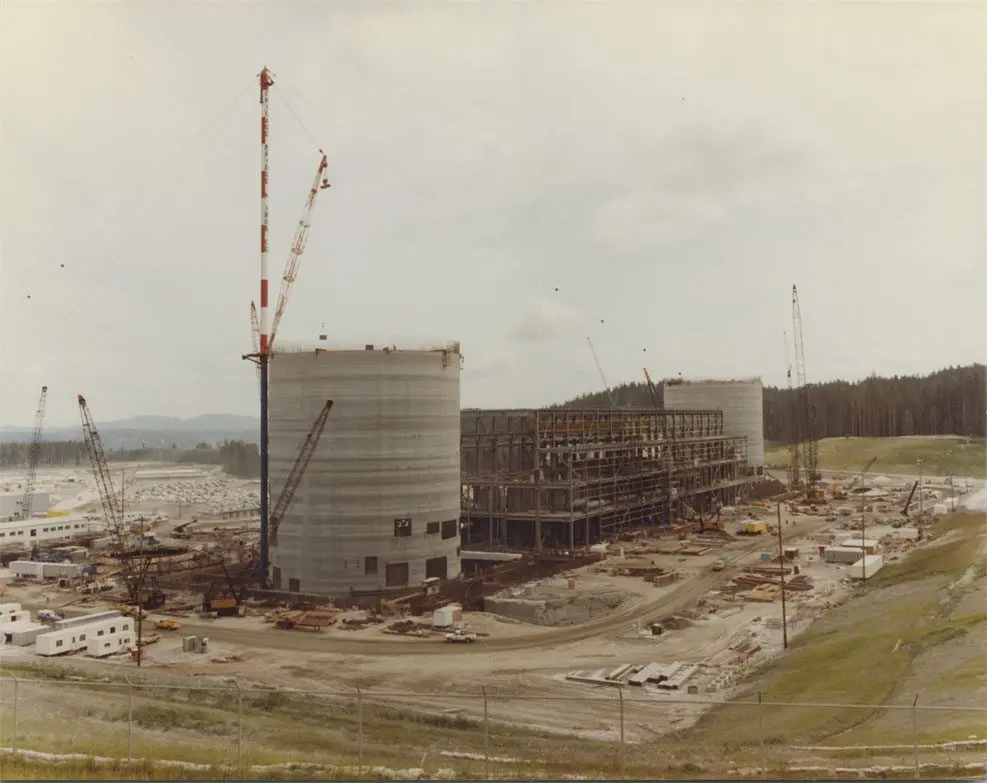
OLYMPIA, WA – Washington spent much of the 1970s trying to become a center for nuclear power, with plans for five huge fission reactors at Richland and Satsop.
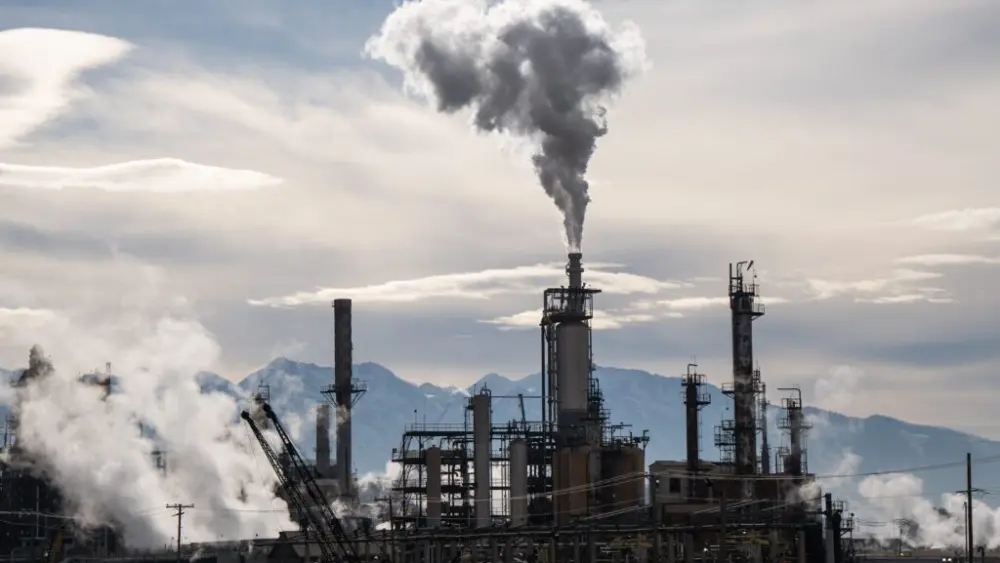
Then came cost overruns, construction problems, and one of the biggest municipal bond defaults in Wall Street history in 1983.
Only one of the five proposed reactors of the Washington Public Power Supply System — or WPPSS, commonly pronounced “Whoops” — was finished at Richland. In 1998, WPPSS became Energy Northwest largely to erase the stigma, and completed the 1,150-megawatt reactor that became the Columbia Generating Station.
Fast forward to today.
Again, Washington is trying to become a hub for nuclear power. But instead of monster-size reactors, the state is now home to multiple ventures involving smaller reactors — all using technologies unheard of in the 1970s and 1980s.
Fusion and small modular reactors are the emerging sources of nuclear power, although both are still fledgling technologies. Policymakers are looking at both. So, too, are some of the nation’s largest tech corporations, eager to find power for electricity-hungry data centers.
One of the first commercially viable fusion reactors in the U.S. is under construction roughly 6 miles southeast of Wenatchee. It’s expected to be working by 2028, with power going to Microsoft. Fusion reactors are attractive in part because they don’t produce highly radioactive waste.
Efforts are also underway to develop a different type of fusion reactor in Everett and Richland. These would be small portable units.
And there are plans for what could be the nation’s second small modular reactor complex at Richland. Amazon is playing a part in that potential undertaking. Small modular reactors are essentially prefabricated mini-versions of traditional fission reactors. They are supposedly faster and cheaper to build than traditional reactors.
In the works
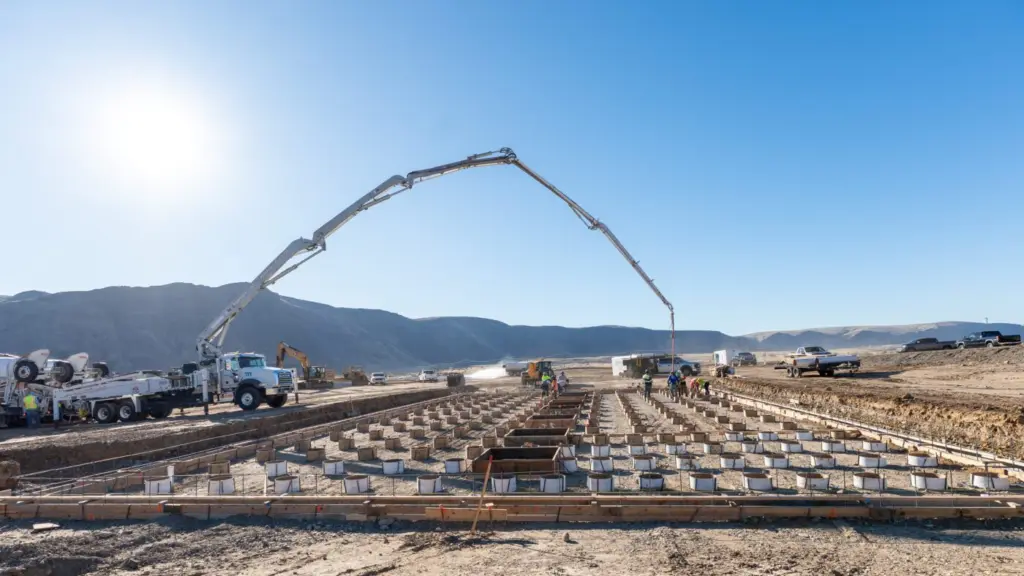
Founded in 2013 in Redmond, Helion Energy moved its main lab to Everett and recently began construction in July on a reactor site in the small Chelan County town of Malaga.
“This is a first-of-its-kind generator,” said Helion co-founder Anthony Pancotti.
The Malaga complex will house a 50-megawatt fusion reactor called Orion. The plan is for the reactor to deliver power to Microsoft under a contract between the two companies.
Helion’s long-term plan is to eventually produce more of these reactors to be distributed worldwide, Pancotti said. Helion has roughly 450 employees at Everett and Malaga.
Small portable fusion reactors — about the size of a wine barrel and capable of generating 100 kilowatts — could become a reality in southern Seattle and Richland in a few years.
“What we are going for is mobile power,” said Brian Riordan, cofounder of Avalanche Energy, a company based in the Seattle area that is developing space and underwater fusion reactors.
Initial customers would likely buy the mini-reactors for military satellites and unmanned underwater vehicles. Riordan hopes to sell Avalanche’s first 100-kilowatt reactor before 2030.
The company plans to branch out into other uses, for portable power generators, with Riordan noting that the fusion device needs to produce electricity cheaper than what is created by wind and solar power options.
Avalanche’s headquarters and research facilities are near Boeing Field. The company recently leased a Port of Benton facility in northern Richland for an operation called FusionWERX.
“FusionWERX is going to be the fusion industry’s equivalent of a commercial wind tunnel — an open-access facility where new ideas, technologies, and components can be tested and validated,” Avalanche’s CEO, Robin Langtry, said in a statement.
Avalanche has roughly 70 employees split between Seattle and Richland.
Another company, X-energy, signed agreements last year with Amazon and Energy Northwest for the retail giant to invest $334 million to study putting four modular reactors on the site of the half-built WPPSS Reactor No. 1, which is next to the Columbia Generating Station.
This piece of federal land gives the project the advantage of existing infrastructure, including roads and utilities from the 1980s.
Amazon’s interest is prompted by its plans to build data centers.
The four-reactor proposal — dubbed the “Cascade Advanced Energy Facility” — would produce 320 megawatts, with the possibility of adding more reactors to reach 960 megawatts.
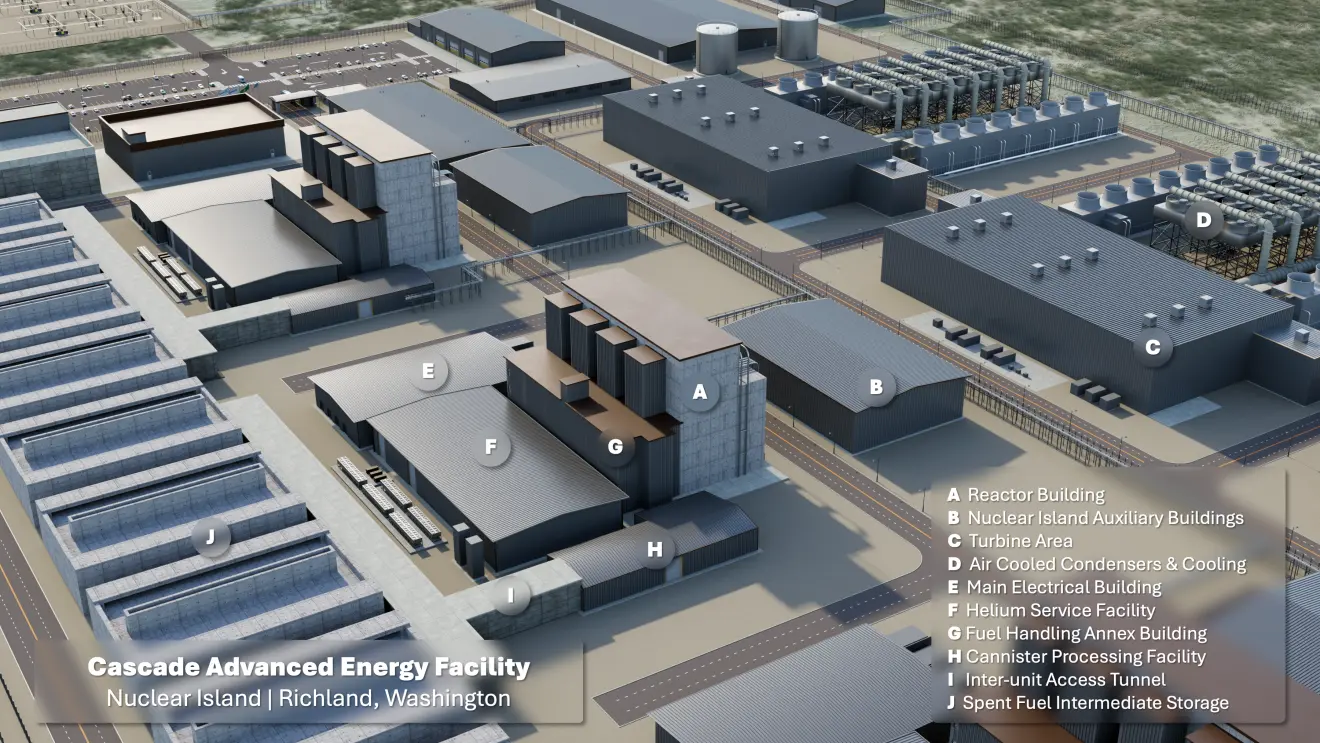
A rendering released last year of the Cascade Advanced Energy Facility, which could end up being the first small modular reactor facility in the Pacific Northwest. (Image courtesy of Energy Northwest)
Energy Northwest has been doing environmental, safety and legal reviews on the proposal. Construction is tentatively set to begin at the end of this decade.
Amazon has tentative plans to work with X-energy to build small modular reactors across the nation by 2039 that would collectively produce 5,000 megawatts of power.
‘The world’s leading hub for fusion’
The concept of fusion has been around for roughly a century. Right now, around 40 fusion development projects using different technologies exist worldwide, while no commercially viable fusion reactors are currently producing electricity.
A huge hurdle is that the amount of electricity needed to create a fusion reaction is greater than the power that would be produced. In 2022, the Lawrence Livermore National Laboratory in California used lasers to produce surplus electricity.
Shortly afterward, Helion Energy achieved that same goal with a setup that slams two atoms together.
Practical fusion is so new that the U.S. Nuclear Regulatory Commission — which routinely takes years to approve new designs for fission reactors — currently does not regulate fusion devices.
Consequently, Helion and Avalanche do not need the commission’s approval for their devices. Instead, they obtain permits from the state and their host counties.
That will likely change soon. Last July, the Nuclear Regulatory Commission sent a report to Congress on how it should license fusion devices.
On Oct. 31, U.S. Sen. Maria Cantwell and U.S. Rep. Suzan DelBene, both Washington Democrats, along with other congressional members of both parties, announced the introduction of a bill to provide tax credits for fusion-related ventures.
“The state of Washington is the world’s leading hub for fusion energy, which one day could provide vast amounts of the type of power we need to keep electricity prices down and increase America’s economic competitiveness,” Cantwell said in a press release.
Then, in November, the U.S. Department of Energy created an Office of Fusion as the Trump administration moved away from renewable energy, such as wind and solar power, in order to shift money to nuclear and fossil fuel development.
Fusion leaders met with the Energy Department on Dec. 9 to lobby for federal support for fusion.
“Now is the time for the U.S. to make a significant investment, and that means over a billion dollars per year in annual appropriations and a one-time infrastructure investment,” Andrew Holland, CEO of the Fusion Industry Association, said at the time, according to Reuters.
Pacific Northwest National Laboratory, a huge federal lab in northern Richland, is beginning two fusion-related materials projects. Materials are critical as, during operation, components of fusion reactors can reach temperatures hotter than the sun.
The Tri-Cities area has deep roots and a strong workforce in the nuclear sector, tracing back to the Manhattan Project in 1943.
Consequently, this region has great interest in new types of reactors, the fusion industry, and clean energy projects, said David Reeploeg, head of federal relations for the Tri-City Development Council, and Sean O’Brien, executive director of the council’s clean energy spinoff called the Energy Forward Alliance.
The Tri-Cities, which include Kennewick, Pasco, and Richland, are also looking at attracting data centers with local nuclear power and having a long-time nuclear fuel assembly plant expand the types of fuel it can offer, Reeploeg and O’Brien said.
“The key focus for us is keeping our workforce employed,” O’ Brien said.
Modular designs
Small modular reactors are like prefabricated houses. There are locked-in designs and pre-built components, which are then taken to a site and assembled. Small modular reactors are designed so extra modules can be added as needed. This concept is supposed to lead to lower costs, faster construction and more flexibility.
Each modular unit would be a mini-reactor capable of generating 50 to 300 megawatts of energy.
Some U.S. and world leaders are pushing this new nuclear reactor as a carbon-emissions-free power technology to combat climate change.
NuScale Power, based in Corvallis, Oregon, is the only U.S. venture so far to receive Nuclear Regulatory Commission approval for its small modular reactor design.
The company obtained a contract to build a modular reactor complex at Idaho Falls for Utah Associated Municipal Power Systems, which is part of the Utah state government and provides electricity to four states.
However, many of that project’s prospective customers dropped out, and the project was canceled in 2023.
A 2022 Stanford University study raised questions about contamination from used nuclear fuel from small modular reactors. It looked at NuScale’s designs, as well as designs from two other companies submitted to the federal government. Not among them was X-energy’s, the company involved in the project with Energy Northwest and Amazon. The study picked NuScale’s design because it was the furthest along in the federal review process.
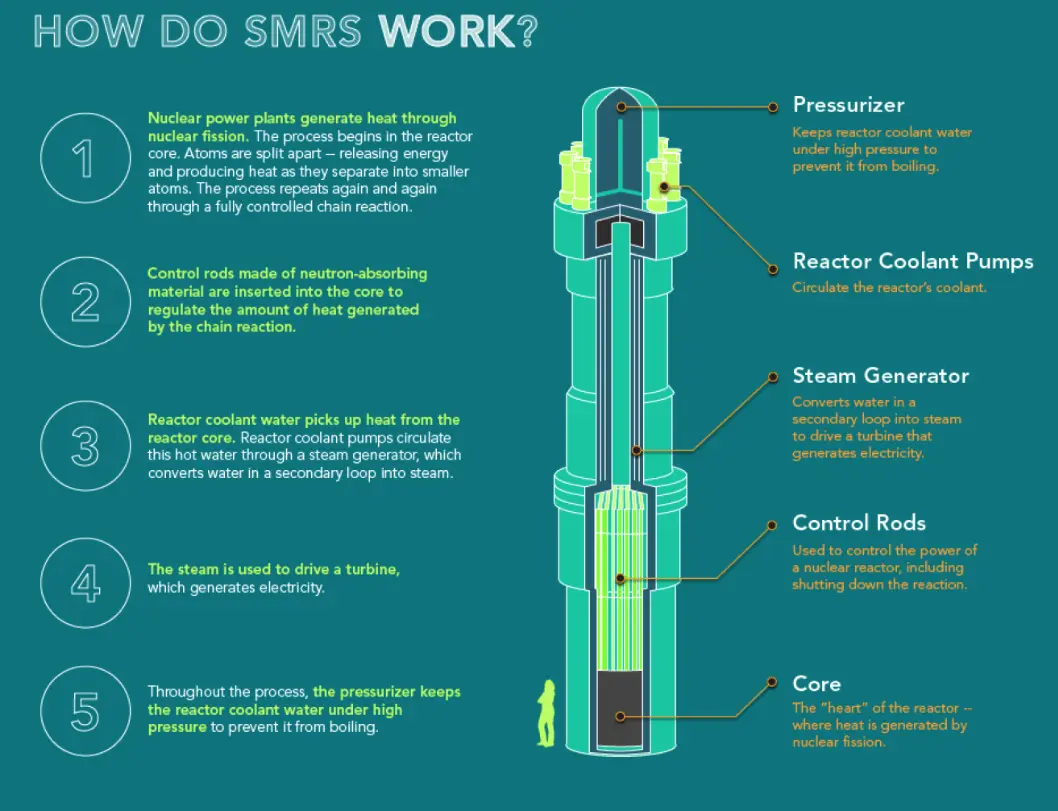
A diagram showing the basics of a small modular reactor unit. (Image courtesy of U.S. Department of Energy)
The Stanford study concluded that NuScale’s design and the two others would produce greater volumes of radioactive waste than conventional reactors, and that the used reactor fuel would be roughly 50% more radioactive.
NuScale contested those conclusions, saying the Stanford study looked at outdated designs.
State legislation teed up
Two Republican Washington state legislators — with high-ranking Democratic cosponsors — have introduced similar 2026 nuclear fission power reactor bills in the Senate and House.
The bills, which do not mention fusion power, call for developing a nuclear power development master plan for Washington state by Dec. 15, 2026. Introduced by Sen. John Braun, R-Centralia and Rep. Stephanie Barnard, R-Pasco, the legislation points to signs that Washington’s push for alternative power sources might not meet the state’s needs.
Washington is a net exporter of electricity, but the state government predicts it will be a net importer of power by 2050. Meanwhile, Montana and Wyoming were expected to send wind and solar power to Washington in the next few decades. But the legislation says that those power sources now look less promising.
The proposed report would address future fission power reactor goals, plus what various governments and utilities should do. It would also look at financing, siting, consulting with tribes, workforce requirements, and regulatory needs.
Washington State Standard is part of States Newsroom, a nonprofit news network supported by grants and a coalition of donors as a 501c(3) public charity. Washington State Standard maintains editorial independence. Contact Editor Bill Lucia for questions: info@washingtonstatestandard.com.