Originally posted on IdahoEdNews.org on January 15, 2026
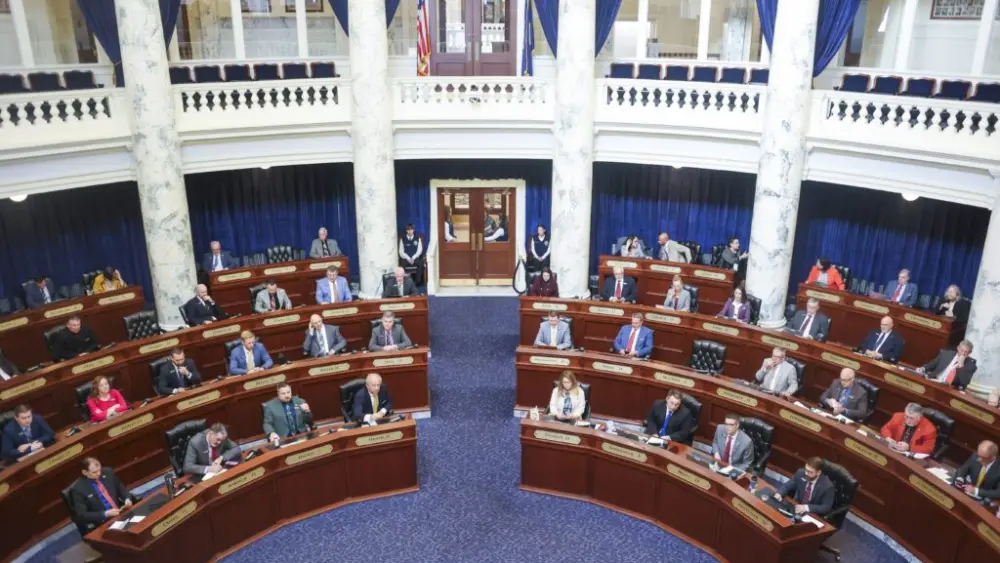
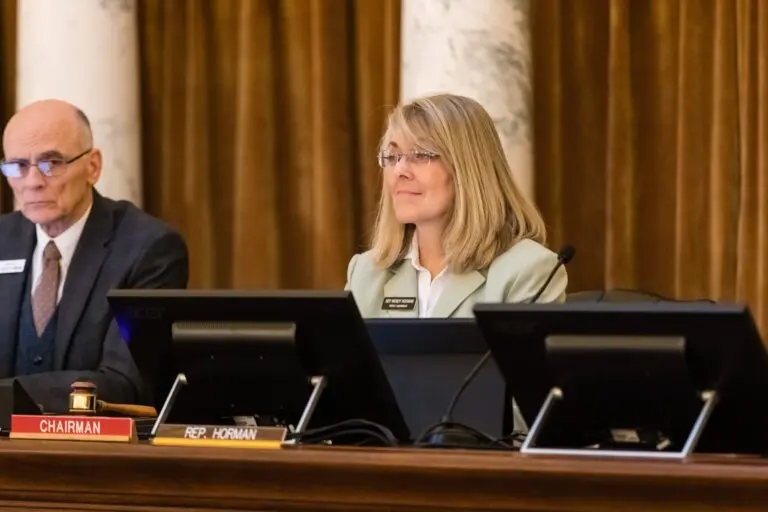
BOISE, ID – While legislators were busily moving back into the Statehouse last week, Wendy Horman was busily moving out.
She was boxing up belongings and recycling paper, accumulated over 13 years in the House and three years co-piloting the Legislature’s most important committee. Sifting through the past, Horman was also sorting out her future.
“OK, I got to call the White House,” she said in mid-interview, glancing at her cell phone.
Horman resigned from the Legislature on Jan. 5. In late January, she will begin her work at the U.S. Department of Health and Human Services. The three-year presidential appointment, as director of the HHS Office of Child Care, will probably mark the end of Horman’s political career in Idaho.
Resigning in the middle of her seventh legislative term, Horman leaves a deep imprint but a complex legacy. And an unfinished body of work.
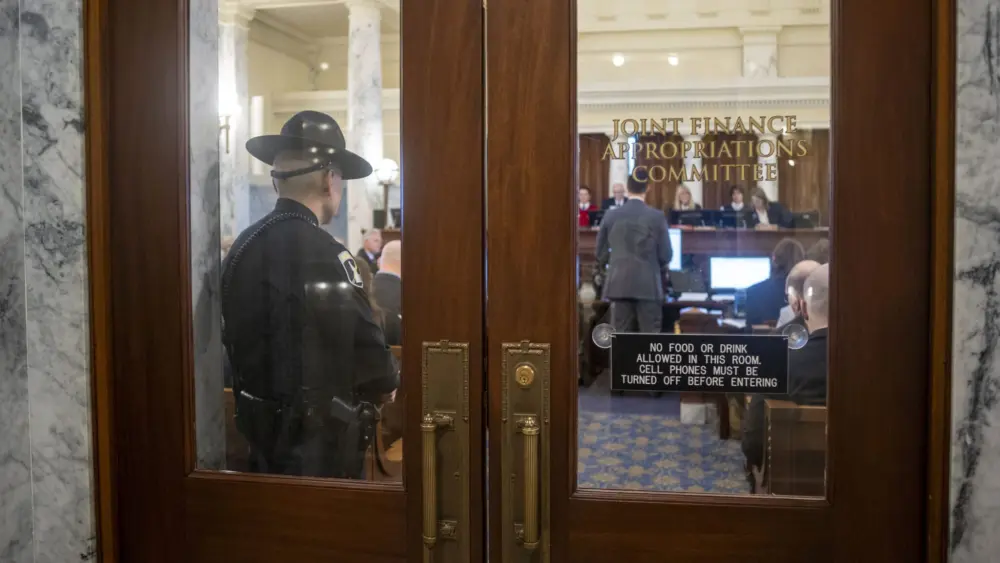
Drawing on her prior experience as a volunteer school trustee, Horman dove into the complexities of state school spending. For more than a decade, no legislator has put more fingerprints on education budgets. But as Horman leaves the Legislature’s powerful budget-writing Joint Finance-Appropriations Committee, lawmakers will face Idaho’s most acute fiscal crunch in nearly 20 years.
Drawing on her life experience as a mother of five children, Horman was a driving force in the Statehouse’s bitter private school choice debate. She finally prevailed in 2025, co-sponsoring a $50 million tax credit law that Gov. Brad Little signed in February. “If I didn’t believe so deeply in the need for families to be able to choose the education setting that works best for their child, especially families of modest means, I would have quit a long time ago,” Horman said in an interview last week.
But now, it will be up to future legislators to implement the controversial program — if the Idaho Supreme Court doesn’t toss out the law first.
Horman’s departure, like her legislative career, draws polarizing reactions. Some education leaders grew to see Horman as an adversary, and now are hoping for a reset in the Statehouse dialogue. Horman’s supporters are already sensing the void.
“You need a partner on the other side of the building,” said Senate Majority Leader Den Hartog, R-Meridian, one of Horman’s closest legislative allies. “This is a relationship business … We’re a whole bunch of different humans thrown in together.”
From Idaho Falls to the White House
The HHS opening, said Horman, was “just lightning in a bottle.” Her husband, Briggs, was in the process of selling his physical therapy business and moving into retirement. The Hormans have a daughter living in the Washington, D.C., area.
The Hormans were open to moving. Alex Adams — a former Idaho state budget chief and state Department of Health and Welfare director — was looking for someone to work with him in the Trump administration’s HHS.
Horman began interviewing for the job in November, all by phone. The White House was involved, she said.
Horman accepted the job on Dec. 16, days before HHS took center stage in a story that went viral during the holiday news cycle.
Conservative YouTuber Nick Shirley posted a video alleging $110 million in fraud in Minnesota day care centers. The Trump administration froze Minnesota’s federal day care funding, thrusting itself into the fray. Adams, assistant secretary for Administration for Children and Families in HHS, became the administration’s public face of the freeze.
Horman supports the freeze, and expecting day care centers and state agencies to validate their attendance records. “Legitimate businesses might see maybe a slight delay, but they’re not going to be threatened,” she said in an EdNews interview last week.
Horman also praises her soon-to-be boss, and says the working relationship she had with Adams factored into her move. “It’s just a great opportunity to work with a fantastic leader again.”
Horman also sees a nexus between her Statehouse experience and her next job. She said Adams wants someone to bring a “school choice mindset” to child care, focusing on policies that work well for families, not government. The job’s increased focus on accountability doesn’t faze her.
“I’ve done this before, and I’ll just be doing it with numbers that have a few more zeroes than here in Idaho,” she said.
From the school board to the Statehouse
After serving a decade on the Bonneville School Board, Horman came to the Legislature in 2012. House leadership appointed her to JFAC in 2014, where she quickly applied her trustee’s experience to state education budgets.
On spending bills, the grunt work of crunching numbers and crafting legislation quietly occurs behind the scenes, done by groups of House and Senate members and Republicans and Democrats. This is where Horman did much of her work, especially on school budgets.
On the House floor, Horman was the go-to source on education policy issues; when she wasn’t carrying education bills on the floor, she frequently jumped into debates to answer technical or pointed questions or talk through sticky spending line items.
Horman continued to accrue seniority. In 2022, Nampa Republican Rep. Rick Youngblood decided not to seek re-election, creating an opening as JFAC co-chair. Horman landed the post after the 2022 elections.
Her three years as JFAC co-chair were turbulent. Horman and her Senate counterpart — Eagle Republican C. Scott Grow, an accountant — reworked the way JFAC wrote budget bills. They pushed a two-step process: writing “maintenance” budgets that included base spending from the previous year, and “enhancement” budgets covering new spending.
In 2024, the fight over process turned into a bloodbath. Moderate Republicans and Democrats fought the process, first in JFAC and then on the House floor. Critics argued that the “maintenance” budgets were cumbersome omnibus bills, and said the process would allow the Legislature to scuttle any new bills that included new spending. The House voted to uphold the process — a political victory for Horman and House Speaker Mike Moyle, R-Star, an architect of the new process.
The same week, House Republicans voted to remove Rep. Megan Blanksma of Hammett from their leadership team, after she opposed the maintenance budgets.
Horman adamantly defends the changes — and says they make even more sense now, when the Legislature will have to cut spending to balance 2026 and 2027 budgets.
“(This) is exactly the moment we were preparing for,” she said.
The funding formula impasse — and a battle with the establishment
Horman’s first elected position put her squarely in the middle of public education, a volunteer trustee in one of Idaho’s largest districts. It also was an entry point to statewide politics. In 2007, she was elected president of the Idaho School Boards Association, one of the state’s preeminent education lobbying groups.
Over time, and particularly in 2025, Horman often found herself at odds with the education establishment. On private school choice, a highly public rift playing out in packed and tense committee hearings. On the state’s school funding formula — an arcane yet critical issue, affecting the way Idaho spends money to educate 300,000 students — the split was subtle yet perceptible.
State superintendent Debbie Critchfield and Sen. Jim Woodward, R-Sagle, partnered on a bill to attach “weights” to some school funding — providing more money for special education and gifted and talented programs and bolstering support for at-risk students. The Senate passed the bill, marking a defining moment; after nine years of debate and study, a funding formula bill had finally cleared a legislative body.
It was dead on arrival in the House. Horman had a competing bill — a go-slow proposal for student weights. She knew her bill had no shot in the Senate. But in a sign of Horman’s clout, the Critchfield-Woodward bill also had no shot in the House.
For ISBA deputy director Quinn Perry, the funding formula impasse represents part of Horman’s complicated legacy. Perry said she has deep respect for Horman and her work on ISBA’s behalf. But in a recent Idaho EdNews podcast, both Perry and Idaho Education Association deputy executive director Matt Compton criticized Horman for slamming the brakes on a funding formula rewrite.
“Even having one person shift away from the Legislature is still going to change the conversations about education policy moving forward,” Perry said. “It’s a more collaborative climate, if I’m being honest.”
Den Hartog forged her working relationship with Horman, in part, on the funding formula issue. In 2017, Den Hartog was named to a legislative committee reviewing the formula; Horman was one of its co-chairs. On the formula and other education issues, Den Hartog and Horman quickly found common ground.
But the funding formula remains unchanged from its 1994 model.
Horman laments the formula’s “unnecessary complexity,” and still supports the idea of student weights. She is leaving draft funding formula bills behind for any legislator who wants to run with them.
And Den Hartog believes the Legislature will take care of this unfinished business. Lawmakers finally seem to have coalesced behind one basic point: Idaho should spend more money for students who need the support.
“When we first started, there wasn’t even agreement on that,” she said.
Private school choice: the biggest fight of Horman’s career
There might be consensus — or at least the makings of one — on the funding formula. No such agreement surrounds private school choice. Supporters liken private school choice to a civil rights issue, opening options to families who cannot otherwise afford them. Opponents consider private school choice unfair and unconstitutional, a threat to the principle of free public education.
It was, not surprisingly, the biggest fight of Horman’s legislative career.
She aligned with Den Hartog and private school choice allies — over several legislative sessions, without success. The debate intensified in 2024.
In March, the House Revenue and Taxation Committee narrowly killed a Horman-sponsored bill to establish a $50 million private school tax credit.
In May, Horman found herself in the political crosshairs. Right 2 Learn, a political action committee aligned with the IEA, spent more than $70,000 opposing Horman and backing one of her Republican primary challengers, Ammon Mayor Sean Coletti.
“The union came after me,” Horman said. “Not because I’d gotten anything passed, but just because I tried.”
Horman won her primary.
Nine months later, a similar $50 million private school tax credit bill became law.
For Horman, the issue was grounded in personal experience. She tried a variety of options for her five children — public schools, charter school, virtual school and home school — searching for the best place for each of them. Only private school was off the table, because it was too expensive.
“I have been that parent. And that’s why I have such a deep commitment to those parents who want to do the best thing for their kid and they can’t afford it,” she said. “It was a worthwhile fight.”
The end of that fight marks a new phase: implementing a new and controversial program that will face unblinking scrutiny. Horman hopes future legislators simply let the data guide them — to determine whether to expand the credits, when funding is available.
While Horman has a passion for parental choice, she also has an eye for substance and data, said Jeremy Chou, a Boise lobbyist who represents American Federation for Children, a Washington, D.C., group that supports private school choice. Other advocates can step into the void, he said. But there will be a void.
“It’s a great loss having her as a stalwart and in the forefront,” he said.
Where Horman — and the Legislature — goes from here
Horman, 60, views her next job as, possibly, her last one.
Her HHS appointment will end when Trump’s term ends. A future president could reappoint her, but that is not guaranteed.
She is unlikely to return to Idaho politics. “That is not the plan,” she said.
It’s also unlikely she will return to Idaho. The Hormans’ children have left Idaho for Washington, D.C., Texas, California and Utah, which could drive their relocation decisions. One option is St. George, Utah — where two of their children live, and where Wendy Horman attended college.
While Horman’s 13-year House career made an indelible mark, her departure has created its own set of ripples. Hardline conservative Rep. Josh Tanner, R-Eagle, left House leadership to take Horman’s spot at the helm of JFAC. Rep. Douglas Pickett, R-Oakley, traded his seat as House Education Committee chairman for Tanner’s leadership post. Hardline Rep. Dale Hawkins, R-Fernwood, was promoted from House Education vice chair to chair — heading a committee that appears to be sharply divided on ideological lines.
Budget and education decisions, Horman’s public policy wheelhouse, will fall to a House that looks considerably different than it did when Horman was still in office.
The 2026 Legislature will have to bridge a budget gap that widened and deepened over the past few months. Little proposed a spending plan Monday that calls for $222.9 million in cuts, reversions and fund transfers balance this year’s budget, and $642.5 million of surgery on next year’s budget.
Horman says she is leaving without misgivings. The Legislature did what it should to prepare for the job before them, loading reserve accounts to $1.3 billion and paying down debt. Horman also has full confidence in Tanner, saying he will partner well with Grow, her Senate counterpart from 2022 through 2025.
Their job will differ fundamentally from the one Horman faced in recent sessions. Instead of managing budget growth bankrolled by one-time federal pandemic aid, she said last week, cuts are now inevitable.
“It’s an exercise on paper at this point,” she said, “until we come in and we make sure that the (Fiscal Year 2026) and the (Fiscal Year 2027) budget are balanced and fully constitutional.
“I used the word ‘we.’ I shouldn’t use that word. ‘They.’”