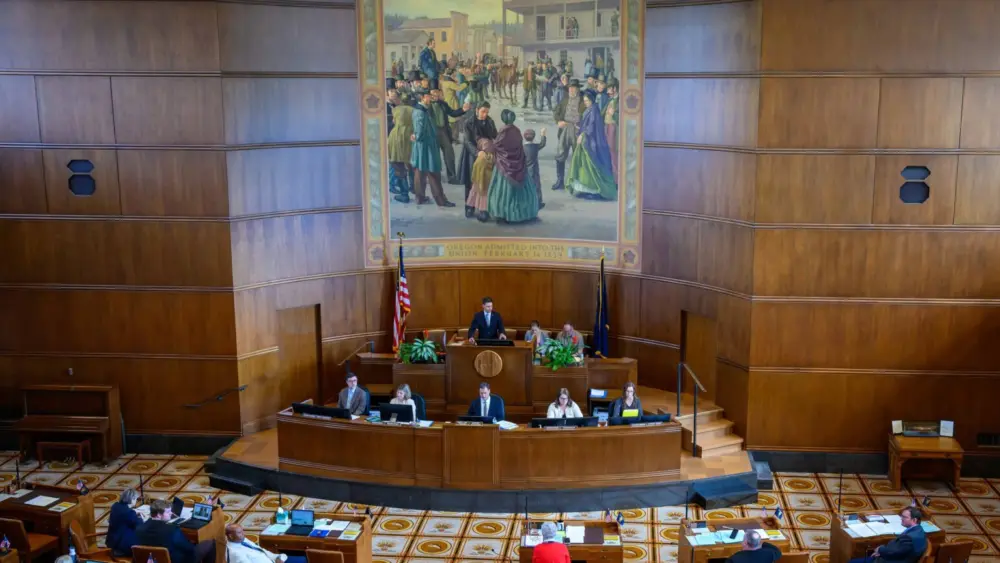
Spokane County Sheriff John Nowels, and the president of the Washington Association of Sheriffs and Police Chiefs, issued a statement on behalf of WASPC after a public hearing on Senate Bill 5974. The group raised “grave” concerns about its potential to remove an elected county sheriff from their office.
However, WASPC’s address was in response to Pierce County Sheriff Keith Swank. Elected in 2024 with more than three decades in law enforcement, the sheriff doesn’t shy away from expressing his political opinion online. He thinks SB 5974 is government overreach to suppress his First Amendment rights.
“I don’t recognize your authority to impose these controls over me, and when you try to remove me from office, thousands of Pierce County residents will surround the County-City Building in downtown Tacoma and will not allow that to happen,” Swank told the Senate Law & Justice Committee Thursday.
“I hope it doesn’t come to that, but I and they are prepared,” Swank warned. “Are you prepared?”
Some people in attendance began clapping before Sen. Manka Dhingra, D-Redmond, said they would be removed if they continued. Senate Republicans posted to social media afterward that nearly 13,000 people signed in against SB 5974 on Thursday, 87% of the total, compared to just 1,871 in support.
Sen. John Lovick, D-Mill Creek, whose prior law enforcement career also spanned several decades, put his name on SB 5974 along with Dhingra and several other majority members. It follows a similar bill from last year that WASPC also opposed, which was referred to a House committee again on Monday.
If approved, SB 5974 would set new criteria to become sheriff. One provision would disqualify a sheriff if the state Criminal Justice Training Commission has ever denied or pulled their certification. State law already provides several options, and critics have recently filed complaints over Swank’s social media.
A background check requirement in SB 5974 also includes a social media review and allows the CJTC to consult polygraph examiners. The proposal says it could also include a psychological examination.
“I propose that everyone who runs for an elected office go through a background check, a social media review, a polygraph, and a psychological test,” Swank testified on Thursday. “Democrats won’t agree to that because you have convicted felons who are elected officials, and you want more.”
Rep. Jim Walsh, R-Aberdeen, told The Center Square on Friday that Swank is a “roughhewn man.”
“He tells the truth in a way that sometimes rubs other people the wrong way. It’s who he is,” Walsh said.
“I’m not even being critical of him,” he said. “Some of the other sheriffs are acting surprised. I don’t think they are really that surprised. They know that’s how Swank operates. I’m not crazy about the compromise proposal. Brian Burnett is a very smart guy. The bill is undeniably better, but I’m not sure it’s good.”
Another recent proposal, House Bill 2387, which has bipartisan cosponsors, takes a different approach by triggering recall proceedings upon decertification, but doesn’t immediately pull a sheriff from office.
Supporters argue that the Senate’s proposal modernizes existing legislation and holds sheriffs to the same standards as other unelected law enforcement leaders. Critics say SB 5974 overrides the voters, including Chelan County Sheriff Mike Morrison, who questioned where Democratic authority will stop.
U.S. Rep. Michael Baumgartner, R-Spokane, told The Center Square that he supports elected sheriff’s right to be in office.
“It’s definitely the wrong move to take away the independence of county sheriffs with a mandate from Olympia and, you know, it’s something that should be resisted,” Baumgartner said Friday, noting that he hadn’t seen Swank’s testimony yet. “When left-wing radicals in Olympia try to tell us how to live in eastern Washington, it creates resentment, and this is a huge government overreach, which is going to further alienate people in rural communities and in the more conservative parts of the state.”
WASPC opposes the bill, but says Swank’s “inflammatory” testimony isn’t representative of the group.
“His testimony went beyond reasonable dialogue,” Nowels said in a statement with WASPC Executive Director Steven Strachan, “and devolved into what could be perceived as threatening to legislators.”
They said Swank challenged the constitutional authority of the lawmakers and acted in a manner that doesn’t align with WASPC’s expectations, reaffirming their commitment to the rule of law. The address closed by stating that WASPC intends to initiate proceedings to “consider expulsion of Sheriff Swank.”
The statement said WASPC’s bylaws require the board to do this and that the association stands ready to work with everyone, including Democrats and Republicans in the Legislature, in a way that builds trust.
Critics responded online by calling Swank’s testimony political intimidation, while others said WASPC is “part of the problem.” An outpouring of support flooded his X post, including the testimony, with some calling for more elected officials like Swank, though that sentiment wasn’t representative of everyone.
“This is what happens when you don’t tow the party line,” Swank posted to X on Thursday in response to WASPC. “Everyone should read this and ask your sheriff if he supports expulsion for Sheriff Swank.”
The Center Square was unable to reach Swank, Nowels and Dhingra for comment before publishing on Friday. Swank’s testimony from Thursday is available to read here.
“Citizens reach out to me all the time regarding overreach of the government by you. Some say they finally have a voice because of me, and you want to silence my voice. If I towed the Democrat line, you would not have any issue with me, but since I know what a woman is and I know transgender women are men, you want me silenced,” Swank testified. “You want to give an un-elected bureaucracy the ability to de-certify me and remove me from office because you don’t agree with my speech.”