HANFORD, WA – Congress this week approved a $3.2 billion budget for the Hanford nuclear reservation’s cleanup in fiscal 2026 — a more than $200 million increase from the prior two years.
That is more than what the Trump administration originally requested for Hanford, but almost $3 billion less than what Washington officials believe is needed this year to keep the site’s cleanup on its legally mandated timetable. This is also the biggest cleanup budget in Hanford’s history.
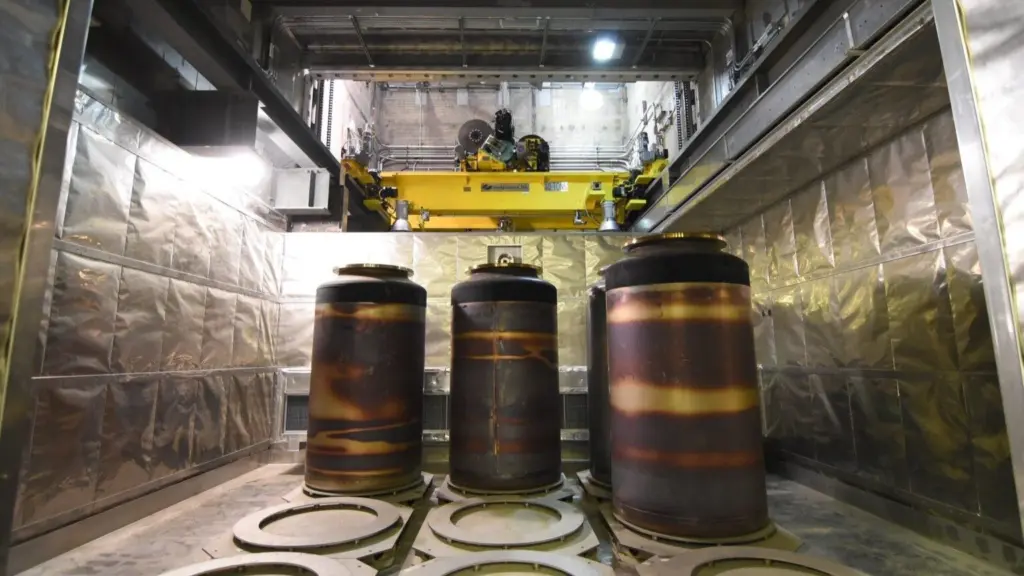
President Donald Trump’s budget request allocated slightly less than $400 million to operate Hanford’s biggest project — the new plant to convert the site’s radioactive waste into glass, which began operating in October.
Congress bumped that budget up to $480 million, according to the office of Washington U.S. Sen. Patty Murray, the top Democrat on the Senate Appropriations Committee.
Murray said in a statement that Thursday’s Senate approval was “a rejection of the Trump administration’s efforts to undermine the Hanford cleanup mission.”
“We cannot do nuclear waste cleanup on the cheap,” she said.
The House passed the same budget earlier this month.
Washington’s Department of Ecology calculates that Hanford needs a budget of $6.15 billion to meet all of its legal cleanup obligations for fiscal 2026, and $6.76 billion for fiscal 2027.
Hanford’s cleanup is governed by an often-litigated and often-changed 35-year-old legal agreement between the state, the U.S. Department of Energy and the U.S. Environmental Protection Agency.
“The federal government has a big job to do cleaning up Hanford,” Gov. Bob Ferguson, a Democrat, said in a statement. “This budget is a positive step forward in ensuring they live up to their responsibilities.”
“We have made important progress this year. Let’s keep up the momentum,” he added.
Casey Sixkiller, director of the state ecology department, also acknowledged progress with the cleanup in the past year.
“We need to keep funding at a level where we can accelerate the pace of cleanup and reduce the risk of a catastrophic infrastructure collapse or contamination release,” Sixkiller said. “Now is the time for the federal government to double down and not back away from its legal and moral obligations to the people of Washington state. ”
Hanford is arguably the most radioactively contaminated spot in the Western Hemisphere.
The U.S. government set up Hanford in 1943 to create plutonium for the nation’s atomic bombs, including those exploded in New Mexico and over Nagasaki in 1945. That work created many billions of gallons of chemical and radioactive waste.
The worst 56 million gallons of that waste were pumped into 177 underground tanks. About a third of those tanks leak. At least a million gallons of radioactive liquid have leaked into the ground, seeping into the aquifer 200 feet below and then into the Columbia River, roughly seven miles away.
Hanford has just begun converting lesser radioactive wastes in the tanks into a benign glass to be eventually stored at an underground storage site at a still undetermined location.
A second plant to tackle more radioactive waste could be operating in the 2030s.
Since the low-activity waste plant will handle only 40-50% of the less radioactive wastes, Hanford recently decided to look into encasing the remaining low-activity materials in a cement-like substance, which would be theoretically faster and cheaper than building a second low-level glassification plant.
Originally, the legal deadline to finish glassifying all 56 million gallons of tank wastes was 2019.
Right now, Hanford’s legal target is removing all the waste from 149 single-shell tanks and closing those tanks by 2043, and closing the 28 newer and safer double-shell tanks by 2052.
The Energy Department has moved those targets back to 2069, a date not reflected in its current cleanup agreements with the state of Washington, according to a 2021 report by the Government Accountability Office.
Washington State Standard is part of States Newsroom, a nonprofit news network supported by grants and a coalition of donors as a 501c(3) public charity. Washington State Standard maintains editorial independence. Contact Editor Bill Lucia for questions: info@washingtonstatestandard.com.