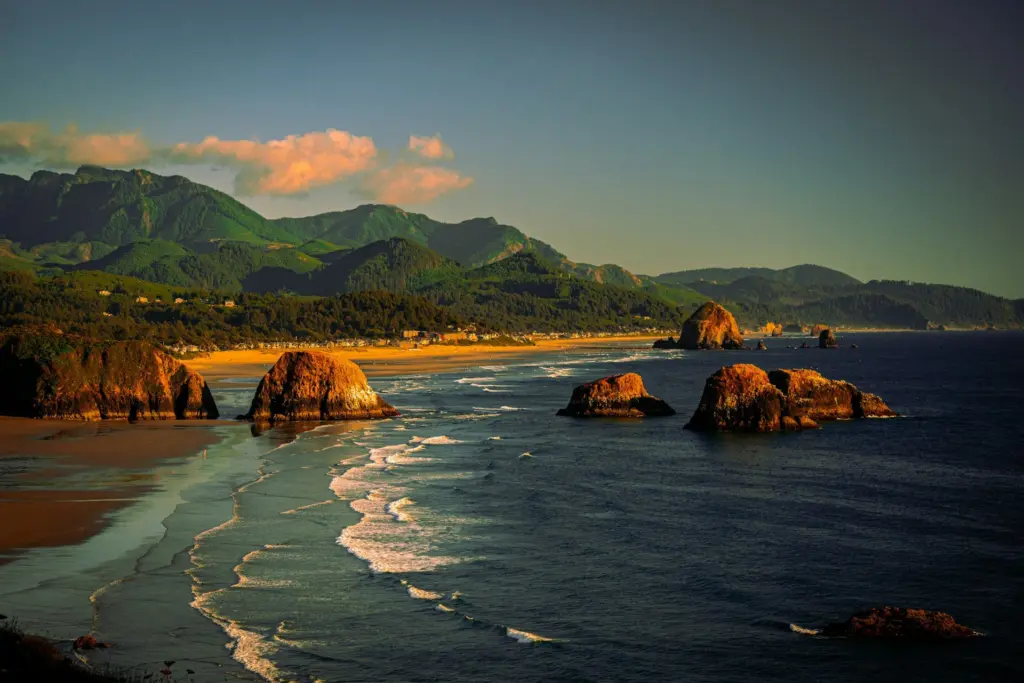
CANNON BEACH, OR – An Oregon family is currently involved in a legal dispute with a state agency, which is facing a budget shortfall, over whether they can remove sand covering a seawall built almost a century ago. The family says the wall was featured briefly at the beginning of the 1984 film “The Goonies.”
The family contends that they have for decades been granted permits from their local city government to remove sand building up along the seawall, which also acts as a visible boundary marker separating their property from the publicly accessibly beach area.
While the state agency fighting to prevent the removal of sand is currently running a budget deficit, the seawall owners say the multi-year legal battle has also been financially costly for them.
“It’s a nightmare,” Stacy Niedermeyer told The Center Square in an interview. “We’re trapped in this kind of no man’s land. They (the state) have prolonged it and prolonged it. We don’t get answers from them. It just goes to show how our state’s run.”
Built in the late 1930s, the seawall is located in front of the Ecola Inn at Cannon Beach. The seawall protects, among other things, the beachfront home of the Niedermeyer family. According to the family, they have the sand removed from it nearly every year since they have owned the property for the last 50 years. To do so, they receive from the city a permit for what is called “remedial grading,” in which sand building up along the seawall is removed and spread out elsewhere.
According to the Niedermeyer’s, since 1997 the city granted a permit whenever an application was submitted.
However, several years ago when their latest application was submitted and the city approved the permit, Oregon Parks and Recreation Department officials with oversight over the process began questioning whether the permit complied with state law, according to emails obtained by The Center Square. In addition to nearby state parks, OPRD manages the sandy beach and intertidal zone of the coastline and has oversight over alterations to the ocean shore.
The permit application to remove the sand was eventually withdrawn by the applicants, then later resubmitted, but ultimately OPRD denied the permit. The decision has been appealed and is now before an administrative judge.
Meanwhile, Stacy Niedermeyer said sand has accumulated to the point where the seawall is now completely covered and can no longer protect their home from high tides, flooding, coastal erosion, debris, or wreckage that might be brought up with the tide.
“We use all of our property,” she said, adding the seawall is “not just a barrier, but a boundary.”
With the seawall no longer visible, she said many people visiting the beach perceive their property as also public.
“They just go on there and set up picnics,” she said. “It’s everyone’s beach until somebody hurts themselves. Then it’s my beach.”
Mack Niedermeyer told The Center Square that it’s strange for OPRD to intervene with something that the city of Cannon Beach has typically handled, especially at a time when the state agency is facing budgetary issues.
OPRD’s initial shortfall for the biennium was estimated to be $14 million, but has since been reduced to $8 million. In response, the state agency has increased day-use parking fees, annual parking permit fees, proposed changes to camping/cabin rates and delayed certain capital projects.
“I think it’s absolutely ridiculous,” Mack Niedermeyer said. “We’ve been doing this for so long, and now the state is doing everything they can to stop us. I think there are way bigger battles (for them). We’re protecting our beach and protecting the barrier of our property.”
He added that without the seawall, “the house has no value.”
The Center Square reached out to OPRD requesting an interview to discuss the dispute and the reasons for the permit denial. External Relations Manager Katie wrote in an email that they weren’t able to discuss it, “as the permit decision is currently under review through the Office of Administrative Hearings contested case hearing process.”
The Center Square also reached out to the city of Cannon Beach requesting an interview to discuss the dispute, but did not receive a response by time of publication.