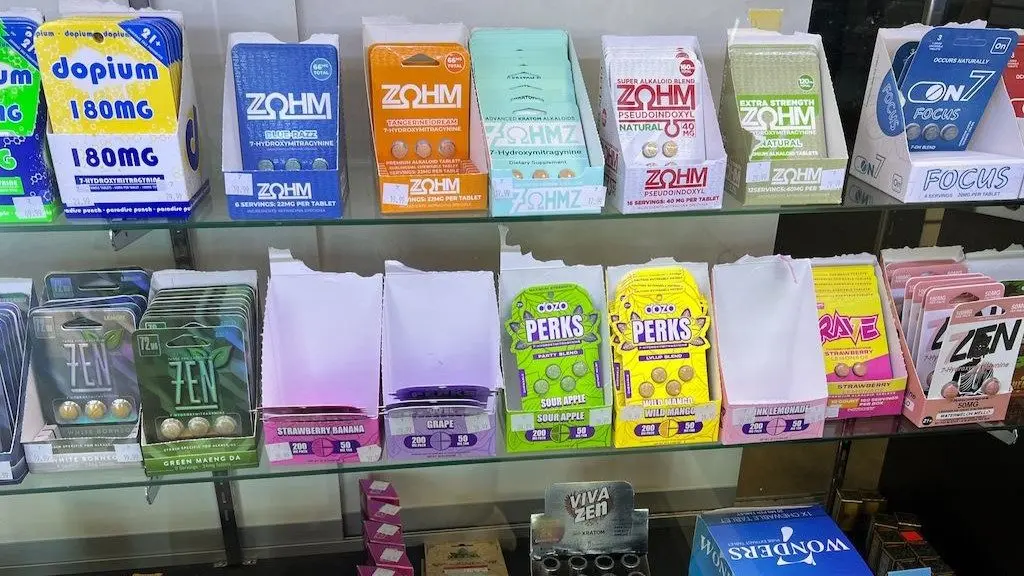
The supplement, which can have opioid-like effects, is available in gas stations and other retail shops. It’s raising public health concerns.
WASHINGTON STATE – Washington lawmakers are considering three bills to strengthen regulation of kratom, a psychoactive supplement sold at convenience stores and smoke shops.
One bill would impose a steep tax on the product. Another would ban the sale of a synthetic substance sometimes found in kratom. The third proposes a smaller tax combined with a version of the Kratom Consumer Protection Act, a regulatory framework passed in other states. All three measures would set new kratom labeling requirements.
Kratom comes from a tropical tree in Southeast Asia of the same name. Touted to treat pain, depression and anxiety, its use in the U.S. is on the rise, but many fear it’s a public health hazard.
According to the Drug Enforcement Administration, in low doses, kratom triggers stimulant effects, but in higher doses, it can be a sedative. Kratom contains a naturally occurring substance called 7-hydroxymitragynine, or 7-OH, that has been linked to opioid-like effects.
Some kratom products contain synthetically derived amounts of 7-OH, which can be addictive and trigger opioid withdrawal symptoms. Other harmful effects of kratom include nausea and vomiting, dry mouth, constipation, drowsiness and in some cases, seizures and hallucinations.
Due to its wide availability and low-cost, youth access is another concern.
‘People exhibiting opiate-like addiction’
Senate Bill 6196, sponsored by Sen. Rebecca Saldaña, D-Seattle, would impose a 95% tax on kratom at the distributor level. That funding would go to programs that prevent and reduce youth access to drugs. Distributors and retailers would be required to get a license from the Liquor and Cannabis Board, and if noncompliant, could face a felony.
The legislation also requires distributors and retailers to maintain invoices of sales for five years, and it would give state agencies the right to enter and inspect the records without a search warrant.
Opponents argue the bill fails to distinguish between lawful, natural products and dangerous synthetic opioids and that the large tax would hurt small businesses.
Tony Sermonti, a lobbyist for the American Kratom Association, said the group supports banning products that contain synthetically derived concentrations of 7-OH. But he said requirements the bill would set around recordkeeping, criminal penalties and how distributors transport kratom are problematic.
Saldaña’s bill is scheduled for a vote in the Senate Labor and Commerce Committee on Feb. 3.
Another proposal, Senate Bill 6287, sponsored by Sen. Jesse Salomon, D-Shoreline, would prohibit the sale of kratom containing more than 2% of 7-OH or any synthetic 7-OH. The bill would also ban the sale of kratom to anyone under 21 and require labeling the product with its full list of ingredients. Violations would be a gross misdemeanor.
“We have people exhibiting opiate-like addiction not just from fentanyl or heroin, but from things that they can buy at a gas station,” said Salomon in a Senate Labor and Commerce Committee hearing. “I think that is extremely concerning and we should take action.”
If a customer buys a product that contains ingredients that this bill prohibits, the person could bring civil action against the processor, retailer or both.
“The bill’s enforcement mechanism is unworkable for small retailers by jumping immediately to a private right of action,” said Molly Pfaffenroth, government affairs director for the Washington Food Industry Association.
Dr. Jimmy Leonard of the Washington Poison Center supports Salomon’s bill, but said the language could be improved.
“We’ve had two near-death experiences for young children who got into (7-OH),” he said, adding that Naloxone, a product used to reverse opioid overdoses, saved their lives. He described 7-OH as similar to morphine but potentially more potent.
Leonard noted that the bill wouldn’t regulate other products similar to kratom that could be considered “semi-synthetic,” but are equally as dangerous.
Scott Waller, board member of the Washington Association for Substance Abuse and Violence Prevention, said the bill could do more by creating a state licensing system for kratom.
Salomon’s legislation is also scheduled for a Feb. 3 vote in the Senate Labor and Commerce Committee.
Pulling from regulations passed in other states
There’s also House Bill 2291, sponsored by Rep. Kristine Reeves, D-Federal Way, which would establish the Kratom Consumer Protection Act. It would prohibit synthetic 7-OH, require contaminant testing and ban the sale of the supplement to anyone under 21. Legislation like this has passed in 19 other states, according to the American Kratom Association’s website.
Reeves’ bill would also impose an 11% excise tax on kratom products and would ban kratom containing more than 2% of 7-OH or kratom that is mixed with other dangerous substances.
It would require retailers and processors to get licensed through the state Liquor and Cannabis Board, setting a $1,000 licensing fee. Operating without a proper license would be a felony.
Processors would have to test kratom products through an independent testing laboratory, list ingredients on labels and use child-resistant packaging.
The Liquor and Cannabis Board would establish an online directory of all licensed processors for retailers to purchase from.
All state revenue from the bill – license fees, penalties and excise tax – would be deposited into a youth substance prevention account.
While the American Kratom Association supports establishing the Kratom Consumer Protection Act, Sermonti says Reeves’ bill differs from legislation in other states and doesn’t distinguish between natural kratom and synthetic products. Another pro-kratom group, Global Kratom Coalition, shares the concern.
The coalition is “ever opposed,” said Matthew Lowe, because of how the bill would regulate natural kratom.
“The enforcement mechanisms and the hard barriers to entry into this marketplace are more suited for the synthetic adulterated products that are hurting people as opposed to the natural leaf, which has been consumed in the United States for fifty years,” Lowe added.
The Washington Food Industry Association opposed the bill because of the $1,000 fee, as it is “significantly higher than tobacco licensing, which is $175,” said Pfaffenroth.
Derrick Nunnally, government relations advocate for the Association of Washington Cities, agreed with most of the bill, but not a block on local kratom regulations.
“Local jurisdictions have voted to prohibit kratom in a couple of isolated instances,” Nunnally said in committee testimony. “Other cities are looking anxiously to this Legislature to tell them when and how they can proceed with these regulations they wish to impose.”
Mike Kelly, city council member of Spokane Valley, said the council is actively considering a total ban on the sale of kratom and suggested amending the provision that would prevent that choice.
Reeves’ bill is scheduled for a vote in the House Committee on Consumer Protection and Business on Feb. 4.
One supporter of the bill described taking kratom for chronic pain.
“This helped me greatly,” said Scott Matlock, a resident of Spokane Valley, who uses kratom to manage neck pain due to an accident. “If you haven’t tried it, don’t judge it.”
Washington State Standard is part of States Newsroom, a nonprofit news network supported by grants and a coalition of donors as a 501c(3) public charity. Washington State Standard maintains editorial independence. Contact Editor Bill Lucia for questions: info@washingtonstatestandard.com.