OLYMPIA, WA – A bill that would allow a state board to remove an elected sheriff in the state of Washington passed off the Senate floor Thursday on a party line vote.
A department in the Washington State Criminal Justice Training Commission would have the power to remove elected sheriffs under Senate Bill 5974.
Currently 38 of Washington’s 39 counties have elected sheriffs. Only King County has an appointed sheriff.
Opponents warn the bill would take away the people’s right to elect a sheriff who represents their values and priorities. Supporters including Sen. Manka Dhingra, D-Seattle, contend the change is needed to update decades-old laws governing sheriffs and other law enforcement leaders, including setting clearer eligibility standards and accountability rules.
“When an elected sheriff can sit in a Senate committee room and threaten senators, what do we expect people to do with a pen and a piece of paper?” Dhingra said. “I fundamentally believe that the pen is mightier than the sword. But for the average person on the street, that gun is a lot more powerful than the pen. And that is why we need this bill.”
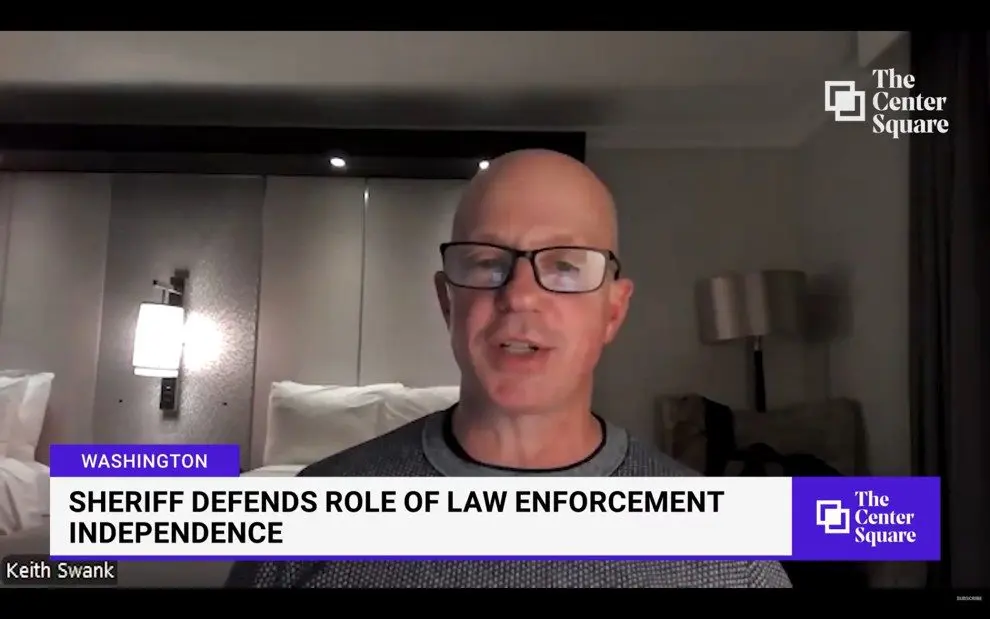
Dhingra was referring to the testimony of Pierce County Sheriff Keith Swank, who as reported by The Center Square, last month told lawmakers that his constituents would protect him if there was an attempt by a state board to remove him from his elected office.
“I’m fighting for the office of sheriff, and the independence of it. The Democrats control the state House, the state Senate. They control every statewide executive office. They control just about every major city in the state,” said Swank in an interview with TCS. “The only thing they don’t control, the only people they don’t control are the sheriffs. And when they have control of the sheriffs, then it’s all over. They can impose their will upon everything.”
The bill digest states in part: “There is a need to clarify and reinforce state law that a primary duty of sheriffs, in addition to upholding the United States Constitution, is to uphold and enforce the Washington state Constitution and laws, as enacted by the legislature and interpreted by the Washington Supreme Court, so as to align state law.”
Sen. John Lovick, D-Mill Creek, who served more than 30 years with Washington State Patrol, is the prime sponsor of SB 5974.
“Since all peace officers must maintain a certification, these laws need to be updated to make clear what occurs when a law enforcement leaders’ certification is revoked for misconduct,” said Lovick during the bill hearing. “I hope the outstanding law enforcement leaders in our state will support this legislation. Great leaders lead by example. They embody the standards of accountability that they expect from their subordinates.”
During debate ahead of Thursdays vote on the Senate floor, several Republicans rose to speak against the measure, including Sen. Mark Schoesler, R-Ritzville.
“I represent eight counties. I represent Garfield County, the tiniest county in the state,” he said. “I also represent Sheriff Knowles in Spokane County. A large county. They all agree that this bill is not good public policy.”
Sen. Nikki Torres, R-Yakima, also urged a ‘no’ vote.
“This is completely undermining the voters,” said Torres. “We need to be able to have a right to choose who we want to elect. There’s a select few here who it sounds like have an issue with one sheriff. This is not the way to address it.”
As reported by TCS, Mason County Sheriff Ryan Spurling, who testified before lawmakers, said the true motivation for the bill as reported to him by the bill sponsors, is not about the current debate of federal immigration, or about a response to comments from any sheriff.
“This is the last piece of legislation that the Coalition for Police Accountability in 2021 wanted to push through,” Spurling said, referring to efforts to defund the police.
Just ahead of the final Senate floor vote, Minority Leader Sen. John Braun, R-Centralia, suggested Washington law enforcement have been put in an impossible position.
“The driver for the bill is because we have put our law enforcement in a situation where they’re having to choose between state and federal law, and sometimes they’re not choosing the way the majority would like,” Braun said. “This won’t solve the problem.”
The final vote off the Senate floor fell along party lines with 30 Democrats in support and all 19 Republicans opposed.
It now moves to the House.