WASHINGTON, D.C. – When Oklahoma Republican state Sen. Todd Gollihare introduced a bill last year to strengthen state law protecting places of worship from protesters, it failed to become law.
This year, his church protest bill sailed through the legislature. Republican Gov. Kevin Stitt signed it into law three days after Gollihare reintroduced it.
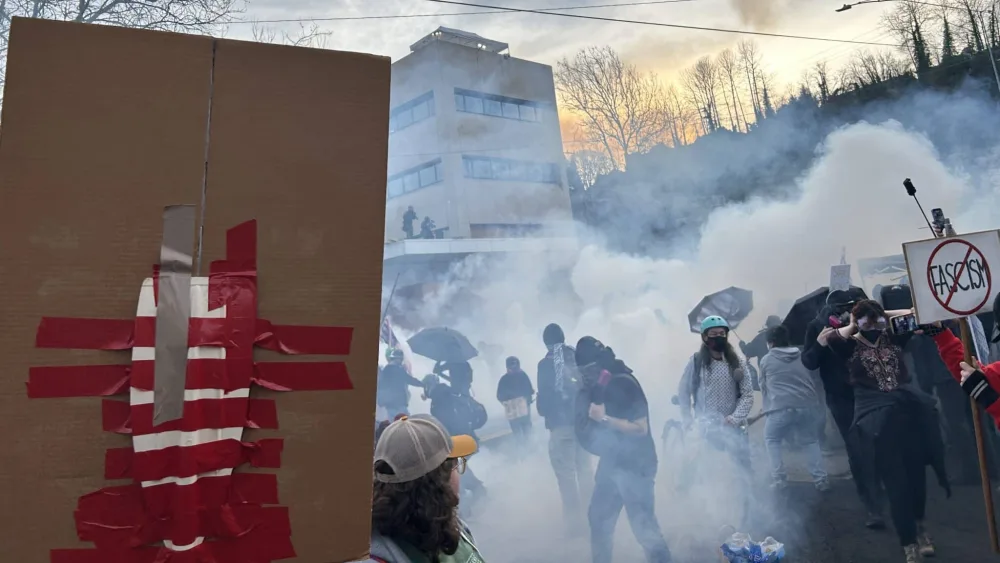
In recent weeks, Republican and Democratic lawmakers in states including Alabama, Idaho, Ohio and South Dakota have pushed legislation (none has passed yet) that would increase the penalties for disrupting religious services at houses of worship in the wake of a widely publicized incident last month at a Minnesota church. On Jan. 18, protesters disrupted a worship service to confront a pastor who is a U.S. Immigration and Customs Enforcement official and to demand justice for Renee Good, who was shot and killed by an ICE agent 11 days before.
Such incursions are already prohibited by trespassing laws, which make it illegal to enter private property without an owner’s permission.
Meanwhile in New York, Gov. Kathy Hochul and New York City Council Chair Julie Menin, both Democrats, want to create new buffer zones around houses of worship. Their proposals come in response to recent anti-Israel protests, including one outside a New York City synagogue in November where protesters chanted pro-Hamas slogans.
Hochul has proposed a 25-foot buffer zone around churches, temples, mosques and other houses of worship, in addition to penalties for protesters who “alarm and annoy” worshippers. Menin has taken it further, proposing to let the police ban protests within 100 feet.
Oklahoma’s law also establishes buffer zones that restrict protesting at places of worship.
The recent push has sparked a constitutional debate: Critics on both sides of the political aisle say such measures infringe on the First Amendment right to free speech, even as supporters tout them as safeguards against those who would impede the free exercise of religion.
Criminal justice is a top issue in state legislatures this year
The new laws could be challenged in court. If so, the idea of creating buffer zones, in particular, would be contested on familiar ground: A 2000 U.S. Supreme Court decision upheld a Colorado law that restricted protesters from coming within a certain distance of reproductive health clinics or people trying to access them. Then in 2014, the court unanimously struck down a broader Massachusetts law, saying it went beyond the limits accepted in the Colorado case.
Last year, the Supreme Court declined to consider overturning the 2000 buffer zone precedent.
In Oklahoma, Republican state Sen. Kendal Sacchieri was one of several conservative legislators who opposed Gollihare’s bill.
“A lot of us conservatives saw it as a violation of the freedom of speech and the freedom to protest,” Sacchieri said. “I couldn’t in good conscience vote for that. I saw it as a way to incriminate more people.”
Ken Paulson, director of the Free Speech Center at Middle Tennessee State University and former dean of the school’s College of Media and Entertainment, said such legislation “strikes me as completely unnecessary and has to be motivated by political concerns, because the law is already clear.”
“If someone enters onto private property and refuses to leave when you ask them to leave, they can be charged for trespassing,” Paulson said in an interview. “The fact that it occurs in a church is no different than if it occurs in a movie theater or any other privately owned setting to which the public is invited.”
Ohio state Rep. Tex Fischer, a Republican, told Stateline he doesn’t expect many prosecutions under proposals like his. He recently introduced a bill, currently in committee, that would raise penalties for protesters who disturb religious worship from a first-degree misdemeanor to a fifth-degree felony.
But he hopes such a law would deter protesters from using places of worship as backdrops for political theater.
Fischer said his proposal is ultimately about “letting people feel comfortable and safe being able to practice their religion within the walls of their own church or synagogue or mosque, without having to worry about their service getting crashed by a bunch of people chanting, regardless of what their point is.”
First Amendment concerns
This month, an Alabama House committee unanimously approved a Republican-sponsored bill that would make intentionally disrupting the proceedings in a house of worship by engaging in “a riot, unlawful protest, or disorderly conduct” — a felony punishable by up to 10 years in prison.
In South Dakota, a Republican legislator and the governor both proposed legislation in response to the Minnesota church protest. Republican state Rep. Brandei Schaefbauer introduced a bill that would create a new felony crime of entering or remaining in a place of worship with the intent to “menace or harass” or for the purpose of “political intimidation” or inciting “fear of violence.”
The bill failed in the South Dakota House, amid concerns that its 50-foot perimeter and one-hour time buffer — barring protests within an hour before or after a religious service — could interfere with lawful protesting or speech.
But a bill filed on behalf of South Dakota Gov. Larry Rhoden, a Republican, passed the Senate and now awaits action in the House. It would raise penalties in an existing law that criminalizes intentionally preventing another person from performing lawful religious acts. The bill would boost the crime from a misdemeanor to a felony, punishable by two years in state prison, a $4,000 fine or both.
You can’t just punish speech or criminalize behavior because it’s rude.
– Eugene Volokh, a senior fellow at Stanford University’s Hoover Institution
These kinds of laws can run afoul of the First Amendment when they try to punish the content of speech, rather than the manner or location of it, said Eugene Volokh, a senior fellow at Stanford University’s Hoover Institution, a conservative-leaning think tank.
“You can’t treat a certain type of speech differently based on the content of that speech,” he said. And vague language is also unconstitutional.
For example, he said, Idaho’s bill would outlaw disrupting a worship service with “profane discourse” or “rude or indecent behavior” but doesn’t define what those mean or explain how speech would be determined to meet those standards.
“You can’t just punish speech or criminalize behavior because it’s rude,” he said, though a law could, for example, punish speech that’s unnecessarily loud.
The issue doesn’t always split neatly along party lines. Democrats helped pass Alabama’s bill out of committee following assurances from the bill’s sponsor that it doesn’t apply to anyone on public property.
In Oklahoma, the Democratic caucus was split on the new measure, with some voting in favor and some against. Shortly after the bill passed, Democrat Julia Kirt, the Senate minority leader, expressed unease and some skepticism while talking with reporters.
“I’m concerned about some of the ambiguous definitions in there, about faith communities and about what ‘disruption’ [means], or how it would be implemented, who would be targeted with it,” said Kirt, who ended up voting against the bill.
“I think we can all agree we want folks to have a safe space to worship and that we need to make sure that happens. I’m just not sure that was the way to take it.”
In South Dakota, Republican state Rep. John Hughes told a committee earlier this month that he had a “pit in his stomach” over the legislation, calling its reach overly broad. He noted the state already has criminal trespassing laws. South Dakota also has an existing law that makes it a misdemeanor to intentionally prevent someone from performing a lawful religious act.
Sacchieri, the Oklahoma Republican, said some of her concerns center on the new law’s implications for Christians Christians preaching or proselytizing outside other religions’ places of worship.
“This bill would criminalize a pastor that wants to preach outside a mosque,” she said. “There’s no language defining a religious meeting and what ‘oral protest’ is, or if you want to pass out a flyer.”
And she believes the law could trigger lawsuits designed to test the U.S. Supreme Court’s stance on buffer zones.
Trump wields abortion clinic law against church demonstrators, providers still fear violence
Volokh is skeptical that the Oklahoma law could be used to test the court’s precedent. There have been calls, he said, mostly from conservatives, to overrule Hill v. Colorado, the 2000 Supreme Court case that allowed some buffer zones outside abortion clinics.
“The court has had opportunities to revisit Hill v. Colorado in abortion protest cases, and some justices have urged it to do that,” Volokh said. “But the other justices haven’t been interested. I don’t think that’s going to change with a law like this.”
Fischer, the Ohio lawmaker, said he’s met with Ohio’s attorney general and other stakeholders, and is working on an amendment to his bill to ensure it wouldn’t apply to protests on public spaces like sidewalks.
“We’re not going to interfere with what anybody does out on the sidewalk,” he told Stateline. “I think the First Amendment is very clear. People have a right to do that and I’m not looking to change anything about that.
“What I have a problem with is people entering and disrupting a religious service to make a political point. That’s what we’re looking to crack down on.”
He also wants to amend the bill to give the state attorney general the ability to go after such protesters if local prosecutors choose not to.
Religious and abortion protections
Gollihare, the sponsor of Oklahoma’s new law, originally introduced his bill last year when conservative protesters who were upset about his vote against an anti-abortion bill showed up at his church in Oklahoma, he said, causing a disturbance and refusing to leave when asked.
He modeled part of Oklahoma’s new law on the 2000 Supreme Court decision that upheld the Colorado law.
In Oklahoma, anyone within 100 feet of the entrance to a place of worship now must give worshippers an 8-foot pathway unless invited to approach. Violators face a penalty of up to a year in jail on the first offense. Gollihare said that the buffer zone in his law “comes right out of” the Supreme Court case.
Paulson, the First Amendment scholar, said buffer zones are well-established and are intended to be relatively small, to place protesters at a distance so they don’t interfere with the business or event that’s occurring.
But they do have to be “reasonable, rational, and can’t be used as a weapon to limit free speech,” he said.
Complicating the issue is a federal law, the 1994 Freedom of Access to Clinic Entrances (FACE) Act, which prohibits using violence, threats or physical barriers to stop people from accessing reproductive health care clinics, such as those that offer abortion services, and places of religious worship.
Last year, the Department of Justice pivoted away from broadly enforcing that law against abortion protesters. President Donald Trump pardoned 23 people previously convicted of violating the FACE Act in relation to abortion clinic blockades. More recently, his administration has used the FACE Act to prosecute people protesting at houses of worship.
Gollihare said he believes Oklahoma’s new law balances Supreme Court precedent with state law, and protects all of the First Amendment — the parts that deal with freedom of religion, as well as freedoms of speech and assembly.
“There’s a balancing between people advocating or protesting, and people who just want to be left alone,” he said. “They came to worship and they weren’t wanting to be part of a political protest. So that’s what this bill is all about. If you don’t want to be in the battleground, you have a right to walk away unbothered and unhindered.”
Stateline reporter Anna Claire Vollers can be reached at avollers@stateline.org.
Stateline is part of States Newsroom, a nonprofit news network supported by grants and a coalition of donors as a 501c(3) public charity. Stateline maintains editorial independence. Contact Editor Scott S. Greenberger for questions: info@stateline.org.