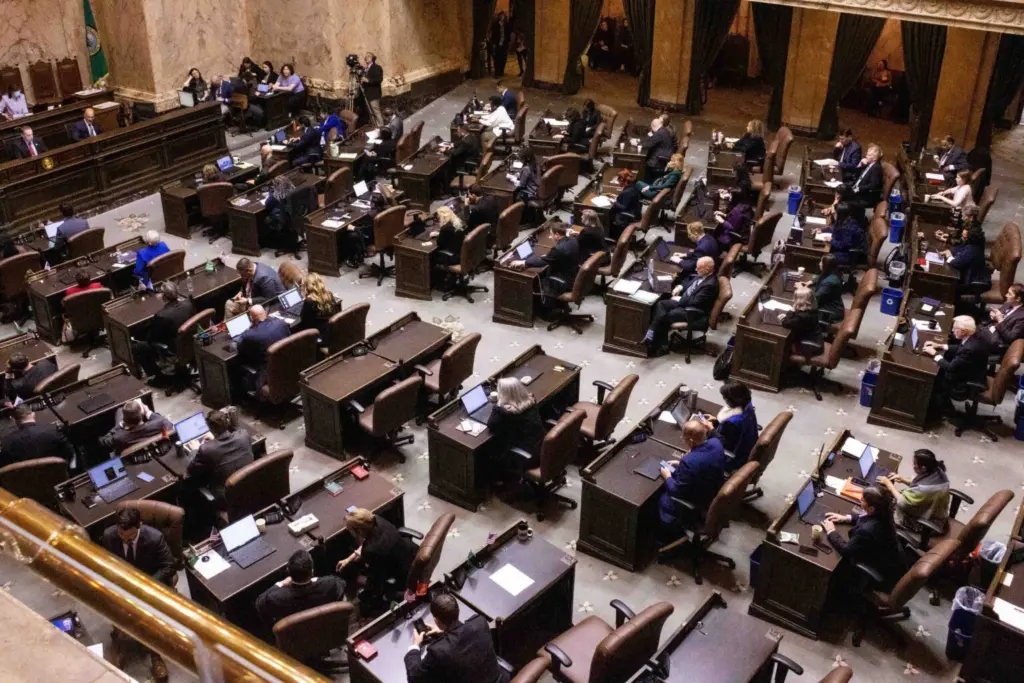
OLYMPIA, WA – The third deadline in as many weeks came Tuesday in the Washington Legislature. It meant the end of the road for numerous bills, including priorities on issues like homelessness, child welfare, gun safety and juvenile detention.
It also signals a turning point in the Legislature’s work, as lawmakers move back to House and Senate committee meetings on bills passed in the opposite chamber. Democratic legislators are also expected to release their proposed budgets in the coming days.
The pressure isn’t letting up, as the next cutoff that could fell more bills is next Wednesday, when legislation needs to pass out of policy committees. Budget bills can remain in play past the deadlines.
The session is set to end March 12.
Here are some of the bills killed at the latest cutoff.
Camping bans
One of the most contentious proposals this session looked to restrict cities and counties from criminalizing camping on public property. House Bill 2489 would’ve barred local governments from enforcing laws banning “life-sustaining activities” unless they can prove adequate shelter space is available for people to go to.
Republicans were staunchly opposed, and some Democrats were conflicted.
Similar legislation last year died at the same stage amid pushback from cities.
Child welfare
Lawmakers came into the session with several ideas on how to address rising deaths and critical injuries in Washington’s child welfare system. Much of the discussion is still to come in budget talks, but key policy ideas expired at this latest deadline.
Senate Bill 6308 would’ve increased court oversight of Child Protective Services cases involving children under age 5 who are allowed to stay with their parents instead of being placed in foster care.
And Senate Bill 6319 looked to develop a community-based referral path to services for cases involving a child under age 4 and high-potency synthetic opioids, like fentanyl.
Neither bill got Senate votes.
“We heard concerns from a lot of stakeholders, and I think that caused members to believe that we needed to make a pause and continue working on those policies,” Senate Majority Leader Jamie Pedersen, D-Seattle, told reporters. “So I suspect that we’ll see them next year.”
In the House, state Rep. Travis Couture, R-Allyn, tried to force votes on a few related bills this week, but was blocked by majority Democrats because the measures hadn’t even passed out of policy committees. A House bill focused on the risk assessment process used when investigating child abuse and neglect referrals also didn’t move forward.
Children online
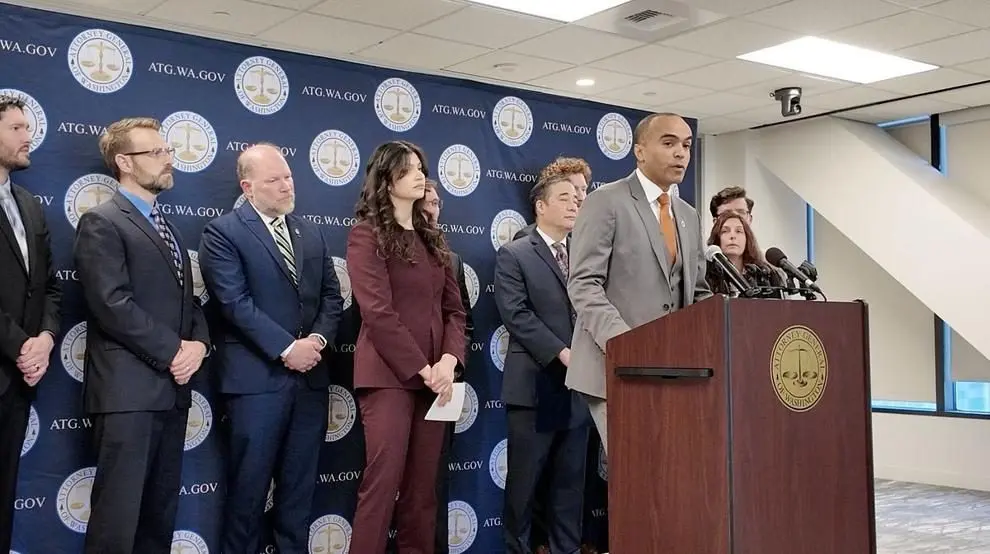
House Bill 1834, requested by state Attorney General Nick Brown, aimed to protect youth in multiple ways.
It would’ve blocked social media companies from providing “addictive feeds” to minors. And companies also couldn’t have sent push notifications to minors overnight or during school hours without parental consent.
Last year, similar legislation passed the Senate but stalled in the House. Again, the proposal couldn’t pass the House.
In a statement, Brown said he was “disappointed that the Legislature once again has not been able to pass a commonsense proposal to protect children online.”
“Addictive social media use is a major contributor to the youth mental health crisis, and we will not stop pursuing policies that can save young people’s lives,” he added.
Guns
Over the past few years, Democratic lawmakers have pushed through a suite of gun safety measures. The one they haven’t gotten to the finish line would require gun owners to lock up their weapons in their homes and cars.
The severity of the punishment for violating House Bill 1152 would rise based on the consequences, from a civil infraction to a felony if unsafe storage leads to someone being injured.
Last year, the legislation couldn’t reach the House floor for a vote. It was the same story this year. The proposal was a top priority for the Alliance for Gun Responsibility.
“While the legislature failed to meet the moment, we know that safe storage is a popular research-based law that can and will save lives,” Renee Hopkins, the alliance’s CEO, said in a statement. “We will continue to fight for the people’s mandate in Olympia.”
Meanwhile, bills to prohibit the use of 3D printers to manufacture certain firearms and ban carrying guns at parks and other locations remain in play.
Initiatives
Opponents argued Senate Bill 5973 threatened to impede voters’ ability to engage in the initiative process. It would have prohibited paying people for each signature they collect in support of initiatives and allowed legal action against those suspected of violations. It also would’ve added a new step by requiring initiative campaigners to submit signatures of 1,000 registered voters to indicate support for their proposal when starting the process.
Backers saw this as a way to keep big money out of this process of direct democracy.
The sponsor and Senate Democratic leader cited unresolved concerns from other senators and Gov. Bob Ferguson as reasons for the controversial legislation’s demise. Sen. Javier Valdez, D-Seattle, said he plans to bring back a new version in 2027.
Read more: Foes called it the ‘initiative killer.’ Now it’s dead in the WA Legislature
Juvenile rehabilitation
Overpopulation has been a longstanding concern in the state’s juvenile detention system. Last year, lawmakers failed to pass substantial policy changes to alleviate the crisis.
This year, they’re poised for a similar result. The House planned for House Bill 2389 to be the final piece of legislation it considered before Tuesday’s deadline, but it didn’t end up getting a vote. The proposal sought to ease criminal sentencing for youth defendants, and provide a path for transfers from juvenile detention to the state’s prisons operated by the Department of Corrections.
“It didn’t have the votes,” House Speaker Laurie Jinkins, D-Tacoma, told reporters.
She said there were a “plethora of reasons” for that.
“I think the good thing about it is we have increased support from last year to this year,” Jinkins added. “I often tell people that I came to the Legislature as somebody who worked on LGBTQ civil rights. It took us 29 years to get them into statute. It will not take that much time for the JR bill to move, but it just takes time to do the incremental work.”
Farmworker unions
Senate Bill 6045, sponsored by Sen. Rebecca Saldaña, D-Seattle, aimed to give agricultural workers collective bargaining rights they’ve long been denied. Farmers argued this would be a financial burden on an already struggling industry.
The reason? Per Pedersen, a familiar story: “It ultimately didn’t have the votes yet in our caucus.”
“There was, I think, more work that will need to be done before that idea can advance to make sure that the agriculture community, more generally, has had a chance to weigh in and figure out how best to make that happen,” he added.
Wire theft
As the 5 p.m. cutoff to pass bills approached Tuesday, Sen. Shelly Short, R-Addy, launched an unusual bid to bog down the Senate process. She demanded Lt. Gov. Denny Heck, a Democrat, to have the chamber’s secretary read all 39 pages of a bill focused on electrical transmission infrastructure. Usually, the clerk reads the first and last line of legislation into the record. Heck agreed.
This maneuver killed the transmission bill, as well as several others Senate Democrats were hoping to vote on before the deadline. One of those looked to address surging theft of copper wiring. Senate Bill 6190 would’ve imposed new recordkeeping requirements on scrap metal businesses and made destroying “critical communications infrastructure” a felony.
Before the deadline, the bill’s sponsor, Sen. Tina Orwall, D-Des Moines, said she had her fingers crossed her measure would move forward.
“There’s a lot of bills on the floor calendar, only so many can go,” she said.
Orwall noted the issue is really affecting her district, which is now served by Sound Transit light rail. The train system is frequently targeted by wire thieves, including last week during the Seattle Seahawks’ Super Bowl victory parade. Orwall plans to bring back the legislation next year.
Artificial intelligence
Lawmakers have a number of ideas to regulate the emergence of generative artificial intelligence. For example, the House has passed legislation to require AI companies to make an AI detection tool available and disclose when content is AI-generated, as well as to mandate safeguards for AI chatbots, like ChatGPT.
But a bill dealing with use of AI-fed algorithms in high-stakes decisions, like hiring and medical insurance, won’t become law this year. House Bill 2157 would have required the companies both developing and deploying the technology to take steps to protect people from discrimination potentially embedded in the algorithms.
Grocery stores
Motivated by the closure of a Fred Meyer in Tacoma, Senate Bill 6147 sought to require grocers to provide at least four months’ notice before closing.
A proposal in the House to ease restrictions on where grocery stores or pharmacies can be located passed with bipartisan support last week.
Parole
Washington abolished parole more than four decades ago. A proposal in the state Senate initially aimed to bring it back starting in 2027. The measure was pared back to establish a work group tasked with recommending how to reinstate parole in the state. This still wasn’t enough to get it a Senate vote before Tuesday’s deadline.
Reporter Jerry Cornfield contributed to this report.
Washington State Standard is part of States Newsroom, a nonprofit news network supported by grants and a coalition of donors as a 501c(3) public charity. Washington State Standard maintains editorial independence. Contact Editor Bill Lucia for questions: info@washingtonstatestandard.com.