BOISE, ID – Idaho Republican lawmakers in the House and Senate this session have pursued various bills dealing with requirements to check work authorization and immigration status of workers, with some pushing for universal requirements for all businesses and others looking to take a more limited approach.
The Idaho House Business Committee on Monday approved two bills prohibiting all employers from hiring workers who don’t have authorization to work in the U.S., one of which would require all employers to use the federal work authorization program E-Verify and the other would create a new state crime for knowingly hiring undocumented workers.
The supporters of these bills, which are headed to the House floor for consideration, say they provide enforcement mechanisms for employers to comply with federal immigration laws and would thus deter undocumented immigrants from coming to Idaho.
The Idaho Senate previously advanced a work authorization bill that only applied to state and local governments and large contractors with government entities, the Idaho Capital Sun reported.
Idaho lawmakers have previously sought to crack down on immigration, including by requiring the use of E-Verify, but the Republican supermajority has remained divided on how far-reaching those requirements should be. There has also been strong pushback from industries that rely on immigrant and undocumented labor.
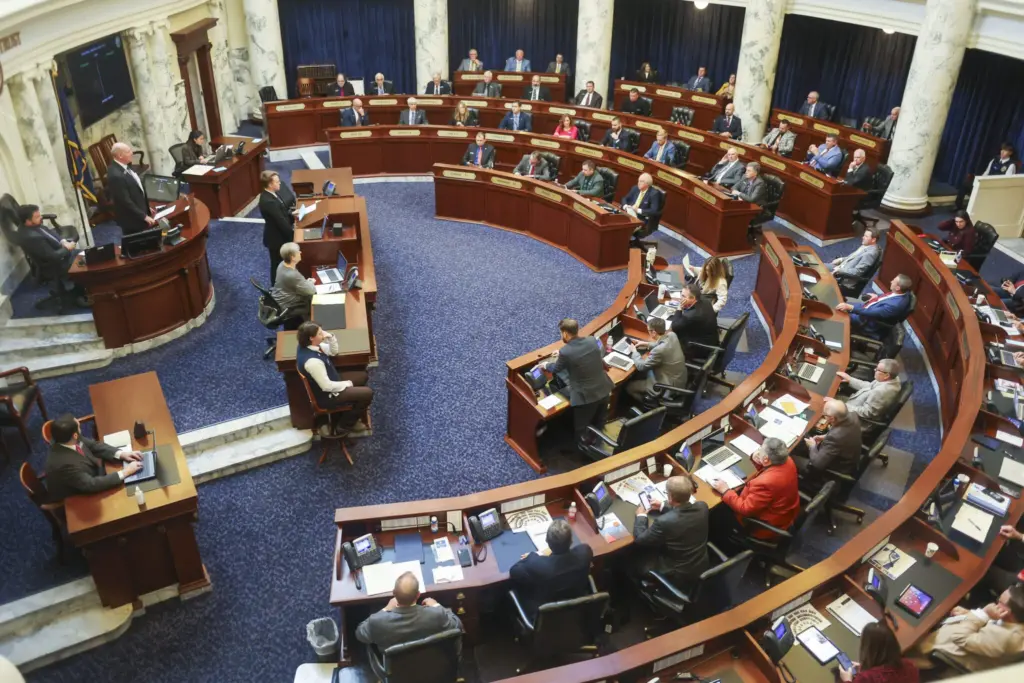
Past legislative proposals haven’t advanced, but this year, there are multiple bills moving through the legislative process in the Idaho Capitol building.
How can states enforce federal immigration laws?
Immigration laws are typically solely enforced by federal authorities, but the U.S. Supreme Court has previously ruled that some limited regulations related to business licensing may be enforced by the states.
There are questions as to whether the penalties proposed in at least one of the bills would go beyond what a 2011 Supreme Court ruling determined is within states’ purview when it comes to immigration laws.
“The Constitution is very clear in its Supremacy Clause, that the federal law is supreme,” said University of Idaho law professor Geoffrey Heeren, who is also director for the UI Immigration Litigation and Appellate Clinic.
Immigration has traditionally been an “exclusively federal domain,” Heeren said.
“Of course a court would need to look at these if there’s a challenge that’s filed,” he said. “… There is a preemption doctrine that could be an issue in litigation if one of these laws passed.”
Spokesperson for the ACLU of Idaho Rebecca De León said the organization is concerned the bills advanced Monday would exceed states’ authority when it comes to immigration. The ACLU is currently challenging an Idaho law that creates new state-level immigration crimes in federal court.
Bill sponsors for the two bills on work authorization that advanced Monday in the House Committee told the Idaho Capital Sun they are not concerned the proposals would be unconstitutional.
One of the bills advanced Monday is similar to a law approved in Arizona in 2008. The Arizona E-Verify requirement was challenged in court and upheld by the U.S. Supreme Court in the 2011 Chamber of Commerce of the United States v. Whiting decision. That decision found while states cannot pass immigration laws that conflict with federal laws, states may revoke business licenses to require employers to use E-Verify.
The decision upheld Arizona’s law, but also noted sanctions that went too far would potentially be superseded, or preempted, by federal law, under the U.S. Constitution’s Supremacy Clause, Heeren said in an interview with the Sun.
An Arizona Attorney General’s Office database of court orders related to the law lists two orders regarding litigation and violations of the law.
House Bill 704 would require all employers in the state to use the federal work authorization verification program E-Verify starting July 1. Any Idaho resident would be able to petition the Idaho attorney general to investigate a business and bring a civil court complaint if there’s an alleged violation.
Bill sponsors Reps. Jordan Redman, R-Coeur d’Alene, and Jaron Crane, R-Nampa, said the bill aligns with federal laws around immigration. Crane told the Sun Tuesday he was confident the bill was constitutional.
Eight people spoke in favor of the bill at the hearing Monday, and four people opposed it.
Lidia Strong, who immigrated to the U.S. legally from Brazil through a fiancé visa, said she and other legal immigrants “feel that something fundamental is being eroded when people enter to work in this country illegally and face no consequences.”
William Mostoller said working in construction allowed him to “rebuild” his life after getting multiple injuries and leaving the Marine Corps. He said large contractors are relying on undocumented labor and pricing out the rest.
“I know many tradesmen who are sitting at home right now that cannot get work because other people are fulfilling those jobs,” Mostoller said.
Those who spoke in opposition said that federal immigration laws already require employers to verify work authorization.
Rick Naerebout, head of the Idaho Dairymen’s Association, said the group opposed the bill, and argued the state should let the federal government handle immigration reform.
Dairy industry leaders have long sought reform that would allow producers to access a visa program such as the H-2A seasonal farmworker visa. Currently, the dairy industry, which operates year-round, does not have access to the temporary migrant worker program.
He also cited a report commissioned by a group of Idaho industry leaders, called the Idaho Alliance for a Legal Workforce, that said mass deportations of the workforce in Idaho’s dairy, construction, farm and hospitality industries would cause a significant economic shock.
The committee discussed whether the bill should be changed to push back its effective date, and perhaps help industries such as dairy producers adjust to the changes, but a motion to send the bill for amendments died in an 11-7 vote.
Rep. David Cannon, R-Blackfoot, said he’d vote Monday to send the bill to the House floor for a full debate, but was “still doing a deep dive on this.”
“And I reserve my right to vote whatever way my conscience dictates on the House floor,” Cannon said.
The bill passed in a 16-2 party-line vote.
Idaho committee advances bill to make hiring unauthorized workers a misdemeanor
The House Business Committee also voted Monday to send House Bill 700 to the floor. The bill would make it a misdemeanor crime if an employer knowingly hires an employee that isn’t authorized to work in the U.S. Employers would have an affirmative defense from prosecution if they used E-Verify.
“We’re just asking people to do their level best, to try and not hire illegal immigrants within the state of Idaho,” bill sponsor Rep. Kyle Harris, R-Lewiston, said Monday.
He co-sponsored the bill with Rep. Dale Hawkins, R-Fernwood.
Harris noted that other states have imposed requirements to check work authorization. Many states that have imposed E-Verify requirements enforce the requirements through fines and business license penalties.
It’s unclear whether imposing a new criminal penalty would risk running afoul of the Supremacy Clause.
When asked Tuesday if he had concerns about the bill preempting federal law, Harris said, “I don’t really have a comment at this time. I’m happy with the legislation as is.”
The testimony for HB 700 was largely the same as it was for HB 704.
The committee voted in a mixed voice vote, which meant each members’ vote wasn’t recorded individually, to send the bill to the floor with a recommendation that it pass.
This story first appeared on Idaho Capital Sun.