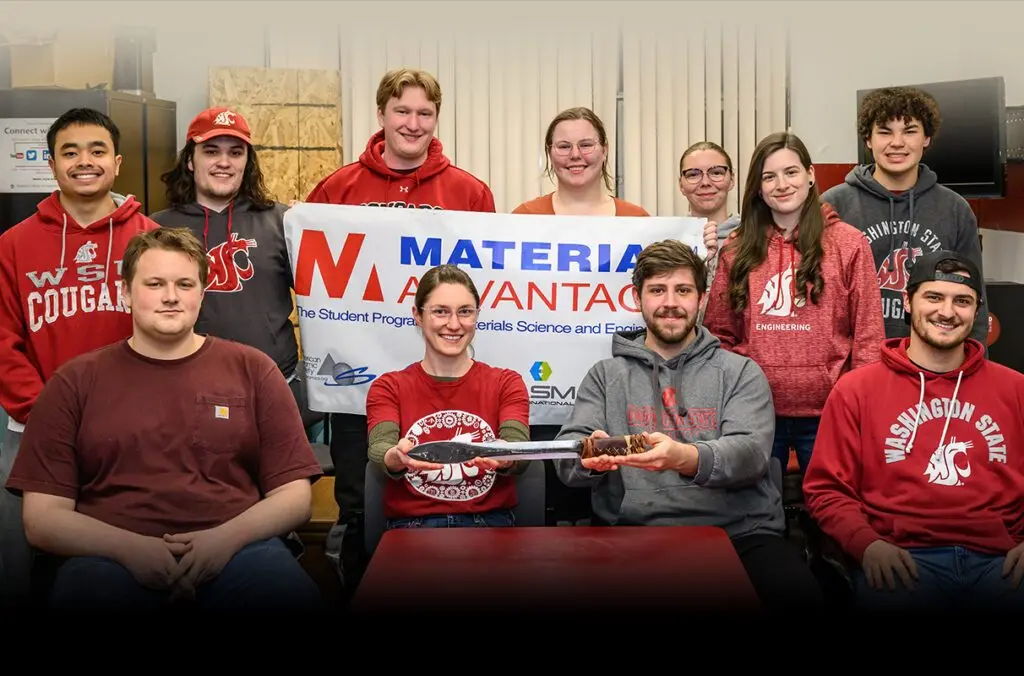
PULLMAN, WA – A team of Washington State University students is preparing to showcase a handcrafted ancient Greek sword at The Minerals, Metals & Materials Society (TMS) Bladesmithing Competition, held during the society’s annual meeting next month.
The competition held every other year brings together student teams from around the world to design and produce blades using traditional blacksmithing techniques.
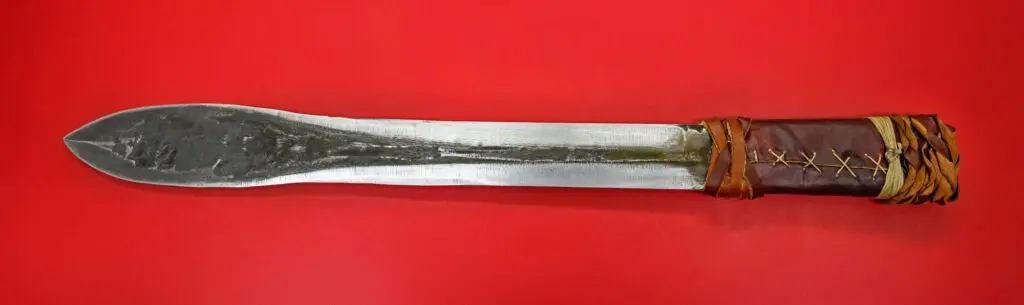
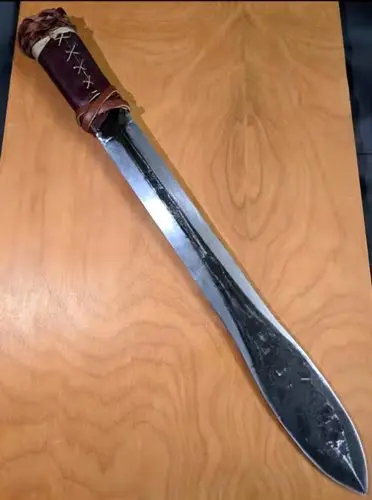
Members of the WSU Material Advantage Club designed and forged a xiphos, a short, double-edged sword widely used throughout ancient Greece and the Mediterranean during the first millennium BC. The project was inspired by extensive historical research and collaboration with WSU’s Department of History, including consultations with medieval warfare expert Associate Professor Alexander Overtoom.
The team forged the blade using 5160 spring steel, a high-carbon alloy valued for its exceptional strength and flexibility. This material choice presented numerous technical challenges and required careful process adjustments, demanding rigorous problem-solving, and strict adherence to safety protocols.
The three-month project allowed the team to apply real-world materials science principles in a hands-on manufacturing environment. Using advanced microscopy techniques such as electron backscatter diffraction, they could examine the metal’s structure at the microscopic level. The team created detailed color-coded maps that show how tiny crystals are arranged throughout the steel, helping them understand why the blade has its strength and flexibility. This scientific analysis gave them valuable insights into how traditional blacksmithing transforms metal at the molecular level.
“We learned a great deal about the crystal structure of metals and the forging processes involved in creating a blade of this size,” said Morgan Chapman, team captain.
Beyond material scientists, the club drew members from varied academic backgrounds, including mechanical engineering, civil engineering, chemistry, and zoology.
“This interdisciplinary collaboration demonstrates that a deep interest in material structures and manufacturing processes is not limited to those formally trained in materials science but can inspire and engage students across the academic spectrum,” said Amber Replogle, president of the WSU Material Advantage Club.
A blade is born
Follow along as members of the WSU Material Advantage Club design and forge a xiphos in a short YouTube video.
The completed sword features a decorative leather-wrapped handle with detailed twine work, enhancing both its visual appeal and historical accuracy while remaining fully functional.
“It was incredibly intense and stressful, but also one of the most rewarding experiences I’ve ever had,” said Replogle. “I’m incredibly proud of the team and grateful to our professors who were always there to offer guidance. It truly feels like we achieved the impossible.”
Replogle and club member Mark Mills will represent WSU at the TMS 2026 155th Annual Meeting & Exhibition, scheduled for March 15–19 in San Diego.