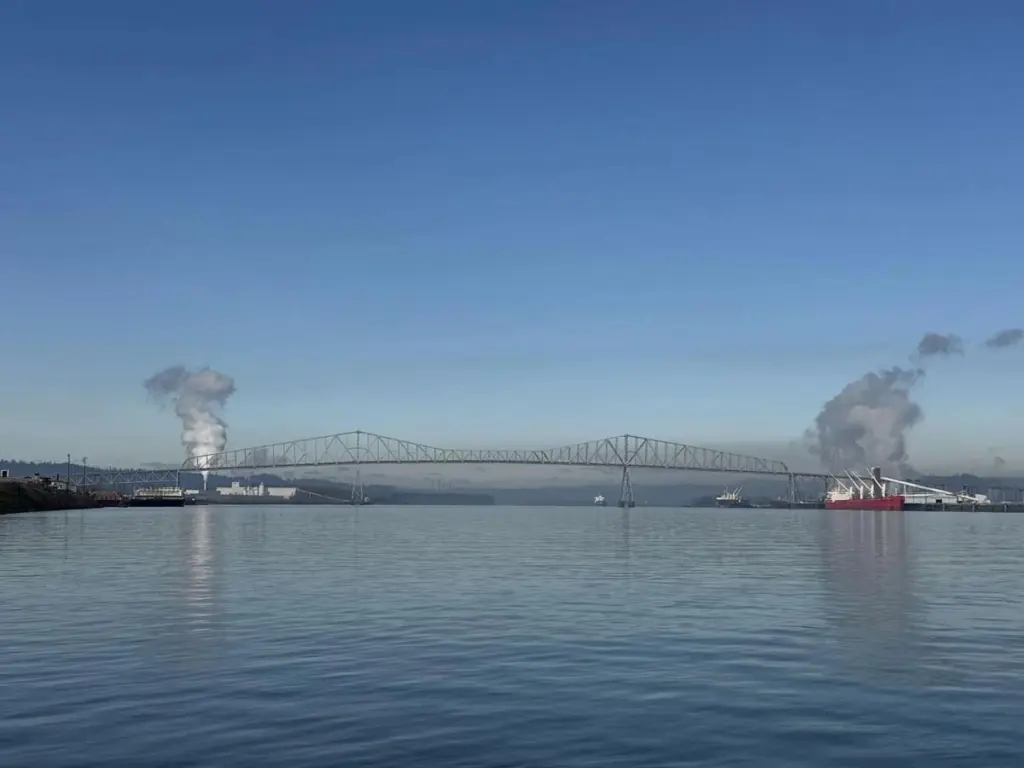
LONGVIEW, WA – Columbia River shipping industry leaders say there is a growing risk the Lewis and Clark Bridge between Rainier and Longview could be hit by a large vessel and possibly collapse.
About four years ago, industry leaders say a cruise ship came within at least a few feet of hitting the structure.
In addition, roughly two dozen ships experience engine failures while navigating the entire Columbia River each year.
The first weekend of February, for instance, a ship headed out to sea from the Port of Longview lost power, just beside the Lewis and Clark Bridge. Tug boats were on hand to help and quickly rerouted, said Capt. Jeremy Nielsen, the president of the Columbia River Pilots, which pilots ships from Astoria to ports along the river.
These issues could lead to a similar outcome as the March 2024 collapse of the Francis Scott Key Bridge after a container ship struck one of its piers, Nielson warns.
The Lewis and Clark Bridge lacks air gap sensors to tell river pilots how much room they have as they steer ships around 1,000 feet long and 200 feet high under the structure.
The shipping industry and Columbia River Pilots have waged a decade-long campaign to add the sensors, as well as alter the shipping channel’s course to ensure ships stay further away from the unprotected bridge.
“It is extremely frustrating for us as pilots, because our safety margins have just decreased tremendously,” Nielsen said. “And we’re doing what we do — we’re professionals, and our job is to protect all this infrastructure — but, at some point, we need the technology there to assist.”
Inches from disaster
Compared to the Maryland bridge, the Lewis and Clark bridge has fewer protections, including no concrete buffers surrounding piers to prevent impacts. However, even these dolphins didn’t safeguard that bridge from collapse in 2024.
That is a problem for the Columbia River structure.
“It’s a single-point failure bridge,” Nielsen about the local bridge. “If a ship hits any part of that bridge, it is coming down — the whole thing, just like the Francis Scott Key Bridge.”
The risk of that happening — during any one of the roughly 3,000 times a ship passes under the bridge annually — is growing, Nielsen added.
In one 2022 incident, a 1,041-foot long cruise ship known as the Celebrity Eclipse came within 4.1 feet of the bottom of the bridge as it headed out to the ocean after repairs in Portland, he said.
That safety buffer was reduced to 3.1 feet because the pilots found that NOAA’s river level data for Longview can be up to 1 foot off.
And even that turned out to be a potential overestimation. Nielsen said he was later told by Washington and Oregon departments of transportation officials that the bridge has about 2 feet of flex, making 3.1 foot safety buffer possibly as little as 13.2 inches.
“So right there, there goes our safety margin,” Nielsen said.
A spokesperson for the Washington Department of Transportation declined to provide a current number for how far the bridge sags, instead writing that “(b)ridges are designed naturally to flex and shift based on temperatures and the amount it flexes is very small.”
And it’s not just the Columbia River Pilots raising the alarm.
A 2025 National Transportation Safety Board report found the Lewis and Clark and Megler bridges are the only “critical/essential” bridges in the Pacific Northwest that cross a waterway frequented by ocean-going vessels which also have an “unknown levels of risk of collapse from a vessel collision.”
A Wall Street Journal investigation the year before had less reserved findings, concluding the Longview bridge was one of eight bridges around the country that are most similarly vulnerable to collapse as the Baltimore bridge.
Engine failures add pressure
The 2024 Baltimore disaster started when the Dali container ship experienced a power outage near the bridge, making it impossible for the captain to operate the vessel before it hit the bridge.
The crash ending up killing six people, closing a global shipping artery for 11 weeks, and causing the region to need to spend an estimated $5 billion on a new bridge.
“If that situation had happened one minute later or one minute sooner, there’s a good chance the bridge wouldn’t have come down,” Nielsen said.
Nielsen and the 45 other Columbia River Pilots have considered that situation many times. That’s partly because he said they experience an average of two engine failures each month over the entire river system.
Those failures of ships’ engine propulsion and rudder systems are similar to what happened in Baltimore, and mean pilots can’t control the vessels, often more than 1,000-feet long.
“Through the work we do as pilots, we keep those from becoming catastrophes,” Nielsen said. “But we can’t control everything.”
Many of the failures are short-lived, he added, and the pilot gets operations back in “a minute or two.” The incidents are also reported to and investigated by the Coast Guard.
“But,” he added, “it’s the one that occurs right above the bridge, or right below the bridge when we’re making our approach on it, that is really concerning to us.”
“We’re going to do everything we possibly can to avoid hitting the bridge,” he said. “We will run the ship aground if we have to before we hit that bridge column, because we all know what’s going to happen.”
Lagging infrastructure
When the bridge was completed in 1930, the shipping channel was authorized at 500-feet wide, documents from the U.S. Army Corps of Engineers’ show. Nearly a century later, the channel is about 600-feet wide.
The size of ships, on the other hand, has increased rapidly because shippers must move immense volumes of goods to make the profits needed to stay afloat in the notoriously low-margin industry.
That’s the case for bulk goods like grain or fertilizer — both of which the Columbia moves at large scale. It’s true for the enormous container ships that occasionally arrive at the Port of Portland. And it’s true for the increasingly giant Portland-bound cruise ships that Capt. Nick Ritter, vice president of the pilots, said pose the largest challenge.
“These days, ships are getting so big, the pace in vessel growth is outpacing infrastructure,” Nielsen said. “All our infrastructure was designed a long time ago for ships that were 600 feet long — and we’re bringing ships that are twice that size in now.”
These ships bring a host of new problems. For example, because many have tall points at both the front and back, pilots must calculate their angle of approach more precisely than ever to make sure both ends not only avoid the bridge’s pier but also lower points of its deck.
The bridge’s arch creates a problem for pilots because the shipping channel largely follows the run of the river’s deepest parts, said Ritter. That means when pilots navigate the bend in the river at Longview, they must pass near a dock on the Oregon side and within about 80 feet of the Lewis and Clark Bridge’s Washington side support piling, models of the channel show.
The pilots and Columbia River shipping industry have spent the last decade trying to get legislators, appropriators and policymakers to start taking the risk of a bridge collapse seriously — and to then fund measures to reduce the chances of a disaster.
And the state and federal governments are finally considering changes to address the issues.
Editor’s note: Read the proposed solutions to protect the Lewis and Clark Bridge in the second installment of this story.
Henry Brannan, reporting for The Daily News in Longview, is with the Washington State Murrow Fellowships, a local news program supported by state legislators.
Washington State Standard is part of States Newsroom, a nonprofit news network supported by grants and a coalition of donors as a 501c(3) public charity. Washington State Standard maintains editorial independence. Contact Editor Bill Lucia for questions: info@washingtonstatestandard.com.