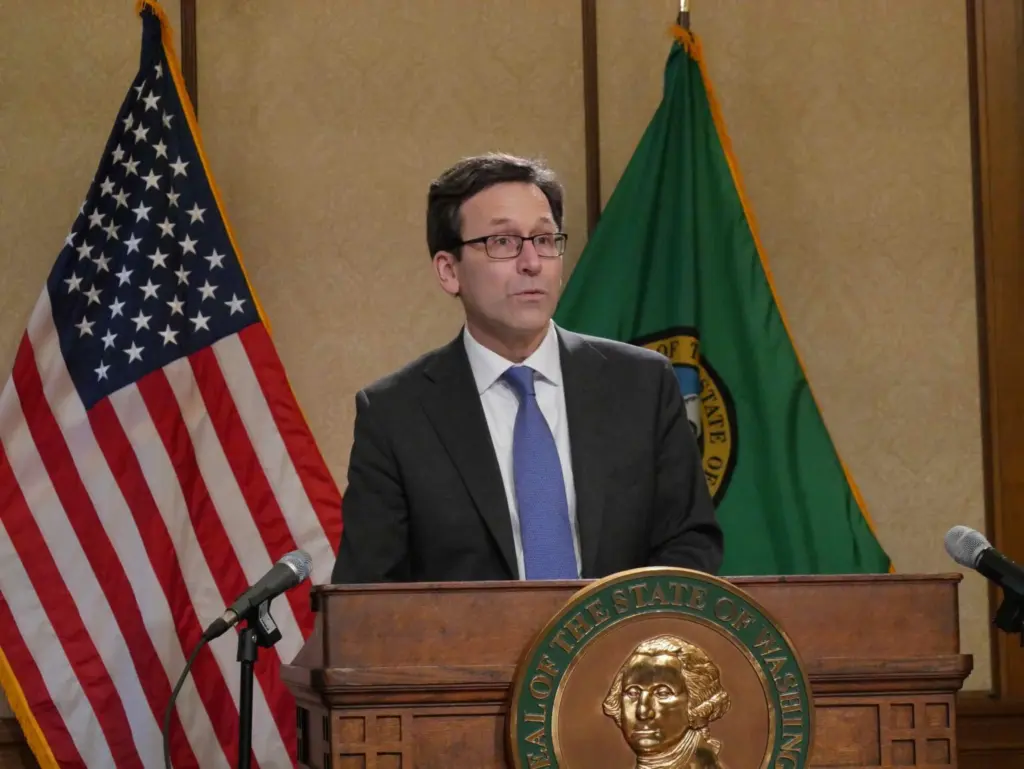
WASHINGTON D.C. – Washington Gov. Bob Ferguson may be satisfied with the House of Representatives’ latest version of an income tax bill – so much so that he said he will sign it if it passes the Legislature – but plenty of others remain skeptical.
In the wee hours of Friday morning, majority party Democrats in the House released an overhauled version of Senate Bill 6346 to impose a 9.9% tax on Washington adjusted gross income exceeding $1 million. The latest version of SB 6346, dubbed the “millionaire’s tax,” puts more money into early learning programs, expands financial aid for low-income households and broadens sales tax exemptions for essential goods.
Supporters claim the income tax would help fix a regressive tax system and fund essential services.
However, many remain unconvinced that a statewide income tax is good for the people of the Evergreen State and its economy.
The Washington Hospitality Association, representing several organizations, sent a letter to Ferguson and Democratic legislative leadership saying it could not support the income tax bill in its current form because it “would impose significant and unpredictable burdens on some of our most economically vulnerable employers across industries.”
The letter says that layering a new income tax over the state’s existing business and occupation tax without safeguards like income-averaging, cyclical business relief, and clear pass-through entity treatment risks taxing unrealized income. Omitting these standard features that are common in other states, according to the letter, threatens to introduce significant financial uncertainty for employers and state revenue planners.”
Other signatories to the letter: Architects & Engineers Legislative Council, Associated General Contractors of Washington, Associated General Contractors of Inland Pacific, Building Industry Association of Washington, National Federation of Independent Business, South Sound Chamber of Commerce Legislative Coalition, Washington Denturist Association, Washington Food Industry Association, and the Washington Retail Association.
The letter concludes that “we strongly urge that SB 6346 be delayed until next session to allow time for meaningful stakeholder engagement and policy refinement.”
Patrick Connor, Washington state director for the National Federation of Independent Business, is similarly skeptical of the latest version of the income tax bill.
“NFIB is still combing through the fine print of the new, 107-page bill to determine exactly how the Millionaire Tax will impact small businesses that might gross $1 million or more, but whose owners’ take-home pay falls far, far below that amount,” he emailed The Center Square on Friday afternoon.
“We are trying to determine how the change to the definition of ‘pass-through entity’ affects owners who report business earnings and expenses, and pay federal income taxes, through their personal tax returns. We are encouraged the bill would now allow business losses to carry forward for future tax years but surprised by new ‘tax relief’ aimed at gambling and cannabis-related income, hospitals, and prescription drug wholesalers.”
Ryan Frost, director of budget and tax policy at the Washington Policy Center think tank, didn’t pull any punches on his thoughts about the revised SB 6346.
“The governor’s statement frames the revised bill as a win for affordability, touting expanded Working Families Tax Credit eligibility, free school meals, childcare funding, and new sales tax exemptions,” he wrote in a Friday blog. “But the state could fund every one of those priorities today if the legislature exercised spending discipline on its existing $80+ billion operating budget.
“Instead, these provisions are being used as justification for an entirely unnecessary new tax, bundled with a poison pill that repeals the meager tax relief if the income tax is ever struck down or repealed by voters.”
SB 6346 has cleared the Senate and is set for a vote in the House. The bill must be returned to the Senate for approval of the changes made by the House or go to a conference committee.
Lawmakers are operating under a time crunch, as the 60-day session is set to adjourn on March 12.