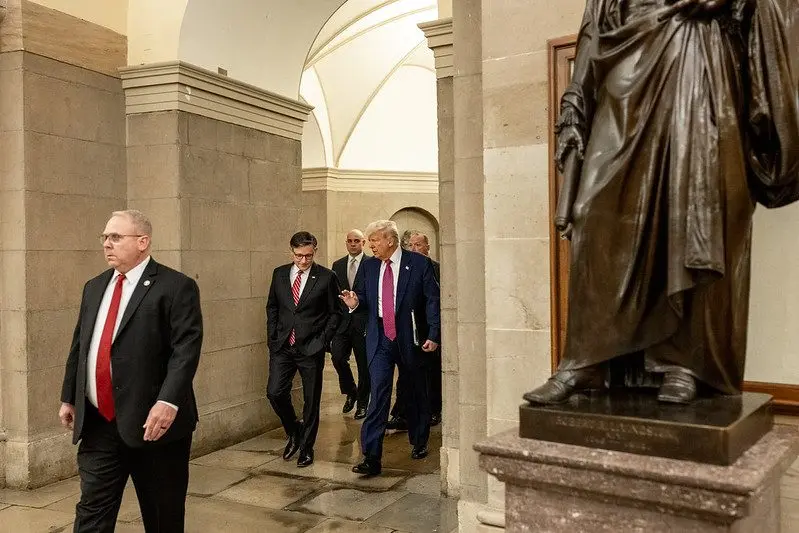
WASHINGTON, D.C. – President Donald Trump and key cabinet members escalated criticism on Tuesday toward U.S. allies for their reluctance to support the joint U.S.-Israeli military campaign against Iran.
As the U.S. and Israel continue attacks against Iran, Trump is hammering American allies for their reluctance to provide support. The administration argues that the lack of international assistance exposes deep divisions within longstanding alliances and raises questions about the future of global security cooperation and the economic ramifications of the conflict.
Trump said Tuesday that it is time for allies to assume more responsibility or learn to protect themselves from global threats. He highlighted Iran’s closure of the Strait of Hormuz, a critical waterway that carries about 20% of the world’s oil trade, as a pressing example.
“Build up some delayed courage, go to the Strait, and just TAKE IT,” the U.S. president wrote in a social media post. “You’ll have to start learning how to fight for yourself, the U.S.A. won’t be there to help you anymore, just like you weren’t there for us. Iran has been, essentially, decimated. The hard part is done. Go get your own oil!”
Secretary of War Pete Hegseth struck a similar tone at a news conference Tuesday morning.
“A lot has been laid bare. A lot has been shown to the world about what our allies would be willing to do for the United States of America when we undertake an effort of this scope on behalf of the free world,” Hegseth told reporters at the Pentagon. “You don’t have much of an alliance if you have countries that are not willing to stand with you when you need them.”
The Center Square reached out to the North Atlantic Treaty Organization, a military alliance with 32 member countries based in Belgium, for comment. A NATO spokeswoman said the organization had nothing to share.
Article 5 of the North Atlantic Treaty states that an armed attack against one NATO member shall be considered an attack against all members, and triggers an obligation for each member to come to its assistance. NATO invoked Article 5 for the first and only time in its history after the 9/11 terrorist attacks against the United States in 2001.
Trump singled out France on Tuesday.
“The Country of France wouldn’t let planes headed to Israel, loaded up with military supplies, fly over French territory,” the U.S. president wrote in a social media post. “France has been VERY UNHELPFUL with respect to the ‘Butcher of Iran,’ who has been successfully eliminated! The U.S.A. will REMEMBER!!!”
In recent weeks, Trump has also had harsh words for Spain, where elected officials have also blocked U.S. planes from using that country’s airspace for the war. Trump has even suggested cutting off all U.S. trade with Spain over the decision.
Spain closed its airspace to U.S. planes involved in the Iran war on Monday. Spain previously said the U.S. couldn’t use jointly operated military bases in the war. Spain’s Prime Minister Pedro Sánchez has described the fight as illegal and reckless.
“We are a sovereign country that does not wish to take part in illegal wars,” Sánchez has said.
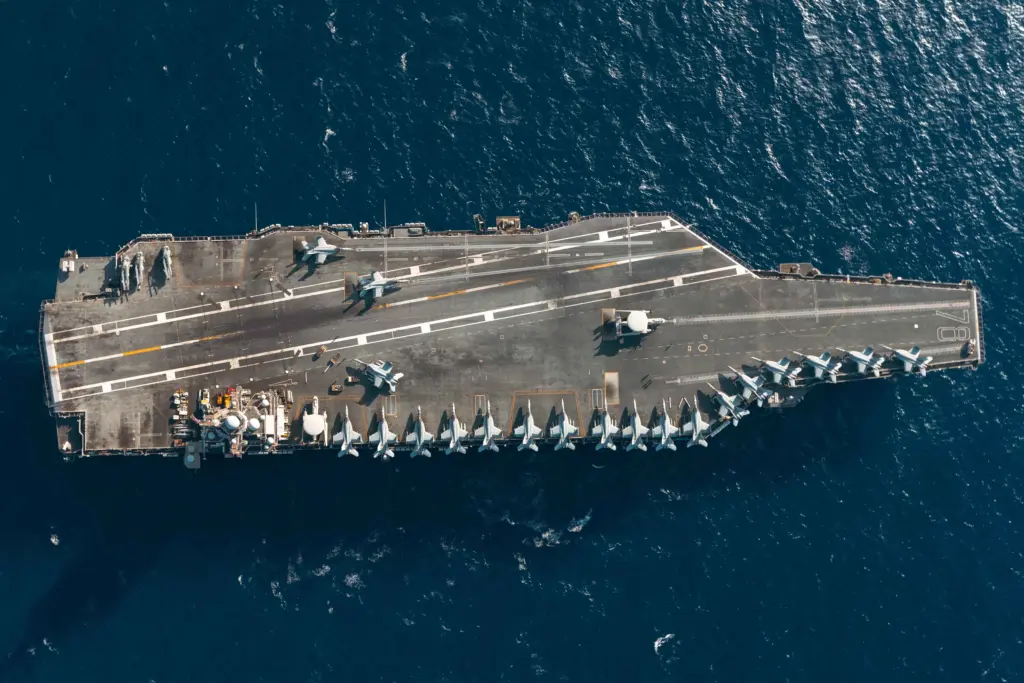
Hegseth goaded America’s closest ally, the United Kingdom, over its position on the war on Tuesday, specifically calling on 10 Downing Street to send ships.
“Last time I checked, there was supposed to be a big, bad Royal Navy that could be prepared to do things like that as well,” Hegseth said.
Both Hegseth and Trump have noted that the U.S. does not rely on the Strait of Hormuz for its own oil supply. Nevertheless, Iran’s closure of the waterway following U.S. and Israeli attacks on Iran on Feb. 28 has driven up global gas and diesel prices, causing significant spikes in the U.S. and widespread frustration among American consumers. U.S. gas prices have climbed about $1 per gallon since the start of the conflict. The national average recently hit $4 per gallon.
Trump made similar comments earlier this month when NATO allies declined to help with the Strait of Hormuz. At that time, Trump called NATO a “one-way street.”
“I always considered NATO, where we spend Hundreds of Billions of Dollars per year protecting these same Countries, to be a one-way street — We will protect them, but they will do nothing for us, in particular, in a time of need,” the U.S. president said on March 17.
NATO’s total budget for 2024 was about $4.6 billion, with the U.S. contributing approximately 15.8%, or $567 million, according to NATO records.
The ongoing conflict with Iran has rattled global markets, sending oil prices to their highest levels since April 2024. If hostilities continue, experts warn that economic strain will deepen, further burdening U.S. taxpayers.
With U.S. military operations costing more than $1 billion per day, analysts say a prolonged war could drive a significant increase in defense spending and further impact the federal budget.
The U.S. and Israel launched attacks on Iran on Feb. 28 after nuclear talks with the Islamic Republic failed to produce a deal. Trump and Secretary of War Pete Hegseth have laid out four military objectives: Destroying Iran’s missile capabilities, neutralizing its navy, preventing the development of nuclear weapons, and ensuring the regime can’t direct terrorism beyond its borders.
Trump and Hegseth have said most of those objectives have been accomplished. Trump has declined to put a time limit on the military operation, but has previously said the conflict will end “when I feel it, feel it in my bones.”