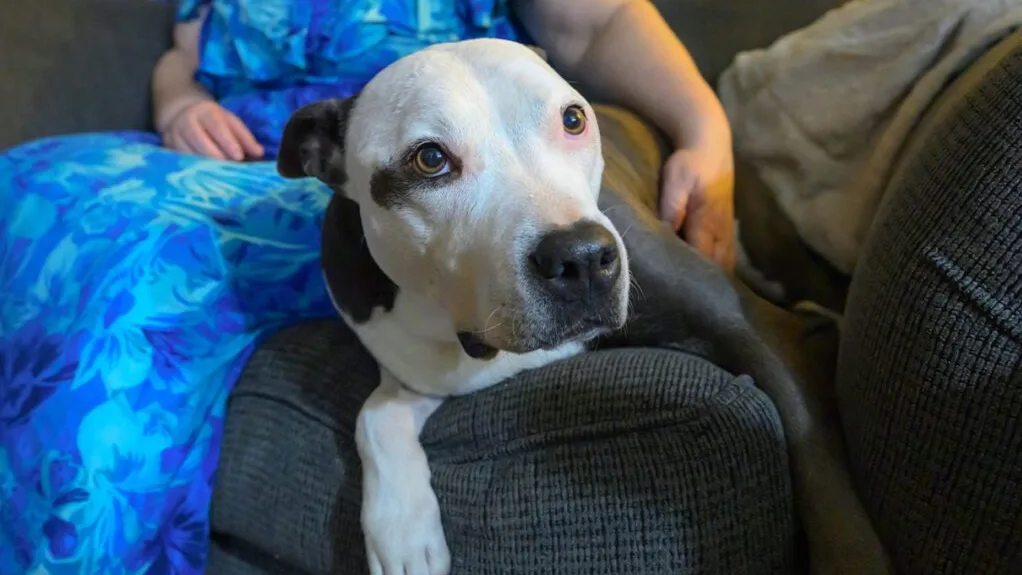
PULLMAN, WA – Her dog ejected from a window in a rollover accident, and already having spent thousands from her savings on veterinary bills, Stacy Nichols was nearly out of money and faced with the real possibility of saying goodbye to her best friend.
Following a veterinary referral to Washington State University’s Veterinary Teaching Hospital, Nichols found hope in WSU’s Good Samaritan Fund, which for 30 years has provided financial assistance to owners who cannot afford specialty or emergency veterinary care. The fund was started in 1996 by WSU’s then graduating Doctor of Veterinary Medicine class. Since 2021 alone, more than $1 million from the fund, which operates entirely on donor gifts, has been used to help some 2,100 animals and their families. While most fund recipients are dogs, the support has also extended to bearded dragons, snakes, horses, cats, and even guinea pigs.
Unsure whether she could afford the care her dog needed — or whether her dog would even survive — Nichols applied to the Good Samaritan Fund and was approved by WSU’s Good Samaritan Committee. The assistance covered a significant portion of her dog’s CT scan, enabling veterinarians to assess trauma to her spinal cord.
“The Good Samaritan program just opened the door. Just when you thought there was no hope, it was like God answering my prayers,” said Nichols, who made the roughly 70-mile drive from Cheney to Pullman. “I probably had the gas money to get down there at the time. I honestly didn’t know what I was going to do; the Good Samaritan program really made it all possible.”
Penny, Nichols’ 10-year-old pitbull mix and former service dog trained to alert her to oncoming seizures, was thrown from a car during a rollover accident on a gravel backroad.
Penny was diagnosed with neurologic paralysis, a condition characterized by the loss of muscle function caused by a disruption of nerve signals between the brain and muscles.
For days, the loving family dog was unable to move anything other than her head. During that time, Nichols fed Penny blended wet food and water through a large syringe.
With Penny’s veterinarian lacking the advanced diagnostic imaging technology to examine her further and with her health not improving, the dog was referred to WSU for a CT scan. Results revealed the pitbull had fractured the top vertebrae in her neck and bruised her spinal cord, both of which were contributing to her paralysis.
To Nichols’ surprise, though, her dog wasn’t in need of lifesaving surgery. She needed time.
“The vets at WSU switched up all of her meds and sent me home with a harness to help get her to moving and prescribed physical therapy that would actually work for her,” Nichols said. “In two weeks, she was a different dog.”
In days, Penny was back on her feet.
“We had gone back to our personal veterinarian a couple times just to make sure there weren’t any infections coming from her not being able to move and stuff, and they were just astounded,” Nichols said.
Today, Penny is still getting back to her old ways. She’s still regaining motion in her legs, but she’s able to make it up and down the stairs at home and play fight with her younger brother, Tigger.
Nichols said the Good Samaritan Fund covered a significant amount of Penny’s CT scan, and she plans to pay it forward by donating to the fund once she is completely caught up on Penny’s veterinary bills.
“It’s a worthy cause and I really don’t know where I’d be without it,” Nichols said.